Haystack Rock by Tisha Clinkenbeard
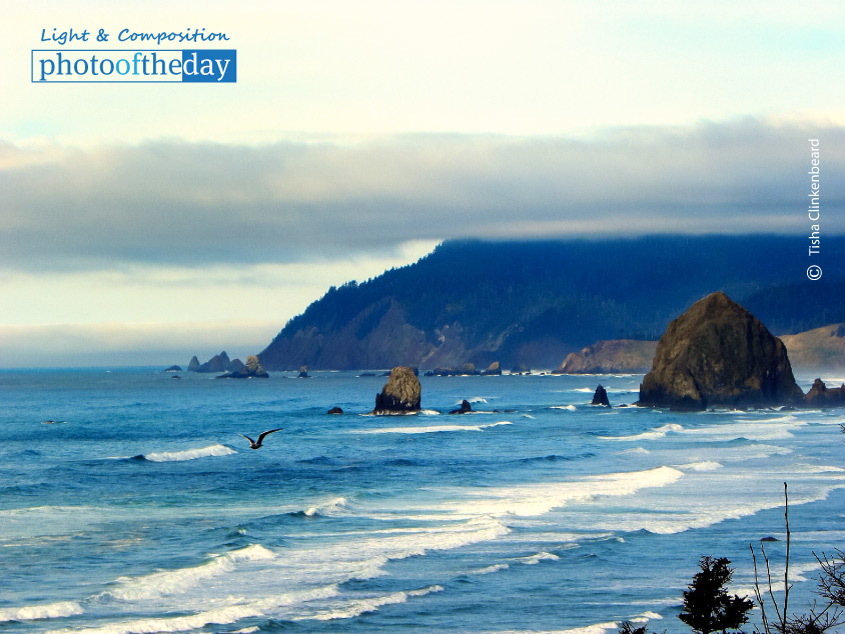
Captured along the rugged coastline of Cannon Beach, Oregon, this photograph depicts the iconic Haystack Rock as evening fog begins to roll across the shore. The composition masterfully balances the dark, imposing silhouette of the monolith against the ethereal white surf and the deep, tranquil tones of the Pacific. By focusing on the interplay between the birds, the crashing waves, and the atmospheric light, the photographer creates a serene yet dramatic landscape. This image is award-worthy for its evocative capture of coastal mood and the precise technical execution that renders the textures of the water and rock with remarkable clarity.
Tisha Clinkenbeard
Based in Powderly, Texas, Tisha Clinkenbeard is a dedicated photographer whose work has been featured in prestigious venues such as The Fine Arts Center of Hot Springs and Portland’s Black Box Gallery. Her artistic journey began long before the digital era, fostering a lifelong passion for documenting the world as she wanders the earth. Through her blog, Found Round & About, she shares her unique perspective on the beauty she encounters, having also earned recognition in publications like Birds & Blooms for her keen eye and storytelling ability.
Resonance Score Breakdown
Transparency Note: The resonance score (12.4/20) is calculated based on social engagement metrics collected before the award announcement.
Expert Photography Reviews · 7
The Weight of the Unmoving
If the earth beneath us is constantly shifting, why do we insist on finding permanence in stone? We build our lives upon the assumption that the ground is a promise, that the landmarks we recognize today will greet us with the same face tomorrow.
Read the reflection →The Weight of Standing Still
There is a peculiar geometry to endurance. We often think of strength as something active—a muscle flexed, a distance covered, a mountain climbed. Yet, consider the monoliths of the world, those heavy, ancient things that do not move, but simply exist in the path of the tide.
Read the reflection →Reviews & Comments
Share your thoughts about this award-winning photograph. Your reviews contribute to the community engagement score.
You waited for the fog to swallow the edges of that rock, and I can feel the damp chill of the Oregon coast in my own lungs. It’s quiet, isn’t it? You didn’t just snap a postcard; you sat with the Pacific until it stopped being a tourist spot and started being a living thing. There’s something honest happening here. You let the birds and the mist do the talking. I respect that patience.
Haystack Rock isn’t just stone; it’s a character waiting for us to listen. We watch the fog roll in, and it feels like a secret being whispered to the Pacific. Tisha caught the birds mid-flight, and I’m struck by how they seem to be the only ones who know the monolith’s true name. It’s a portrait of a landscape that’s breathing. I find myself wanting to sit in that mist until the story finally reveals itself.
The fog doesn’t just obscure; it breathes. Tisha stood here as the Pacific exhaled, waiting for the monolith to surrender its sharp edges to the mist. I’ve felt that same damp chill, the way the world turns quiet when the light softens into grey. It’s a humble surrender to the coast’s rhythm. Looking at these birds caught in the surf, I feel a sudden, sharp ache for that silence. She didn’t rush the tide.
1/280sec at f/6.3, ISO 64, 32.7mm. The Nikon P90 sensor is a bottleneck here. It’s a small-sensor compromise that leaves the textures of Haystack Rock feeling muddy and processed. I’ve seen better micro-contrast from a smartphone. While the shutter speed correctly freezes the surf, the optics just don’t have the resolving power to handle the fog’s transition. It’s technically thin. I find myself wishing for a real lens, not this digital approximation of a landscape.
The monolith anchors the frame at a 1:2 horizontal ratio, creating a heavy visual anchor against the negative space of the fog. I’m struck by the diagonal vector of the surf, which cuts the lower quadrant with precise, rhythmic tension. It’s a beautifully solved spatial equation. The birds provide the necessary scalar contrast to the rock’s mass. I’ve rarely seen such a clean, geometric resolution of chaos into a perfectly balanced, tranquil coastal plane.
The shutter speed here is a masterstroke. It’s fast enough to freeze the birds mid-flight, yet the surf retains just enough blur to suggest the tide’s relentless rhythm. I’ve spent hours watching the Pacific, and this frame captures that exact, heavy silence before the fog swallows the horizon. The cut would have been a mistake; the rock’s silhouette anchors the entire sequence. It’s the frame the editor keeps because it’s where the film finally breathes.
Before the eye identifies the monolith, the chest tightens. There’s a sudden, cooling stillness in the lungs, as if the fog in Tisha’s frame has leaked into the room. I feel the salt-damp weight of that Oregon air pressing against my skin. When I return to this a year later, the silence of the birds still haunts me. It’s a quiet, heavy ache—the kind that follows you into sleep, long after the tide recedes.