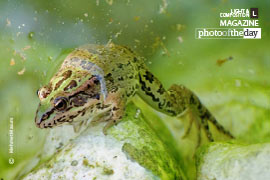
Hasankeyf Frog by Mehmet Masum Suer
Captured in the historic town of Hasankeyf, Turkey, this poignant image features a frog residing in an ecosystem threatened by the impending Ilisu Dam project. The photographer utilized a 135mm focal length to isolate the subject, emphasizing the fragile beauty of a creature whose habitat faces total submersion. By documenting this small inhabitant, the image serves as a powerful visual protest against the destruction of thousand-year-old historical caves and natural landscapes. It is an award-worthy piece that masterfully blends environmental advocacy with wildlife photography, turning a local ecological concern into a compelling narrative about the urgency of preserving cultural and natural heritage.
Mehmet Masum Suer
Based in Diyarbakir, Turkey, Mehmet Masum Suer is a distinguished documentary photographer and former journalist with a career spanning several decades. His work focuses on the rich cultural and historical tapestry of the region, documenting ancient architecture, festivals, and the evolving landscape of cities like Hasankeyf and Mardin. An internationally recognized artist with FIAP and PSA affiliations, Suer has seen his photography featured in global exhibitions, touristic publications, and even postage stamps. His commitment to preserving cultural heritage through the lens has earned him a place among the world's top photographers.
Resonance Score Breakdown
Transparency Note: The resonance score (9.8/20) is calculated based on social engagement metrics collected before the award announcement.
Expert Photography Reviews · 8
The Weight of Small Things
There is a quiet, persistent arrogance in how we measure the importance of a place. We look for the grand architecture, the towering stone, the echoes of empires that left their signatures in marble and mortar.
Read the reflection →The Weight of a Small Life
There is a quiet dignity in the way a creature occupies its place in the world, unaware of the tides of change that threaten to erase its home.
Read the reflection →Reviews & Comments
Share your thoughts about this award-winning photograph. Your reviews contribute to the community engagement score.
The light here is heavy with the weight of what’s vanishing. I’ve spent enough hours in the silence of Hasankeyf to recognize that stillness; it’s the quiet before the water rises. He stood there, waiting for the frog to settle, listening to the land’s final breath. It’s a fragile, aching beauty. Looking at those eyes, I feel a sudden, sharp grief for a world we’re drowning. It’s not just a photograph; it’s a goodbye.
A 1/250th shutter speed at f/5.6 captures a blink in the life of this frog, a creature unaware that its home in Hasankeyf will soon vanish beneath water. I’ve spent my life tracking photons that have traveled eons, yet this small, terrestrial urgency hits me harder than a supernova. It’s a quiet, fragile existence. We’re losing history and biology simultaneously, and honestly, it’s heartbreaking to watch such a brief, beautiful light go out.
You caught this little guy right before the water took everything. It’s a quiet, heavy moment. I’ve spent enough time in places being erased to know that look—it’s not just a frog, it’s a refugee. You waited for the stillness, and that’s where the truth lives. It hurts to look at, honestly. Because you didn’t just snap a picture of nature; you documented a ghost. You felt the weight of that loss, and I felt it too.
The frog sits in a purgatory of silt, its skin a map of impending erasure. I find myself shivering; it’s not the cold, but the silence of a creature unaware that its world is drowning. The shadows here don’t merely define form; they swallow the light, turning the creature’s stillness into a heavy, suffocating indictment. When the water rises, this darkness will be absolute. It’s a brutal, quiet confrontation with our own inevitable, vanishing history.
That frog sits there like it knows the water’s coming. It’s a quiet, heavy stillness. Cartier-Bresson would’ve loved the geometry of that rock against the impending flood. I feel a genuine ache looking at those eyes; they’re watching a world vanish. One tenth of a second later and the creature hops, the frame collapses into nothing. Suer caught the exact heartbeat before the silence of the dam. It’s raw, honest, and perfectly timed. You were paying attention.
The frog’s skin, a mottled tapestry of lichen-green and the bruised, subterranean ochre of ancient silt, vibrates against the parched, limestone-grey earth like a Morandi still life mourning its own displacement. It’s heart-wrenching, really; the way those cold, amber eyes catch a light that’s already fading into the shadow of the dam, turning the creature into a relic of a world that’s being drowned in silence, leaving one to weep for the vanishing pigment of Hasankeyf.
One wonders how many hours Mehmet spent ankle-deep in that silt, waiting for a creature that doesn’t care for human schedules. It’s a quiet, stubborn piece of work. Most would’ve snapped a frame and retreated to the cafe, but he stayed. I’ve spent enough damp mornings in the reeds to recognize the stillness required here. It’s not just a frog; it’s a small, cold victory against the rising tide. I find myself actually liking it.
The frame holds its breath. It’s a tight, claustrophobic close-up that feels like the final shot before the floodwaters arrive. The frog stares back, unblinking, unaware that its world is about to be cut to black. I’ve seen enough disaster films to know that look; it’s the silence before the dam breaks. The 135mm lens isolates the subject perfectly. It’s a haunting, fragile performance. I honestly felt a lump in my throat looking at it.