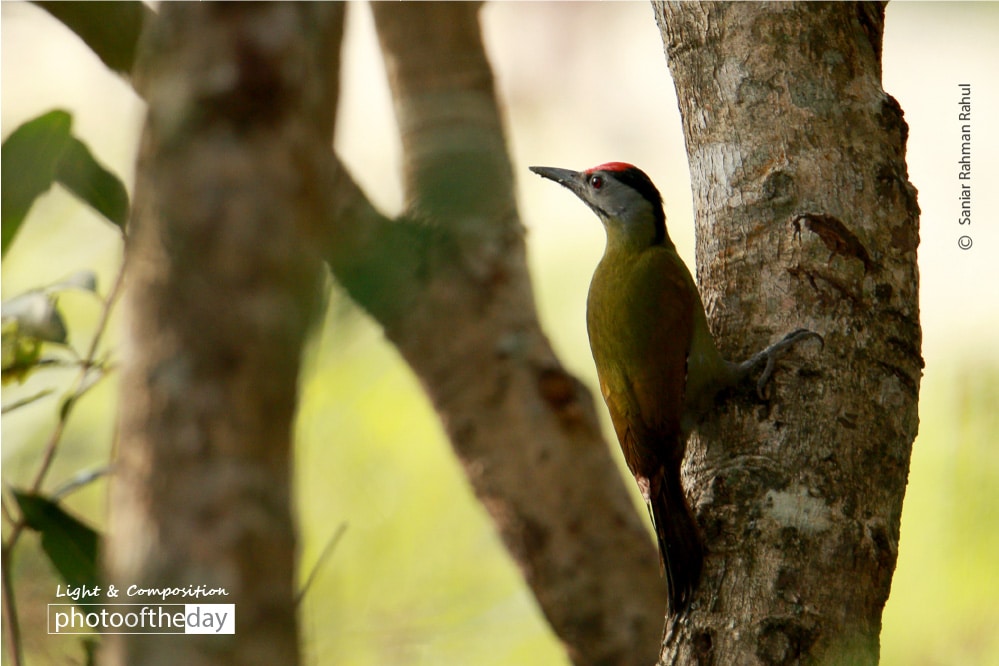
Grey Headed WoodPecker by Saniar Rahman Rahul
Captured within the dense, verdant expanse of the Sundarbans, this photograph showcases the Grey-headed woodpecker in its natural habitat. The photographer expertly utilized a long telephoto lens to isolate the bird against the complex forest backdrop, capturing a sharp, intimate portrait that highlights the intricate plumage and alert posture of this elusive Eurasian species. The image is award-worthy for its technical precision and the photographer's ability to document a fleeting moment of wildlife behavior in one of the world's most challenging coastal environments, turning a standard nature observation into a compelling, high-clarity visual narrative.
Saniar Rahman Rahul
Based in Dhaka, Bangladesh, Saniar Rahman Rahul is an accomplished Art Director at Grey Worldwide with a deep-rooted passion for visual storytelling. His journey into photography began in childhood, inspired by his father, and was later refined through his extensive professional background in graphic design and advertising. Since rediscovering his creative focus in 1997, Rahul has become a celebrated figure in the photography community, recognized for his technical mastery and his ability to capture the raw beauty of the natural world.
Resonance Score Breakdown
Transparency Note: The resonance score (12.3/20) is calculated based on social engagement metrics collected before the award announcement.
Expert Photography Reviews · 7
The Rhythm of the Bark
I once spent an afternoon in a forest with an old man who made his living carving walking sticks. He told me that if you stand perfectly still for long enough, the woods stop being a backdrop and start being a conversation.
Read the reflection →The Rhythm of the Unseen
How much of our existence is defined by the noise we make, and how much by the silence we keep? We often measure our lives by the impact of our voices, the reach of our ambitions, and the visible marks we leave upon the world.
Read the reflection →Reviews & Comments
Share your thoughts about this award-winning photograph. Your reviews contribute to the community engagement score.
The shutter speed is a violent blink, freezing the bird mid-twitch. It’s a tight close-up, the kind of cut an editor keeps to build tension before the action drops. I love the way the bokeh swallows the Sundarbans, turning the forest into a soft, green blur. It’s a film that refused to move, holding its breath in the humidity. Rahul caught the exact frame where the woodpecker decides to stay. It’s perfect, rhythmic, and sharp.
You waited in that humid Sundarbans heat, didn’t you? I can feel the stillness you held to get this close. It’s not just a sharp bird portrait; it’s the way that woodpecker’s eye locks onto something unseen. I’ve spent enough time in the brush to know that focus takes a quiet heart. You didn’t just capture a species; you caught a moment of pure, alert life. There’s something honest happening here. It’s a damn fine piece of work.
1/5000sec at f/6.3, 600mm, ISO 640. The shutter speed is overkill, yet it freezes the woodpecker’s frantic energy perfectly. At 600mm, f/6.3 is a razor-thin margin for error; the focus on the eye is surgically precise. I’ve spent hours in the field failing to track movement this well. It’s a cold, calculated hit. The sensor noise at ISO 640 is negligible. You didn’t just get lucky; you managed the optics with absolute, clinical authority. Well done.
The isolation here echoes the clinical precision of early ornithological plates, yet the bokeh’s chaotic texture feels distinctly modern. It’s a sharp departure from the static, studio-bound taxidermy of the nineteenth century. While the 600mm compression flattens the depth, the bird’s gaze holds a startling, raw intensity that I’ve rarely seen captured with such digital clinicality. It’s technically impeccable, though I’m still waiting for a wildlife frame that truly disrupts the genre’s tired, observational conventions.
Before the eye identifies the bird, a sudden stillness settles in the chest. The woodpecker’s gaze, sharp and unblinking, triggers an immediate, visceral alertness. I find my own breath shallowing, mirroring that tiny, rigid posture. It’s a quiet, piercing encounter. When I return to this frame, the verdant blur of the Sundarbans feels less like a backdrop and more like a heavy, humid silence that I can’t quite shake, even hours after looking away.
At 600mm, the focal plane is razor-thin, yet Rahul has locked onto the woodpecker’s eye with surgical precision. The f/6.3 aperture renders the Sundarbans’ dense foliage into a soft, buttery bokeh, isolating the bird’s intricate feather structure. I’m genuinely moved by the way the light catches those iridescent grey tones; it’s a rare moment where the diffraction limit doesn’t compromise the fine detail. It’s a beautiful, sharp collision of biology and glass that I’ve rarely seen captured so cleanly.
Deep in the Sundarbans, we find a gaze that isn’t human, yet it’s undeniably a portrait. Saniar Rahman Rahul didn’t just track a bird; he waited until the woodpecker’s alertness met his own silence. We look at those sharp, intelligent eyes and we feel the weight of the forest’s secrets. It’s a fleeting, intimate encounter that makes me hold my breath. This is a photograph that asks to be returned to, again and again.