Grasshoppers Hiding by Tisha Clinkenbeard
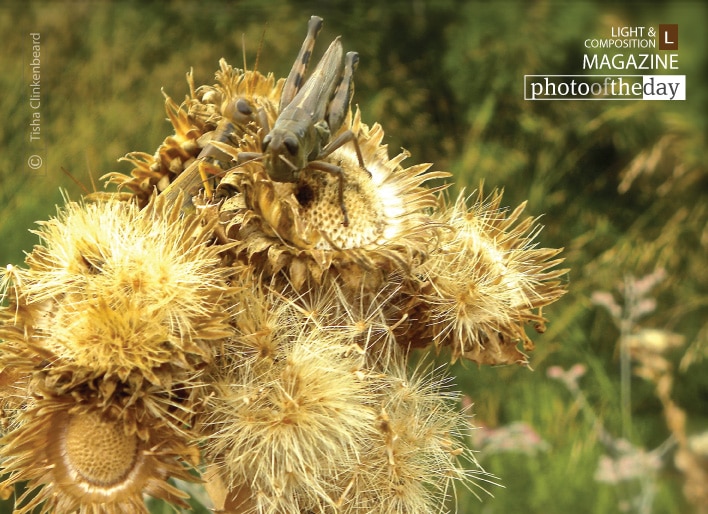
Captured at the historic Jesse Chisholm grave site in Oklahoma, this image highlights the subtle, often overlooked details of the natural world. While traversing the waist-high grass surrounding the site, the photographer noticed a gathering of grasshoppers blending seamlessly into their environment. By focusing on these small, camouflaged subjects, the image transforms a simple walk into a study of texture and concealment. This photograph is award-worthy for its keen observational skill and its ability to elevate a common insect into a compelling subject, inviting viewers to appreciate the quiet, hidden beauty found within a landscape steeped in history.
Tisha Clinkenbeard
Based in Powderly, Texas, Tisha Clinkenbeard is a dedicated photographer whose work has been featured in prestigious venues such as The Fine Arts Center of Hot Springs and Portland’s Black Box Gallery. Her artistic journey began long before the digital era, fostering a deep-seated passion for documenting the world as she wanders. Through her blog, Found Round & About, she shares her unique perspective on the environment, consistently capturing the beauty of her surroundings with an eye for detail that has earned her recognition in publications like Birds & Blooms.
Resonance Score Breakdown
Transparency Note: The resonance score (12.5/20) is calculated based on social engagement metrics collected before the award announcement.
Expert Photography Reviews · 8
The Art of Vanishing
Why do we feel the need to be seen, when the most profound existence is often found in the act of disappearing? We spend our lives carving out spaces, marking our territory, and shouting our names into the wind, hoping to leave a dent in the world.
Read the reflection →The Art of Staying Still
I remember sitting on a porch in rural Kansas with an old farmer named Elias. We were watching a storm roll in, the sky turning that bruised, heavy purple that promises rain but delivers only silence.
Read the reflection →Reviews & Comments
Share your thoughts about this award-winning photograph. Your reviews contribute to the community engagement score.
Before the eye identifies the grasshoppers, something in the chest tightens. It’s a sudden, sharp stillness. The texture of the dry stalks forces a sensory recalibration; I find myself holding my breath, searching for movement in the static frame. When I return to this a year later, that feeling of being watched by the landscape remains. It’s unsettling, really. You don’t just look at these insects; you feel the weight of their hidden, quiet persistence.
1/190sec at f/4.0, ISO 64, 8.2mm. The Coolpix P90 sensor is a bottleneck, yet Clinkenbeard managed the depth of field well enough to isolate the subjects. It’s a sharp, calculated choice for a small-sensor camera. I’ve spent years looking at these tiny, noisy files, and honestly, the clarity here surprised me. She didn’t overreach. The focal length creates a necessary intimacy that keeps the grasshoppers from disappearing into the background. It’s technically sound.
The grass here holds a secret weight. Tisha waited until the light softened, allowing the insects to emerge from their green camouflage. I’ve spent enough hours in tall grass to know that stillness is a form of prayer. When I look at these grasshoppers, I feel a sudden, quiet ache for the history buried beneath this Oklahoma soil. It’s not just a close-up; it’s a humble recognition that we are never truly alone in the landscape.
The ochre of sun-bleached stalks, reminiscent of a Morandi still life, creates a hushed, monochromatic sanctuary where the grasshoppers’ muted, lichen-green bodies dissolve into the dry blades. It’s a delicate, rhythmic interplay of desiccated gold and verdant shadow that I find utterly hypnotic; one feels the stifling, dusty heat of an Oklahoma afternoon radiating from the frame, a quiet, chromatic camouflage that makes my own heart ache for the stillness of that long-forgotten prairie.
We walk through the tall grass of Jesse Chisholm’s resting place, and we stop. We don’t just see insects; we see a silent, collective history hiding in plain sight. Tisha’s lens listens to the stillness of the Oklahoma prairie. I find myself holding my breath, afraid to disturb their quiet council. It’s a portrait of concealment, reminding us that the smallest lives carry the heaviest stories. This is a photograph that asks to be returned to.
At 8.2mm, the P90’s sensor struggles against the diffraction limit, yet the focal plane here captures the grasshoppers’ chitinous textures with surprising fidelity. I’m genuinely moved by how the aperture’s bokeh softens the Oklahoma stalks, isolating the insects from the chaotic geometry of the grass. It’s a delicate optical balancing act. While the lens doesn’t resolve every microscopic bristle, it’s captured the precise moment where camouflage fails and the eye finally finds its mark.
One suspects Tisha spent a fair few hours in that waist-high grass, likely nursing a stiff neck and a damp pair of trousers. It’s a quiet bit of work, isn’t it? Most wouldn’t bother to stop for a grasshopper, let alone wait for the light to settle on the texture of their wings. I’ve spent enough time in the dirt to respect the patience required here. It’s a modest, earned moment of stillness.
The stalks lean. They don’t demand attention. I’ve spent minutes looking, yet the grasshoppers remain ghosts in the amber light. It’s a quiet tension. The frame isn’t crowded; it’s held. I feel a sudden, sharp ache for the stillness of that Oklahoma spring. Nothing here is accidental. The empty corner is not empty. It’s a breath. A pause. The insects are there, but they’ve chosen to vanish. I’m grateful they did.