Grand Mother by Payman Mollaie
In this poignant portrait, the photographer captures his grandmother, Rana, within the quiet rhythm of her daily life in a remote Taleghan village. Taken with a 18mm focal length at a slow shutter speed of 1/20 sec, the image emphasizes the intimacy of her domestic environment. The photograph serves as a heartfelt tribute to her resilience, independence, and kindness as she manages her household and traditional chores alone. Its award-worthy quality lies in the raw, authentic connection between the subject and the lens, transforming a simple domestic scene into a powerful narrative of heritage and human spirit.
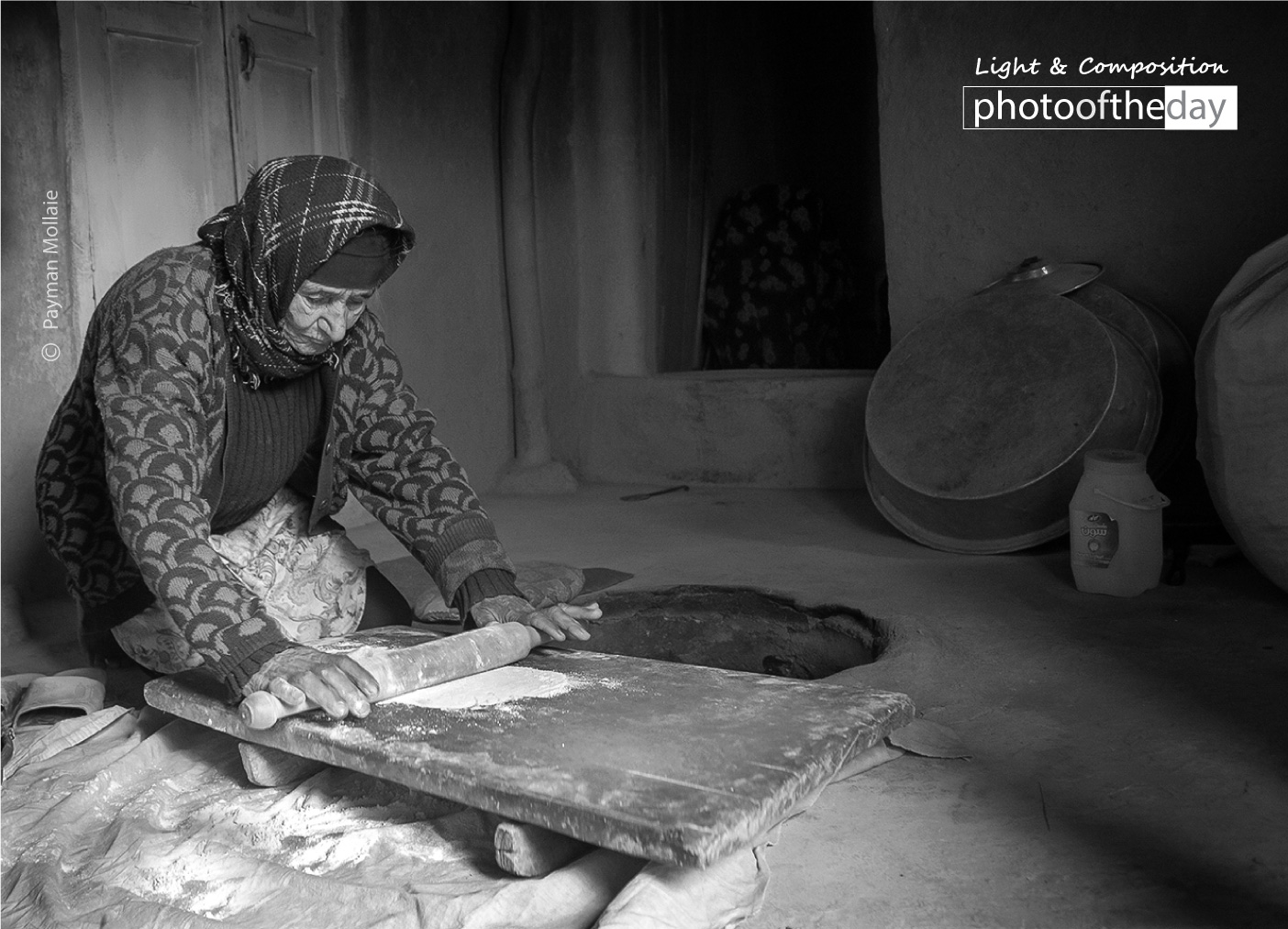
Exposure 1/20sec @ f/3.5 | ISO 800 | Focal Length 18mm
Payman Mollaie
Born in 1981 in Qazvin, Iran, Payman Mollaie is a dedicated photographer with a profound appreciation for minimalist aesthetics and the stark beauty of snowy landscapes. Often utilizing analogue equipment like his Yashica camera, he focuses on clean compositions that highlight the quiet essence of his subjects. His work reflects a deep passion for travel and a commitment to capturing the authentic, often overlooked moments of life through a thoughtful and artistic lens.
Resonance Score Breakdown
Transparency Note: The resonance score (11.2/20) is calculated based on social engagement metrics collected before the award announcement.
Expert Photography Reviews · 7
The Weight of Quiet
The light of late afternoon in the mountains has a specific, heavy quality, like wool that has been left out in the damp. It is not the sharp, piercing clarity of a high-altitude winter morning, nor the fleeting, bruised violet of a storm passing over the fjords.
Read the reflection →The Weight of Woven Time
I keep a small, silver thimble in my desk drawer, its surface worn smooth by decades of rhythmic friction against a needle. It belonged to a woman who believed that everything worth having required a steady hand and a quiet patience.
Read the reflection →Reviews & Comments
Share your thoughts about this award-winning photograph. Your reviews contribute to the community engagement score.
Most portraits of the elderly lean on sentimentality, but this one avoids that trap. By using an 18mm lens at a slow shutter speed, Payman forces us into Rana’s cramped, lived-in space. It’s the blur of her hands against the sharp, weary lines of her face that caught me; I felt a sudden, sharp ache for my own grandmother. It’s not just a portrait; it’s a quiet, enduring record of a life lived entirely on her terms.
Looking at Rana, I’m struck by the stillness. It’s a stark contrast to the chaotic, light-starved depths I usually inhabit. Here, the light isn’t being swallowed by the water column; there’s no backscatter to fight, no refraction to distort her features. She exists in a medium that doesn’t steal her warmth. It’s refreshing to see a portrait where the atmosphere is so clear, so honest, and entirely free from the physics of the abyss.
The light here doesn’t announce itself; it settles, thick and patient, against the walls of her home. I’ve spent enough hours in the quiet of Taleghan to recognize that stillness. Payman waited for the moment when the room’s shadows softened, letting Rana exist within the frame rather than posing for it. It’s a humble, holy silence. Looking at her hands, I feel a sudden, sharp ache for my own grandmother. He listened well.
At 18mm, the wide-angle distortion pulls the viewer into Rana’s domestic orbit, yet the f/3.5 aperture keeps the focal plane razor-thin. I’m struck by how the 1/20sec exposure introduces a subtle, organic motion blur that softens the diffraction limit of the kit lens. It’s not technically perfect, but that slight softness feels like a heartbeat. It’s a rare moment where the optics don’t just record light; they capture the fragile, fading warmth of a life.
Rana’s gaze hits me right in the chest. It’s that 1/20th shutter speed that does it, dragging the blur of her movement into the frame. It’s risky, but it works. Cartier-Bresson would’ve loved the geometry of her hands against the domestic chaos. One tenth of a second later and the tension would’ve vanished. You caught the soul of Taleghan here. It’s raw, it’s honest, and damn, it’s alive. You were paying attention. That’s everything.
Rana sits in the dimness of Taleghan, where the shadows aren’t merely absences but the heavy, unyielding architecture of a life lived in solitude. Mollaie’s 18mm lens forces us into her claustrophobic intimacy. It’s unsettling. I’ve spent hours staring at the way the darkness swallows her hands; it feels like watching time itself erode. She doesn’t invite us in. She endures our gaze from the gloom, a quiet, stubborn resistance against the encroaching light of modernity.
At 1/20sec, Mollaie abandons the clinical obsession with sharpness for something far more visceral. By choosing not to resolve the fine lines of Rana’s face, he captures the kinetic blur of her labor. It’s closer to a painterly gesture than a portrait. I’m genuinely moved by how the motion renders her presence as a fading echo of tradition. Why resolve the details when the movement tells the truth of her exhaustion so much better?