Grand Corridor by Sanak Roy Choudhury
The photographer captured the Grand Mosque in Muscat, Oman, with a deliberate focus on the interplay between modern Islamic architecture and geometric precision. By positioning the camera to align the grand corridor with the mosque’s magnificent dome, the image achieves a rhythmic synchronization of form and light. The three-second long exposure emphasizes the stillness of the space, allowing the intricate architectural details to emerge with clarity. This photograph is award-worthy for its masterful composition, which transforms a frequently documented landmark into a fresh, balanced, and visually compelling study of structural harmony.
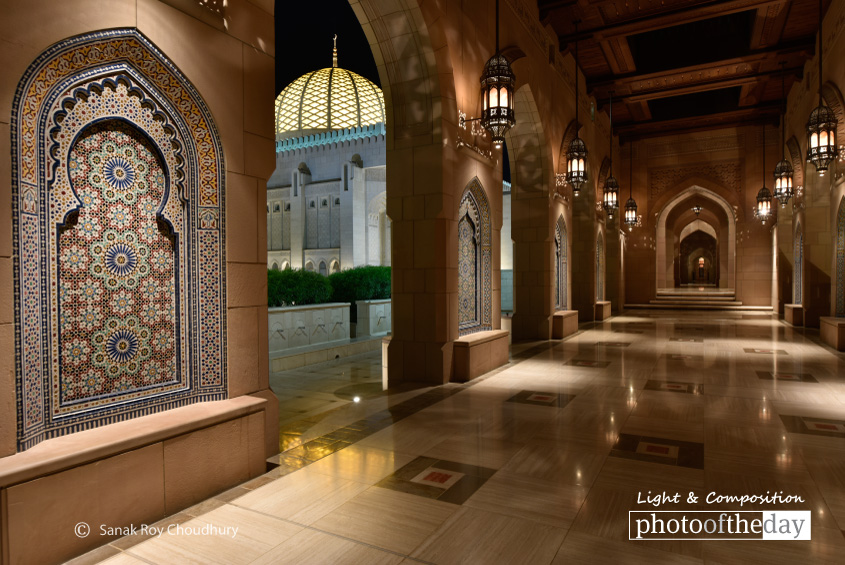
Exposure 3sec @ f/8 | ISO 100 | Focal Length 22mm
Sanak Roy Choudhury
Based in Muscat, Oman, Sanak Roy Choudhury balances a professional career as a clinical optometrist and research assistant with a dedicated pursuit of photography. Since acquiring his first DSLR in 2012, he has evolved from a casual enthusiast into a passionate observer of the world, specializing in capturing compelling situations during his travels. His work, which has earned recognition in numerous photography contests, reflects a constant desire to learn and a commitment to achieving technical perfection in every frame he captures.
Resonance Score Breakdown
Transparency Note: The resonance score (12.5/20) is calculated based on social engagement metrics collected before the award announcement.
Expert Photography Reviews · 8
The Architecture of Silence
We often mistake stone for something permanent, something that stands against the flow of time. But if you sit long enough in a place built for prayer, you realize that the walls are not there to hold back the world, but to gather the quiet.
Read the reflection →The Architecture of Silence
We often mistake stillness for an absence, as if a quiet room is merely a vessel waiting to be filled. But silence has a weight, a density that gathers in the corners like dust motes in a shaft of afternoon sun.
Read the reflection →Reviews & Comments
Share your thoughts about this award-winning photograph. Your reviews contribute to the community engagement score.
The central axis anchors the frame with surgical precision. It’s a rigid geometry that demands total submission from the viewer. The rhythmic repetition of the arches creates a spatial tension that’s almost suffocating, yet the dome’s placement provides a necessary fulcrum. I’ve rarely seen such disciplined negative space. It doesn’t invite sentiment; it commands respect. The structural harmony is absolute. It’s cold, it’s clinical, and frankly, it’s the most satisfying thing I’ve seen all year.
At f/8, the D810’s sensor resolves the mosque’s intricate stonework with clinical precision, well shy of the diffraction limit. The 22mm focal length maintains a flat focal plane, ensuring the geometric rhythm doesn’t collapse into distortion. I’m genuinely moved by how the three-second exposure renders the ambient light; it’s not just stillness, it’s a physical weight. It’s rare to see optics handled with such restraint, allowing the architecture’s inherent mathematical beauty to breathe without chromatic aberration.
The ochre of these sun-drenched arches, reminiscent of Morandi’s dust-laden palettes, breathes with a stillness that’s almost sacred. It’s the pale, chalky gold of desert stone at high noon, cooling into the soft, bruised violet of shadows that cling to the floor like spilled ink. I’m utterly breathless before such luminous restraint; it’s a symphony of light where the warmth doesn’t merely sit upon the surface, but radiates from within the very marrow of the architecture.
The cooling marble floor beneath his feet must have felt like a prayer. He waited for the light to soften, letting that three-second exposure drink in the silence of the corridor. It’s not just architecture; it’s a breath held in stone. I’ve stood in such places, and I can feel the hum of the air here. He didn’t force the geometry; he simply listened until the light finally aligned with the soul of the space.
The light here doesn’t just fall; it breathes. Three seconds of exposure turns the corridor into a silent, infinite tracking shot. I’m standing there, feeling the cool marble against my palms, waiting for a character to walk into the frame. But they don’t. The stillness is the point. It’s a perfect, locked-off wide that refuses to cut. Choudhury understood that the architecture is the lead actor. It’s a frame the editor keeps forever.
You’ve captured a silence here that’s almost heavy. I’ve walked through spaces like this, and you’ve managed to strip away the tourist noise to find the stillness. It’s clean, sure, but it’s the way the light hits those arches that caught me. I felt a sudden, sharp sense of solitude looking at this. You waited for the world to stop moving, and because of that, I can finally hear the building breathe. That’s rare.
Most architectural shots of this mosque are cluttered, but Choudhury’s precision here is surgical. By holding that three-second exposure, he’s drained the space of human distraction, leaving only the geometry. It’s a cold, calculated perfection that I find deeply haunting. Of the thousands of corridor shots I’ve reviewed, this one endures because it doesn’t just document a building; it forces you to confront the silence of the stone. It’s a rare, quiet victory for structural clarity.
The vertical axis here is a masterclass in symmetry. By aligning the central arch with the dome’s apex, Choudhury creates a perfect vanishing point that anchors the frame. The 1:1 ratio of the lateral corridors creates a rhythmic, repetitive sequence that feels almost musical. I’m genuinely breathless at how the three-second exposure flattens the light into such precise, geometric planes. It’s a solved equation of space, where every shadow serves as a necessary variable for total equilibrium.