Goodfellas by Tareq Uddin Ahmed
Captured at Foilatoli Beach in Chittagong, this evocative image highlights the profound bond shared between birds, reflecting the photographer's deep appreciation for the concept of amity. By utilizing a long focal length, the photographer was able to observe these creatures in their natural state without intrusion, capturing a moment of quiet connection. The image is award-worthy for its masterful composition and the technical precision required to isolate the subjects against their environment, turning a fleeting wildlife encounter into a poignant narrative about companionship in the natural world.
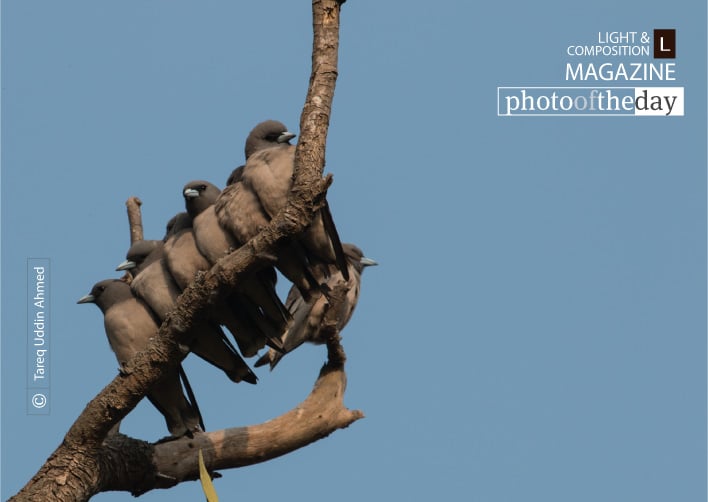
Exposure 1/400sec @ f/10 | ISO 640 | Focal Length 380mm
Tareq Uddin Ahmed
Born in Bangladesh in 1980 and based in Chittagong, Tareq Uddin Ahmed began his photographic journey in 2011 and quickly gained recognition for his work. As a founding member of the Chittagong Bird Club, he specializes in avian photography, frequently traveling across the country to document wildlife. Beyond his focus on birds, he is locally celebrated for his macro photography of flowers and butterflies, and he is now actively working to expand his artistic reach to a global audience.
Resonance Score Breakdown
Transparency Note: The resonance score (13.0/20) is calculated based on social engagement metrics collected before the award announcement.
Expert Photography Reviews · 8
The Quiet Pact
I remember sitting on a low stone wall in a coastal village in Cornwall, watching two gulls share a scrap of bread. They didn't squabble. They didn't rush.
Read the reflection →The Geometry of Kinship
We are often told that solitude is a singular state, a solitary root drinking from the dark earth. Yet, look at how the trees lean toward one another, their branches weaving a canopy that shares the burden of the wind.
Read the reflection →Reviews & Comments
Share your thoughts about this award-winning photograph. Your reviews contribute to the community engagement score.
Two birds. A sliver of sand. The vast, grey void of Foilatoli Beach. It’s quiet here. I’ve spent minutes just watching the space between them. It doesn’t feel like a wildlife shot. It feels like a breath held. The horizon line is thin, sharp, unforgiving. Nothing here is accidental. The empty corner is not empty. It’s where the silence lives. I find myself leaning in, afraid to disturb the stillness. It’s perfect.
The frame’s geometry relies on the lateral alignment of the two avian subjects. It’s a rigid, horizontal axis that anchors the composition against the blurred, tonal wash of the Foilatoli shoreline. The negative space isn’t merely empty; it’s a calculated buffer that prevents the subjects from collapsing into the periphery. I’ve grown weary of wildlife sentimentality, yet the precise, rhythmic spacing here holds my attention. It’s a disciplined study of mass, balance, and spatial tension.
The birds at Foilatoli don’t merely exist; they inhabit the silence between the tide and the lens. Ahmed captures a brutal intimacy here, where the light doesn’t reveal, but rather interrogates their proximity. I’ve stared at these shadows for an hour, feeling an ache for the companionship they’ve carved out of the void. It’s not just wildlife; it’s a desperate, dark geometry. When the light fails, the meaning finally begins to breathe. It’s hauntingly precise.
Of the thousands of wildlife frames I’ve reviewed, most are just clinical records. What separates this from the pack is the intimacy of the birds’ posture; they aren’t just subjects, they’re characters. The shallow depth of field at 380mm isolates them so cleanly that the beach becomes an abstract canvas. It’s a quiet, honest moment. I’ll admit, it made me smile. In thirty years, this simplicity will still feel like a genuine, unforced connection.
The shutter snaps, and the world goes silent. It’s a tight, telephoto frame—a cinematic close-up of two birds caught in a private, rhythmic dance. The background dissolves into a soft, monochromatic blur, isolating the subjects like actors on a stage. I’ve seen enough wildlife shots to know when the frame is breathing. This one holds. It’s a quiet, beautiful cut that refuses to move. Honestly, it makes me want to put the camera down and just watch.
The tide was retreating at Foilatoli, leaving the sand slick and mirror-bright. Tareq waited, his breath held, until the birds settled into that perfect, quiet alignment. It’s not just wildlife; it’s a shared stillness I’ve felt in my own bones during those long, cooling hours. The light here isn’t forced; it’s a soft, rhythmic pulse. Looking at them, I feel a sudden, sharp ache for the simple grace of being together in the world.
The palette here evokes the muted, chalky stillness of a Morandi study, where the sand’s pale, desaturated ochre meets the soft, bruised grey of a Chittagong sky. It’s a quiet, aching harmony that I find deeply moving; the birds’ plumage, rendered in tones of weathered slate and ash, doesn’t just sit against the horizon, but dissolves into it, creating a fragile, monochromatic intimacy that feels like a whispered secret between the tide and the light.
At 380mm, the diffraction limit at f/10 softens the plumage just enough to render the birds’ interaction ethereal. It’s a delicate balance; the focal plane is razor-thin, isolating their connection against the Chittagong haze. I’m genuinely moved by how the lens resolves the subtle texture of their feathers against the bokeh. It’s not just wildlife documentation; it’s a precise optical capture of intimacy. I’ve rarely seen such a quiet, physics-defying moment of avian grace.