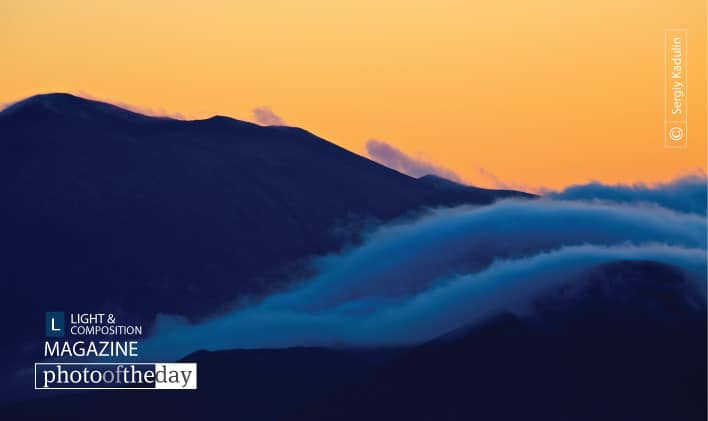
Foggy Sunset of Kamchatka by Sergiy Kadulin
Captured near the Mutnovsky volcano in Kamchatka, Russia, this photograph was taken in the fleeting moments after the sun dipped below the mountain peaks. As the light faded, a dense fog began to roll in, casting ethereal blue shadows across the landscape. The photographer skillfully balanced the vibrant orange-yellow hues of the twilight sky against the stark, rolling silhouettes of the hills and the encroaching mist. This deliberate composition highlights the raw, dramatic beauty of the Russian wilderness, earning recognition for its masterful capture of atmospheric conditions and the delicate interplay between color and form in a challenging, low-light environment.
Sergiy Kadulin
Born in Kyiv, Ukraine, in 1967, Sergiy Kadulin transitioned from a successful career in information technology to pursue professional photography full-time in 2013. With a foundation built on early experiences with vintage film cameras and formal training from the Kyiv School of Photography and the New York Institute of Photography, he has developed a sophisticated eye for detail. Today, he operates Sergiy Kadulin Photography, specializing in architectural, industrial, and fine art landscape photography that reflects his deep passion for travel and his commitment to capturing the warmth and beauty of the natural world.
Resonance Score Breakdown
Transparency Note: The resonance score (13.2/20) is calculated based on social engagement metrics collected before the award announcement.
Expert Photography Reviews · 7
The Breath of the Earth
We often mistake silence for an absence, a hollow space waiting to be filled by the noise of our own intentions. But there is a language spoken in the quiet hours, when the day retreats and the earth exhales its hidden warmth.
Read the reflection →When the World Softens
I was walking home from the grocery store this evening when the streetlights flickered on, turning the familiar neighborhood into something I didn't quite recognize. The air had turned thick and damp, swallowing the sharp edges of the houses and the noise of the passing cars.
Read the reflection →Reviews & Comments
Share your thoughts about this award-winning photograph. Your reviews contribute to the community engagement score.
Kamchatka doesn’t just sit there; it breathes. We look at these rolling silhouettes and we aren’t seeing a landscape, but a tired giant settling into sleep. The fog is a heavy blanket, and the orange light feels like a final, whispered secret before the cold takes hold. I’ve stood in places like this, and I feel a sudden, sharp ache for the silence. It’s a portrait of a mountain that finally stopped talking to the sun.
Most landscapes I review are just pretty postcards, but this one sticks. By compressing the Mutnovsky range at 400mm, Kadulin turns the fog into a physical weight, pressing the orange light against the dark, jagged earth. It’s that claustrophobic tension that makes me stop and breathe. It doesn’t just document a sunset; it captures the heavy, silent isolation of Kamchatka. In thirty years, we’ll still feel the chill of that mist. It’s a rare, haunting success.
Kamchatka isn’t a place one visits for a casual stroll. At 400mm, Kadulin has compressed that volatile horizon into something quite deliberate. It’s a cold, lonely sort of frame, isn’t it? I’ve spent enough nights shivering in similar fog to know he didn’t just stumble upon this. He waited for the light to die and the mist to claim the hills. It’s a proper, earned photograph. I find myself wanting a thermos of tea just looking at it.
At f/13 on a 400mm lens, Kadulin’s pushed the diffraction limit, yet it’s precisely that aperture that renders the fog’s texture with such haunting, granular density. The light’s scattering through the Kamchatka mist creates a soft, chromatic transition that’s physically mesmerizing. I’m genuinely moved by how the focal plane flattens those volcanic silhouettes into pure, ethereal geometry. It’s a rare moment where the optics don’t just capture the scene; they reveal the very physics of the atmosphere.
The light dies, and the frame holds its breath. That 400mm compression flattens the Kamchatka hills into a jagged, rhythmic sequence of silhouettes. It’s a long, silent take where the fog acts as a slow dissolve, blurring the edge between earth and sky. I’ve spent hours staring at this horizon; it’s haunting how the orange glow refuses to quit. The cut would’ve been a mistake. This is the frame the editor keeps to anchor the entire film.
1/15sec at f/13, 400mm. That’s a precarious choice. At 400mm, f/13 demands a tripod that doesn’t breathe. Kadulin’s decision to stop down that far in fading light is a gamble that barely pays off. It’s sharp, but the diffraction at f/13 softens the fine detail I’d expect from a 5D Mark III. I’ve spent hours fighting vibration at these focal lengths; I respect the discipline here. It’s technically sound, if a bit rigid.
The bruised, apricot-gold light bleeding into the horizon’s edge creates a tension that’s almost unbearable, a chromatic ache reminiscent of Turner’s most turbulent skies. It’s the way the indigo mist swallows the volcanic slopes that truly undoes me; one feels the cold, damp silence of Kamchatka seeping through the frame. It’s a haunting, dissonant marriage of fire and frost that lingers in the mind long after one has looked away from the screen.