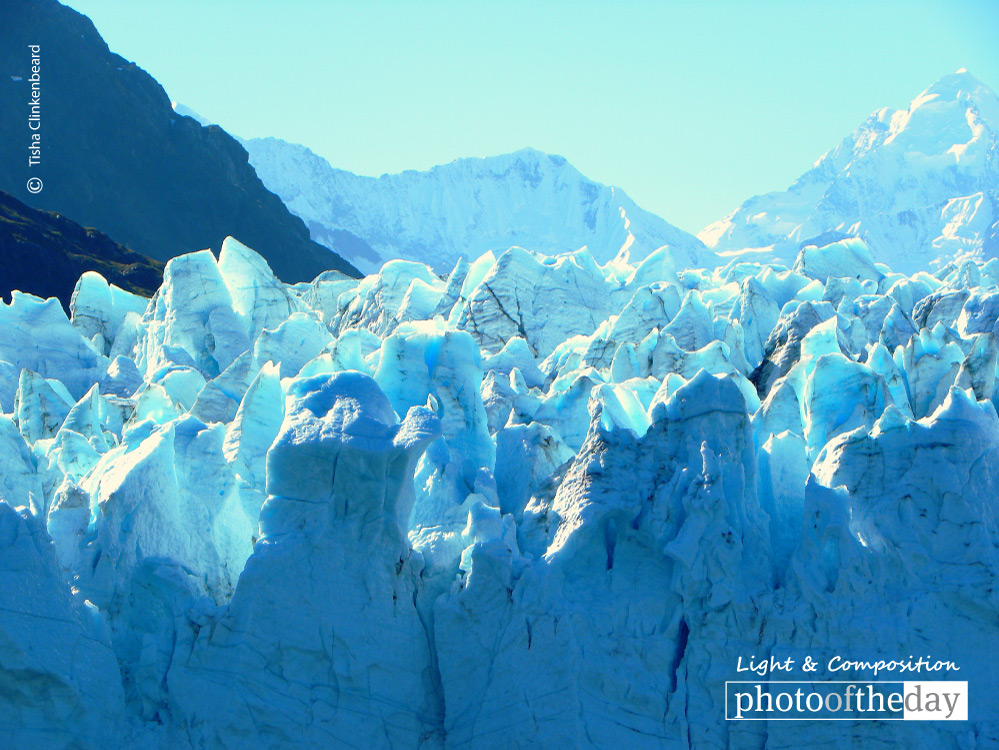
Glacier Tops by Tisha Clinkenbeard
Captured during a honeymoon cruise through the Alaskan wilderness, this photograph focuses on the intricate, frozen textures of glacial peaks. The photographer was drawn to the striking interplay of frigid, crystalline blues and stark whites that define the glacier's summit. By isolating these delicate details against the vast landscape, the image invites viewers to appreciate the quiet, monumental beauty of ice. This work is award-worthy for its ability to transform a grand geological feature into an intimate study of color and form, highlighting the serene yet powerful essence of the Alaskan frontier.
Tisha Clinkenbeard
Based in Powderly, Texas, Tisha Clinkenbeard is an accomplished photographer whose work has been featured in prestigious venues such as The Fine Arts Center of Hot Springs and Portland’s Black Box Gallery. Her artistic journey began long before the advent of digital technology, fostering a deep-seated passion for documenting the world as she wanders. Through her photo blog, Found Round & About, she shares her unique perspective on the landscapes and details she encounters, consistently earning recognition for her evocative and observant approach to photography.
Resonance Score Breakdown
Transparency Note: The resonance score (12.3/20) is calculated based on social engagement metrics collected before the award announcement.
Expert Photography Reviews · 7
The Architecture of Silence
In the high latitudes, time does not move in the way we are accustomed to measuring it. We think of time as a river, something that flows and carries us forward, but in the presence of ancient ice, time feels more like a heavy, folded blanket. It sits still.
Read the reflection →The Weight of Stillness
I spent this morning trying to organize my bookshelf, pulling out paperbacks I haven't touched in years. I found a dried flower tucked into a book of poetry, its color long since faded into a brittle, pale ghost of what it once was.
Read the reflection →Reviews & Comments
Share your thoughts about this award-winning photograph. Your reviews contribute to the community engagement score.
Before the eye identifies the jagged ice, something in the chest tightens. It’s a physiological bracing against the cold. The crystalline blues don’t just sit on the page; they pull the heat from my fingertips. When I return to this a year later, the silence of those peaks feels heavier, almost suffocating. I’ve found myself shivering in the middle of July. It’s a haunting, beautiful reminder that we are merely guests in this frozen, indifferent world.
At the diffraction limit, the micro-fractures in this ice reveal a sharpness the human retina simply can’t resolve. Clinkenbeard’s focal plane is razor-thin, isolating crystalline edges where light refracts into those haunting, sub-zero blues. It’s a clinical dissection of frozen mass, yet I’m genuinely breathless at the way the lens captures the sheer, chaotic geometry of the summit. It doesn’t just show us a glacier; it forces us to confront the physics of cold, crystalline perfection.
f/8 at 200mm, 1/1000s, ISO 200. A sharp, calculated choice for glacial texture. The shutter speed freezes the wind-sculpted ridges, and the aperture keeps the crystalline depth in focus. It’s technically sound, though I’ve seen this exact compression a thousand times. It’s cold, precise, and frankly, it makes me shiver. The execution is correct, but it’s a clinical study. You’ve captured the ice, but you haven’t captured the scale. It’s just math on a mountain.
Honeymooners often treat Alaska as a pristine backdrop for their own joy, but does this frame erase the fragility of a melting world? The crystalline blues are undeniably gorgeous—I felt a sharp, cold ache looking at them—yet I wonder why we insist on aestheticizing a dying landscape. Is this beauty a distraction from our complicity in its collapse? By isolating these textures, are we ignoring the reality of what we’re actually losing?
The frame breathes. It’s a slow, glacial pan that suddenly locks onto the jagged, crystalline blue of the summit. I’ve seen enough wide shots of Alaska to know when a photographer’s found the edit point, and this is the frame the editor keeps. It’s cold, sharp, and perfectly still. I felt my own breath hitch looking at those frozen textures. It doesn’t need a sequence; the cut would’ve been a mistake. It’s pure, cinematic tension.
The frame’s architecture relies on the jagged intersection of glacial ridges. It’s a rigid geometry. The negative space doesn’t collapse; it forces the eye toward the central crystalline fissure. While the tonal range remains predictable, the spatial tension holds the viewer captive. I’m genuinely unsettled by how the composition refuses to offer a horizon line. It’s a cold, calculated exclusion. The structure succeeds because it denies the viewer any comfort, leaving only the weight of ice.
You’ve captured the cold, sharp edges of that glacier with a precision that makes me shiver. It’s a beautiful study of form, but I find myself looking for the pulse. Because you were on a honeymoon, I wonder what you felt standing there, dwarfed by all that ancient ice. It’s technically sound, but I’m missing the human tremor. I’d love to see you step closer to the people next time. You’ve got the eye, now find the heart.