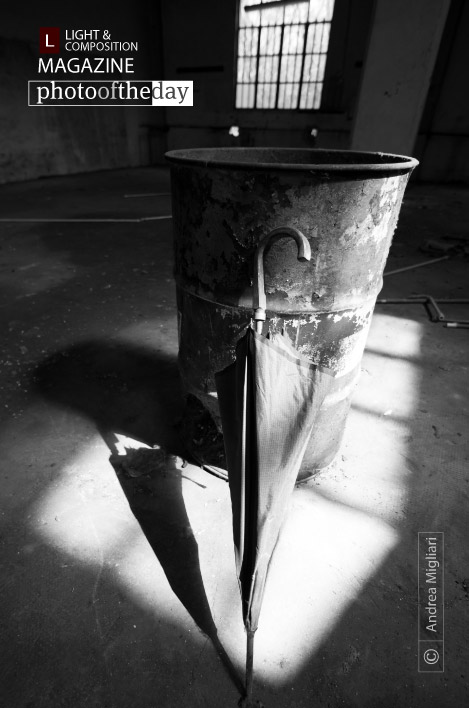
Forgotten for Ages by Andrea Migliari
While exploring an abandoned factory, the photographer was drawn to a collection of long-forgotten elements. Seeking the perfect perspective, he waited for natural sunlight to stream through a rear window, creating a striking interplay between light and shadow. This deliberate patience allowed him to highlight the textures of decay, transforming a derelict space into a compelling study of stillness. The image is award-worthy for its masterful use of natural light and its ability to find profound beauty in the overlooked, demonstrating a keen eye for composition and atmospheric depth within a challenging, low-light environment.
Andrea Migliari
Born in Italy in 1981, Andrea Migliari is a versatile photographer currently based near Bergamo. His creative journey began with film photography and darkroom processing before transitioning to digital in 2009, a shift that helped him refine a sophisticated post-processing workflow. Migliari’s work spans diverse genres, including landscapes, portraits, and live music, and has earned recognition in prestigious publications such as the Italian art magazine Overart. Driven by the belief that beauty exists in the mundane, he continuously seeks to capture the artistic potential found in everyday surroundings.
Resonance Score Breakdown
Transparency Note: The resonance score (12.3/20) is calculated based on social engagement metrics collected before the award announcement.
Expert Photography Reviews · 7
The Architecture of Silence
In the quiet corners of an old house, dust settles like a soft, grey blanket over the things we have stopped needing. We tend to think of abandonment as a sudden departure, a slamming door or a hurried exit, but it is rarely so dramatic. It is a slow, creeping process.
Read the reflection →The Weight of Dust
I keep a small, rusted iron key in a velvet pouch, though I have no idea which door it once opened. It is heavy, cold, and carries the faint, metallic scent of a time before my own.
Read the reflection →Reviews & Comments
Share your thoughts about this award-winning photograph. Your reviews contribute to the community engagement score.
The frame functions as a rigid grid, anchored by the strong vertical axis of the central pillar. I’m captivated by how the light creates a 1:2 ratio between the illuminated debris and the deep, negative quadrant on the left. It’s a precise spatial equation where the diagonal shadows act as vectors, pulling the eye toward the decay. It’s rare to see such chaotic textures resolved into such perfect, balanced geometry. I’m genuinely impressed by the math here.
Decay isn’t just aesthetic; it’s a history of labor. Migliari frames this Milanese factory as a hollowed-out shell, but who actually worked these floors before the light hit them? I feel a strange, cold distance looking at these textures. Why do we romanticize the ruin while ignoring the people displaced by its closure? It’s a beautiful composition, sure, but it’s also an erasure. Does the light reveal the space, or does it just prettify the abandonment?
Dust motes dance in that singular, piercing shaft of light. Andrea waited until the sun aligned perfectly with the decay, listening to the silence of the factory floor. It’s a quiet, holy stillness. I’ve spent hours in such places, and my heart aches seeing how he’s honored these forgotten remnants. He didn’t just capture a room; he let the light reveal the soul of the ruin. It’s a rare, patient grace that I deeply admire.
The light hits that debris like a spotlight on a stage set for a ghost. It’s a wide, cinematic gaze, that 14mm lens pulling the decay into a vast, suffocating silence. I feel the dust in my own lungs. The cut would’ve been a mistake; the frame holds because Migliari understood the rhythm of the shadows. It’s the shot the editor keeps, the one where time finally stops moving. A haunting, perfectly held breath.
We look at these rusted, abandoned relics and we hear the echoes of the hands that once held them. Andrea Migliari didn’t just photograph a factory; he sat with its silence until the shadows began to speak. It’s a portrait of absence, where the light reveals what time tried to erase. I feel a heavy, quiet ache in my chest looking at this. It’s a photograph that asks to be returned to, again and again.
Sharpness here feels like a missed opportunity. Migliari’s obsession with resolving the textures of decay at f/2.8 creates a clinical distance that I find frankly exhausting. Why settle for a literal document when the light offered a chance to dissolve the factory’s history into pure abstraction? It’s closer to a real estate listing than Sugimoto’s ethereal theatres. I’d have traded every crisp edge for a long exposure that let the dust breathe and the shadows bleed.
Most abandoned factory shots are just clutter, but Migliari’s work avoids that trap. By using the 14mm lens to pull the light across those rusted surfaces, he forces us to confront the decay rather than just observe it. I’ve seen thousands of these, yet this one makes me feel a strange, quiet ache for what was lost. It’s the precision of that light hitting the debris that ensures this will still matter in thirty years.