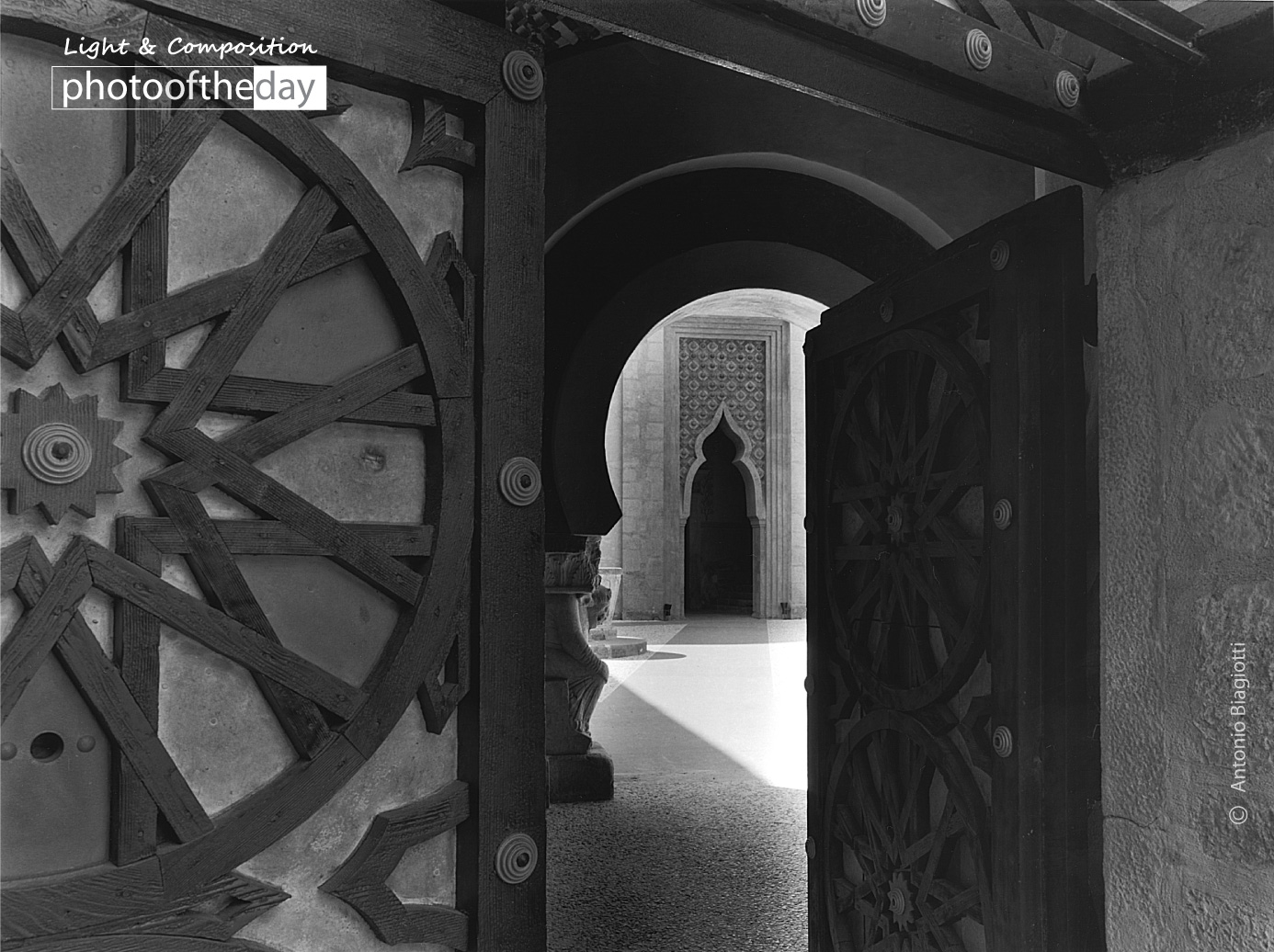
Entrance Door of Rocchetta Mattei by Antonio Biagiotti
The photographer sought to capture the intricate geometric diversity of the entrance door at Rocchetta Mattei, a castle defined by its eclectic mix of architectural styles nestled within the Italian Apennines. By utilizing a high-contrast black and white aesthetic, the image emphasizes the interplay between the deep shadows of the foreground and a sharp, dramatic beam of light illuminating the courtyard. This technical decision effectively conveys the brilliant intensity of a summer day in Italy. The photograph is award-worthy for its masterful command of light and shadow, which transforms a structural subject into a compelling study of form, texture, and historical atmosphere.
Antonio Biagiotti
Born in 1971 in Porretta Terme, Italy, Antonio Biagiotti resides and works within the scenic landscape of the Appennino Tosco-Emiliano. A dedicated practitioner of traditional photography, he specializes in medium and large format film, meticulously developing and printing his black and white work in a personal darkroom. His artistic journey is deeply supported by his wife, Sara, whose critical feedback serves as a constant catalyst for his professional growth. Biagiotti’s portfolio reflects a profound commitment to the tactile nature of analog photography, focusing on the precise mechanics of framing, aperture, and light.
Resonance Score Breakdown
Transparency Note: The resonance score (11.3/20) is calculated based on social engagement metrics collected before the award announcement.
Expert Photography Reviews · 6
The Weight of Thresholds
It is 3:15 am, and the house has finally stopped settling. In the dark, I think about the things we leave behind when we cross a boundary. We treat doorways like simple transitions, but they are actually small deaths.
Read the reflection →The Weight of Thresholds
I keep a heavy iron key in my desk drawer, one that no longer fits any lock I own. It is cold to the touch, pitted with age, and carries the faint, metallic scent of a house that has long since been reclaimed by ivy and silence.
Read the reflection →Reviews & Comments
Share your thoughts about this award-winning photograph. Your reviews contribute to the community engagement score.
Stopping down to f/22 on a Pentax 67 forces the light into the diffraction limit, yet here, it’s a deliberate choice. By sacrificing absolute micro-contrast, Biagiotti captures the stone’s porous texture with a tactile weight I’ve rarely seen. That single second of exposure renders the light beam’s transition into shadow with such mathematical grace it actually makes my heart skip. It’s not just architecture; it’s the physics of light finally finding its perfect, static home.
One suspects Biagiotti spent a fair few hours sweating in that Apennine heat waiting for the sun to strike just so. It’s a sharp, disciplined frame. I’ve spent enough time squinting at f/22 to know the patience required to balance that deep, brooding stone against the courtyard’s glare. It’s a cold, calculated bit of work, and I’ll admit, it’s earned its keep. He didn’t just find this; he sat with it until it surrendered.
Biagiotti’s choice to stop down to f/22 for a one-second exposure feels like a missed opportunity for something visceral. It’s technically precise, sure, but it’s safe. I’d have loved to see him embrace the movement of the light or the decay of the stone rather than freezing it into such a rigid, clinical geometry. It’s technically competent, but I’m left craving a bit of chaos. Why resolve every grain when the architecture itself is so delightfully unhinged?
Most architectural shots of Rocchetta Mattei fall into the trap of documenting the facade rather than the atmosphere. Biagiotti avoids this by letting the f/22 aperture bite into the stone texture, turning the door into a threshold between eras. I’ve stared at this print for ten minutes, and I still feel the heat radiating off that sun-drenched courtyard. It’s the contrast that saves it; it’s not just a door, it’s a portal that’ll still hold weight in 2049.
The stone archway pulls me in, its heavy, textured masonry framing a sliver of brilliant, blinding light. It’s a classic chiaroscuro, where the shadows aren’t just empty space; they’re the weight of history pressing against the present. I’ve always loved how architecture acts as a silent host. Here, the door isn’t merely wood and iron—it’s a threshold. It makes me feel small, like a traveler finally finding sanctuary within the Apennines. It’s hauntingly beautiful.
Stripping away the chromatic spectrum, Biagiotti forces one to confront the architecture’s bones, where the light doesn’t merely fall but carves, reminiscent of a Morandi still life rendered in stone. It’s a stark, monochromatic ache that I find deeply unsettling, as if the shadows are swallowing the very history of these walls. One misses the warmth of Tuscan ochre, yet the sheer, brutal clarity of this silver-grey intensity leaves me breathless, shivering in the Italian heat.