Ebi Nigiri by Barbara Martello
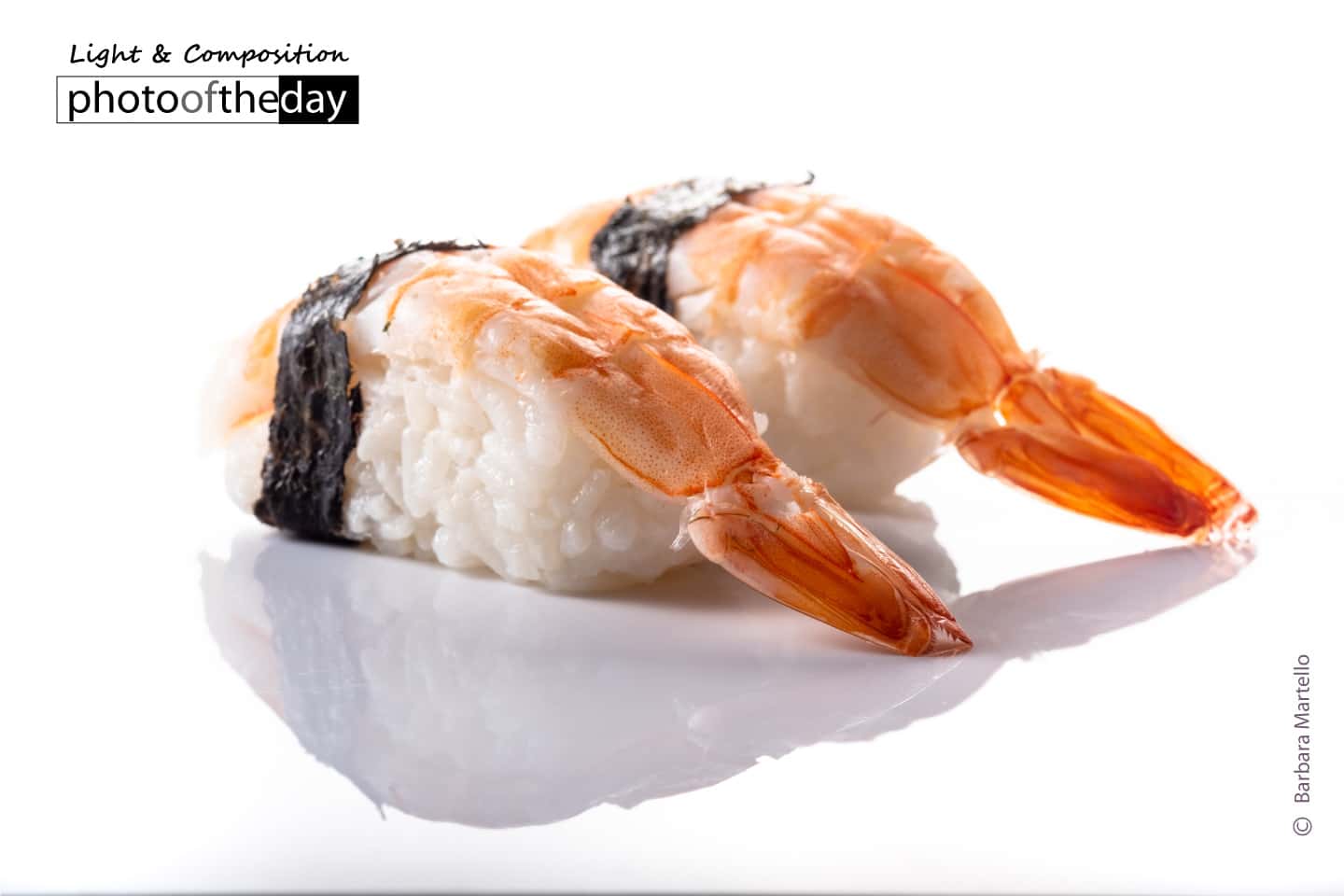
In this meticulously crafted food study, Barbara Martello captures the elegant simplicity of ebi nigiri. By placing the shrimp sushi on a reflective plexiglass surface, the photographer creates a striking circular symmetry that elevates a common culinary staple into a work of art. The lighting setup, utilizing two strobes—one for the background and one positioned to the left—highlights the delicate textures and vibrant colors of the dish. This photograph is award-worthy for its clean, professional execution and the creative use of reflection to transform a standard food subject into a compelling, balanced visual narrative.
Barbara Martello
Born in Italy, Barbara Martello is a dedicated photographer based in Udine who travels extensively across Europe to document the culinary arts. Since beginning her professional journey five years ago, she has specialized in food photography, focusing on restaurant work and personal projects that explore the origins of recipes and food harvests. Her versatile portfolio also includes live music and pet photography, reflecting her ongoing commitment to mastering studio lighting and the historical nuances of the photographic craft.
Resonance Score Breakdown
Transparency Note: The resonance score (11.1/20) is calculated based on social engagement metrics collected before the award announcement.
Expert Photography Reviews · 4
The Geometry of Sustenance
The dragonfly’s wing is a marvel of structural efficiency, a lattice of veins designed to distribute stress and capture the wind with absolute economy. It is a reminder that nature rarely wastes energy; form is almost always a direct response to the necessity of survival.
Read the reflection →The Weight of Stillness
There is a particular stillness that arrives just before the first frost, when the air loses its humidity and becomes thin, sharp, and entirely transparent. In the north, we learn to respect this clarity.
Read the reflection →Reviews & Comments
Share your thoughts about this award-winning photograph. Your reviews contribute to the community engagement score.
It’s technically flawless, sure, but where’s the pulse? I’ve spent my life chasing the truth in a stranger’s eyes, and here, there’s nobody home. It’s just cold shrimp on plastic. I find myself craving a messy kitchen, a tired chef’s hands, or the steam of a real meal. This doesn’t tell me a story; it just sells a product. It’s pretty, but it’s hollow. I’m left feeling hungry for something with a soul.
It’s quiet here, isn’t it? The way the shrimp rests on that dark, reflective pool feels less like a meal and more like a meditation on stillness. I’ve spent my life watching the light change over vast deserts, but here, the artificial glow mimics the soft, directionless clarity of an overcast noon. It’s a humble, sacred geometry. I find myself wanting to reach out, to disturb the silence of that perfect, mirrored circle.
The plexiglass reflection creates a symmetry that feels almost suffocating. It’s a sterile, clinical geometry. I’ve spent my life chasing the truth hidden in the dark, but here, the light is too eager, too revealing. It doesn’t let the shrimp exist in its own mystery. It’s technically precise, sure, but it’s afraid of the void. I find myself wanting to reach out and dim the strobes, just to let the shadows finally breathe.
Technically, it’s flawless, which is exactly why it leaves me cold. The plexiglass reflection is a neat trick, but it’s too safe. Why resolve every grain of rice? I’d rather see the shrimp dissolve into a smear of color, pushing toward the abstraction of a Sugimoto seascape. It’s a perfectly executed commercial study, but it lacks the courage to fail. I’m bored by this obsession with clarity. Where’s the risk, Barbara?