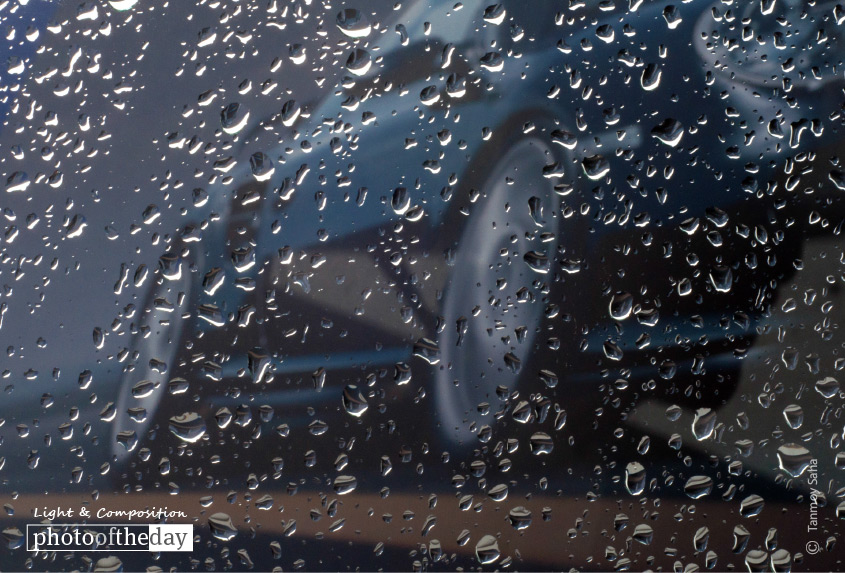
Driving in the Rain by Tanmoy Saha
Captured from the unique perspective of a moving vehicle, this photograph plays with the viewer's perception of reality. By framing a scene through the glass of a car window, the photographer introduces an unusual angle that blurs the line between the subject and the environment. The image invites the audience to look closer, revealing that the car itself is part of a larger, layered composition. This clever use of framing and the interplay of light and rain elevate the shot, transforming a mundane transit moment into a thoughtful, conceptual exploration of perspective and reflection.
Tanmoy Saha
Based in Dhaka, Bangladesh, Tanmoy Saha Turja is a dedicated photographer who began his creative journey in 2007. An Electronics and Telecommunication Engineering graduate, he balances his technical background with a deep passion for portraits, landscapes, and wildlife. His work has been showcased at the National Art Gallery in Bangladesh, reflecting a commitment to artistic growth fostered through foundational training at the Dhaka University Photography Society and Pathshala. Tanmoy continues to refine his craft, blending technical precision with a keen eye for conceptual storytelling.
Resonance Score Breakdown
Transparency Note: The resonance score (12.4/20) is calculated based on social engagement metrics collected before the award announcement.
Expert Photography Reviews · 5
The Glass Between Us
The blue wool sweater my father wore every Sunday is gone. It was not just a garment; it was a specific texture of safety, smelling faintly of pipe tobacco and the damp air of the garden. When he stopped wearing it, the world did not end, but the air in the hallway changed.
Read the reflection →The Glass Between Us
I remember sitting in the back of a taxi in Jakarta, watching the city dissolve into streaks of grey and neon. The driver, a man named Agus, kept his radio tuned to a station that played nothing but static and old pop songs.
Read the reflection →Reviews & Comments
Share your thoughts about this award-winning photograph. Your reviews contribute to the community engagement score.

The frame operates on a complex grid of refraction. The vertical axis of the window frame bisects the composition, creating a 1:2 ratio between the sharp, static foreground and the blurred, kinetic Dhaka streetscape. Those diagonal rain streaks act as vectors, pulling the eye toward the negative quadrant. It’s a brilliant spatial equation. I’m genuinely captivated by how the glass flattens the depth, turning chaotic transit into a perfectly balanced, geometric abstraction. It’s a solved problem.
You’ve captured the claustrophobia of a Dhaka commute perfectly. I’ve spent enough time in those rain-slicked streets to know that feeling of being trapped behind glass, watching the world blur into gray streaks. It’s lonely, isn’t it? You didn’t just snap a window; you caught the isolation of transit. I felt a shiver looking at it, remembering my own long rides in the monsoon. There’s something honest happening here. You waited for the right rhythm.
Rain streaks against the glass like tears on a shuttered soul. It’s not just transit; it’s a claustrophobic meditation on the barrier between the observer and the observed. The darkness here doesn’t merely obscure the Dhaka streets—it swallows them, forcing us to confront the void within the frame. I’ve felt this ache before, this desperate need to see through the blur. It’s haunting. When the light fails, the truth finally begins to breathe in the shadows.
The rain-slicked glass of Dhaka transforms the world into a Morandi-esque study of muted, melancholic greys and the bruised, electric violet of a dying afternoon. It’s a liquid veil, isn’t it? I’m utterly captivated by how the blurred, ochre-stained light bleeds into the cold, slate-blue shadows, creating a chromatic dissonance that feels like a heavy, wet sigh against the windowpane. One finds the atmosphere here isn’t merely observed; it’s felt as a visceral, chromatic ache.
Before the eye identifies the street, something in the chest tightens. The rain-slicked glass creates a sensory barrier, a blur that mimics the way grief obscures the world. I’ve felt this exact isolation—that strange, detached hum of a city moving while you remain suspended behind a window. It’s a quiet, claustrophobic ache. Returning to it a year later, the blur feels less like weather and more like a memory I can’t quite touch.