Double Trouble by Tamal Debnath
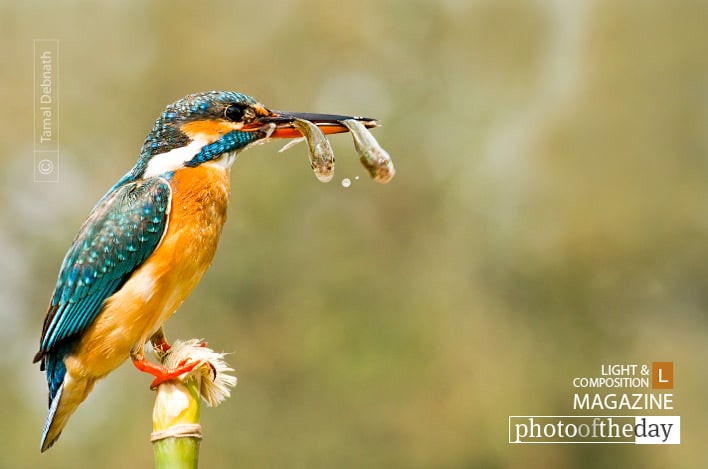
Captured on a quiet morning by a local pond, this image documents a rare and fascinating encounter with a Common Kingfisher. After patiently waiting in a makeshift hide for over an hour, the photographer witnessed the bird successfully catch two fish simultaneously. The scene took an unexpected turn when the kingfisher, finding the double catch cumbersome, consumed one fish and discarded the other—a moment of natural struggle that inspired the title Double Trouble. The photograph is award-worthy for its sharp focus on the bird's behavior and the precise timing required to freeze such a fleeting, complex interaction in the wild.
Tamal Debnath
Based in Coochbehar, West Bengal, Tamal Debnath is an English language teacher and dedicated amateur photographer. Since beginning his photographic journey in 2008, he has cultivated a deep passion for wildlife, treating his camera as a constant companion and a tool for lifelong learning. By observing the work of others and embracing the daily lessons found in the field, he continues to refine his craft and capture the intricate beauty of the natural world.
Resonance Score Breakdown
Transparency Note: The resonance score (13.1/20) is calculated based on social engagement metrics collected before the award announcement.
Expert Photography Reviews · 7
The Weight of Enough
I was at the grocery store this morning, staring at a shelf of cereal, trying to decide if I needed one box or two. It sounds silly, but I stood there for a long time, weighing the cost of having too much against the fear of running out.
Read the reflection →The Weight of Excess
We are taught from a very young age that more is better. We gather, we hoard, we stack our plates high, convinced that the abundance of our reach is a measure of our success. Yet, there is a quiet, biological truth that contradicts this human impulse: the burden of the extra.
Read the reflection →Reviews & Comments
Share your thoughts about this award-winning photograph. Your reviews contribute to the community engagement score.
The kingfisher’s plumage, a startling electric cobalt that rivals the most luminous Vermeer, vibrates against the muted, muddy ochres of the Coochbehar pond, creating a chromatic friction that’s utterly intoxicating. It’s a rare, visceral joy to witness such a violent, saturated collision of life and light. One feels the humidity of the West Bengal morning in those bruised, earthy tones, yet it’s the bird’s piercing, impossible brilliance that truly steals my breath away.
An hour in a makeshift hide is a decent start, though hardly a marathon. Still, catching a kingfisher mid-fumble with two fish isn’t luck; it’s a reward for sitting still while the mosquitoes dine on you. I’ve spent enough mornings in damp reeds to know that frustration. It’s a sharp, honest bit of work. One suspects the bird didn’t make it easy, but the photographer clearly earned the right to press the shutter. Well done.
Nature isn’t a spectacle; it’s a brutal negotiation. Here, the kingfisher’s double catch isn’t mere luck, but a violent arithmetic of survival. I’m unsettled by how the discarded fish hangs in the air, a ghost of potential energy. Debnath’s shadows don’t just frame the subject; they swallow the excess. It’s a cold, sharp reminder that life’s abundance is often just a prelude to waste. I’ve never felt the cruelty of a pond’s surface quite like this.
Most wildlife shots are just trophies, but this one captures a genuine, messy failure of nature. I’ve seen thousands of kingfisher portraits, yet they’re usually just static poses. Here, the discarded fish mid-air is the hook. It’s a brutal, fleeting moment of inefficiency that makes me laugh every time I look at it. It’s not just a sharp capture; it’s a story about the absurdity of survival. That’s why it’ll still matter in thirty years.
The air in Coochbehar holds a heavy, humid stillness that morning. Tamal waited in the dark, listening to the water’s pulse until the light finally broke. It’s a rare, fleeting grace to catch a kingfisher mid-struggle. I feel a sudden, sharp ache in my own shoulders just imagining the hours he spent crouched there, motionless. He didn’t just capture a bird; he listened to the pond’s secret, waiting for the land to reveal its messy, beautiful truth.
At f/8, the focal plane is razor-thin, yet it resolves the kingfisher’s plumage with startling clarity. The diffraction limit hasn’t compromised the micro-contrast of those iridescent feathers, which is a rare feat for a D3100 sensor. I’m genuinely moved by the way the light refracts through the water droplets; it’s a crystalline moment of physics. It’s not just a capture of behavior, but a precise optical dissection of a fleeting, violent struggle in the morning sun.
The pond is still. A kingfisher holds two lives. It’s a heavy moment, yet the frame breathes. I’ve spent years watching for this kind of restraint. The bird discards the excess. It chooses the essential. I feel a sudden, sharp ache in my chest watching that discarded fish fall. Nothing here is accidental. The empty corner is not empty. It is the space where the struggle ends. Silence remains. It’s enough.