Death Note by Ryan Perris
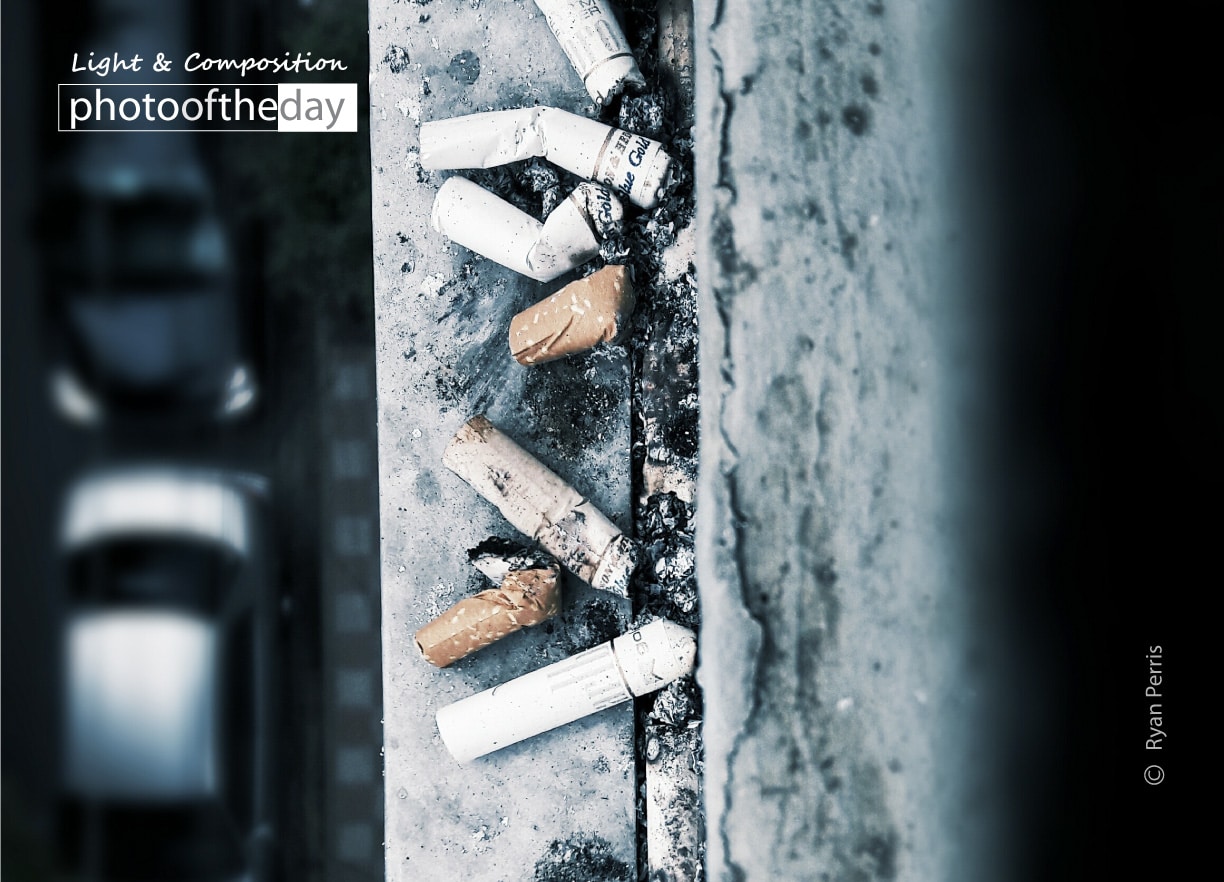
Death Note captures the poignant irony of human habit, using discarded cigarette filters as somber symbols of mortality. The photographer frames these remnants not merely as litter, but as literal 'death notes' left behind by those who succumb to the temptation of smoking. By focusing on the stark, tactile reality of the filters, the image transforms a common urban sight into a powerful conceptual commentary on the slow, deliberate choices that define human life. The composition’s sharp clarity and thoughtful arrangement elevate this everyday scene into a compelling visual narrative about the fragility of health and the persistence of desire.
Ryan Perris
Born in Dhaka, Bangladesh, Ryan Perris is an amateur photographer who balances his creative pursuits with a professional career in art and advertising. Driven by an insatiable wanderlust, he travels extensively to document the subtle magic found within nature and the intricate details of the world around him. His work reflects a keen eye for conceptual storytelling, consistently seeking to capture the profound beauty hidden in the smallest, most overlooked moments of daily life.
Resonance Score Breakdown
Transparency Note: The resonance score (10.7/20) is calculated based on social engagement metrics collected before the award announcement.
Expert Photography Reviews · 6
The Weight of What Remains
We leave traces behind us, like breadcrumbs on a path that leads nowhere. A spent match, a crushed petal, the filter of a cigarette pressed into the cold earth. We think these things are small, inconsequential, but they are the geography of our habits.
Read the reflection →The Residue of Choice
If we are the sum of our habits, are we also the sum of what we discard? We move through the world leaving a trail of small, deliberate endings behind us. Each day is a collection of tiny renunciations, a series of quiet departures from the people we were only moments before.
Read the reflection →Reviews & Comments
Share your thoughts about this award-winning photograph. Your reviews contribute to the community engagement score.
You’ve found something heavy in the gutters of Banani. It’s easy to walk past trash, but you stopped. I’ve spent years looking at the debris of human habit, and these filters feel like quiet, discarded endings. Because you knelt down to frame them, you turned a sidewalk into a graveyard. It makes my chest tighten, thinking about the hands that held these. You didn’t just take a picture; you felt the weight of the habit. That’s honest work.
Sharpness here feels like a missed opportunity. By rendering these cigarette filters with such clinical, high-shutter precision, the work loses the visceral decay inherent in the subject. It’s too literal, too safe. I’d have preferred a long-exposure blur or a lumen print to capture the fleeting nature of mortality. Why resolve every fiber of the filter? It’s technically competent, sure, but it doesn’t make me feel the weight of the death it claims to document.
The frame’s geometry is its only salvation. The scattered filters create a rhythmic, staccato tension across the picture plane, anchoring the chaos of the Banani pavement. It’s a rigid, calculated distribution of mass that keeps the eye from drifting into the periphery. I’ve grown weary of such heavy-handed conceptual metaphors, yet the structural discipline here is undeniable. The composition doesn’t just hold; it demands a cold, clinical respect for the architecture of decay.
Discarded filters on a Dhaka sidewalk don’t inherently signify mortality; they signify a specific urban neglect. Why do we romanticize trash in Banani while ignoring the labor that cleans it? Perris frames these butts with a clinical detachment that feels unearned. It’s a sterile aestheticization of poverty’s byproduct. I find myself wincing at the pretension. Does the photographer see the people who actually walk here, or are they just inconvenient blurs in his conceptual narrative?
Most entries in this category rely on heavy-handed metaphors, but Perris avoids the trap. By isolating these discarded filters against the harsh Dhaka pavement, he forces us to confront the debris of addiction. It’s a quiet, brutal inventory of mortality. I’ve seen thousands of conceptual shots, but this one sticks because it doesn’t preach; it just documents the slow rot of habit. It’s haunting. In thirty years, this stark reality will still feel like a punch.
The shutter speed here is a surgical strike. It freezes the decay, turning discarded filters into a grim, rhythmic sequence of exits. I’m struck by the texture; it’s visceral, almost tactile. The frame holds a silence that’s heavy, like the final beat before a cut to black. It’s a scene where the narrative doesn’t need motion to scream. Ryan caught the exact moment the habit ends. I’d keep this frame; it’s the editor’s final choice.