Carabao Reflected by Ryszard Wierzbicki
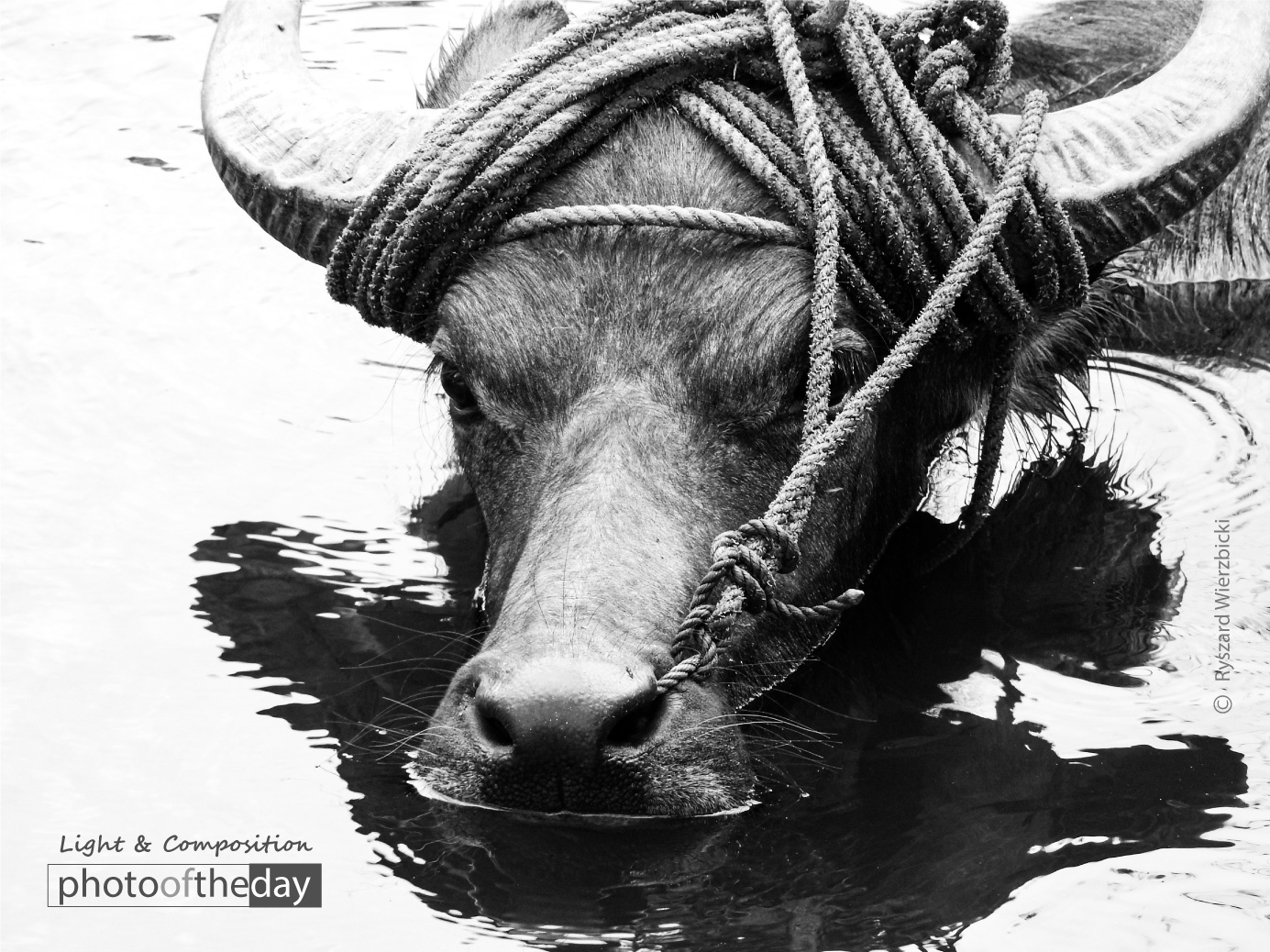
Captured in the lush landscapes of El Nido, this photograph highlights the carabao, or water buffalo, an iconic symbol of the Philippines. Beyond their role as essential agricultural companions for plowing fields and providing transport, these animals are deeply woven into the cultural and commercial fabric of South-East Asia. The photographer masterfully captures the animal in its natural environment, reflecting a keen eye for the intersection of wildlife and local tradition. The image is award-worthy for its ability to elevate a common, everyday sight into a compelling portrait that speaks to the spirit and heritage of the region.
Ryszard Wierzbicki
Born in 1963 and a graduate of the University of Gdańsk, Ryszard Wierzbicki transitioned from a diverse career in social sciences and marketing to become a dedicated traveler and photographer. After relocating to the United Kingdom in 2006, he channeled his passion into exploring South-East Asia, where he frequently volunteers with orphanages. As a PADI scuba instructor and the founder of multiple travel and photography forums, Wierzbicki now balances his life as a marketing advisor and tour organizer, capturing the world through a lens shaped by his extensive global experiences.
Resonance Score Breakdown
Transparency Note: The resonance score (11.7/20) is calculated based on social engagement metrics collected before the award announcement.
Expert Photography Reviews · 7
The Mirror of the Earth
We often mistake stillness for an absence of life, forgetting that the deepest roots grow in the silence of the mud. There is a heavy, ancient patience in the earth—a rhythm that does not hurry to bloom or to harvest.
Read the reflection →The Weight of Still Water
In the quiet corners of a rural morning, there is a stillness that feels almost heavy, as if the air itself is holding its breath. We often mistake silence for an absence, a void waiting to be filled by the noise of our own industry.
Read the reflection →Reviews & Comments
Share your thoughts about this award-winning photograph. Your reviews contribute to the community engagement score.
f/5.6 at 1/500s, ISO 200, 70mm. A sensible choice for a static subject, though the depth of field is surprisingly thin for a landscape. It isolates the carabao effectively, but the reflection lacks the necessary sharpness to justify the wide aperture. I’ve spent years staring at these sensors, and it’s frustrating when the focus plane misses the eye by a hair. It’s technically competent, yet it doesn’t quite earn the weight of its own ambition.
The water breaks. A ripple, then the stillness of a mirror. It’s a tracking shot that stops dead, forcing us to stare at the carabao’s heavy, wet silhouette. I’m struck by the silence here; it’s a frame the editor keeps because the pacing is perfect. The reflection isn’t just a trick of light—it’s the weight of the animal anchored in the mud. It’s a beautiful, quiet cut. I’d have watched this scene for hours.
The carabao’s obsidian hide, slick with the wet, bruised violet of a storm-heavy sky, anchors a scene where light doesn’t merely fall; it dissolves into the murky, jade-tinted shallows. It’s a Morandi-esque meditation on stillness, where the muted, earthy ochres of the beast’s reflection bleed into the water’s surface, and I’ve found myself utterly breathless, caught in the quiet, humid ache of a palette that feels like the very soul of the tropics.
The carabao’s horizontal mass anchors the lower third, creating a perfect tension against the vertical ripples of the water. It’s a study in symmetry, where the reflection acts as a mathematical inversion of the subject’s heavy geometry. I’m genuinely struck by how the ripples distort the animal’s form into a series of rhythmic, oscillating vectors. It’s not just a portrait; it’s a solved spatial equation where the negative space balances the weight of the beast perfectly.
You waited for that stillness in the water, didn’t you? It’s a quiet moment, but I feel the heat of that Philippine sun just looking at the carabao’s heavy, patient gaze. You didn’t try to make it something it isn’t. You just let the animal exist in its own rhythm. And that’s the truth of it. I’ve spent enough time in those fields to know that look. You captured a piece of a life.
The carabao stands in the water, a beast of burden turned into a picturesque prop. I’m struck by how the reflection smooths over the grit of agricultural labor. Does this framing erase the farmer’s sweat to satisfy a tourist’s aesthetic hunger? Why must we romanticize the animal while ignoring the human reality of the field? It’s a pretty composition, but it feels like a hollow souvenir. Whose heritage are we actually consuming here?
Most wildlife shots are just snapshots of biology. What separates this from the thousands of mediocre animal portraits I’ve reviewed is the stillness of the water. By aligning the carabao’s heavy, grounded form with its perfect reflection, Wierzbicki forces us to confront the animal’s gravity. It’s a quiet, heavy beauty that makes me want to reach out and touch the surface. Thirty years from now, this will still feel like a deep breath of rural peace.