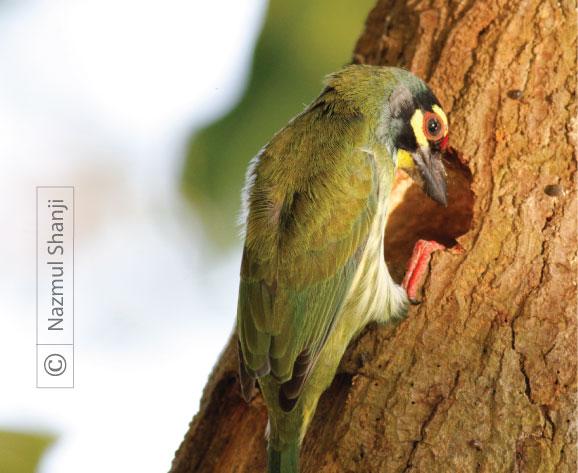
Busy with New Home by Nazmul Shanji
Captured during a late afternoon excursion to Ramna Park, this photograph showcases a barbet perched amidst the foliage. Initially setting out for casual birding, the photographer transitioned from capturing squirrels and thrushes to focusing on this elusive subject. By gently tracking the bird, the photographer managed to secure a crisp, intimate portrait that highlights the creature's vibrant plumage and natural behavior. The image is award-worthy for its patience and technical precision, transforming a spontaneous afternoon walk into a compelling study of local wildlife, demonstrating the photographer's keen eye for detail and ability to seize fleeting moments in nature.
Nazmul Shanji
Born in 1986 in Dhaka, Bangladesh, Nazmul Shanji is an electrical power engineer who transitioned into photography as a dedicated creative pursuit. Influenced by his wife and a commitment to self-directed learning, he has rapidly developed his skills through formal courses in photojournalism and professional photography. Shanji specializes in nature, wildlife, street, and candid portraiture, consistently striving to develop a unique artistic signature. His work reflects a deep desire to document the unseen diaries of life, blending his technical background with a passionate, observational approach to the world around him.
Resonance Score Breakdown
Transparency Note: The resonance score (12.5/20) is calculated based on social engagement metrics collected before the award announcement.
Expert Photography Reviews · 4
The Architecture of Belonging
There is a quiet industry in the way the world prepares for its own continuity. We often overlook the small, persistent labor of those who build their lives in the hidden corners of the canopy.
Read the reflection →The Architecture of Belonging
We spend our lives gathering the debris of existence—twigs of memory, soft moss of comfort, the stray threads of conversations—trying to weave them into a shape that feels like shelter. There is a quiet, frantic holiness in the way we build.
Read the reflection →Reviews & Comments
Share your thoughts about this award-winning photograph. Your reviews contribute to the community engagement score.
The barbet’s placement within the frame creates a precarious spatial tension. It’s anchored by the diagonal thrust of the branch, which prevents the composition from collapsing into mere documentation. The negative space doesn’t offer comfort; it demands focus. I’m genuinely irritated by the distracting foliage blur, yet the bird’s sharp ocular focus holds the plane together. It’s a rigid, disciplined geometry. The frame doesn’t fail, but it’s a narrow victory for structural integrity.
The barbet’s plumage burns with a frantic, desperate color, yet it’s the encroaching gloom of the Ramna foliage that truly holds me. I’ve spent hours staring at these dark, tangled voids; they don’t merely frame the bird, they consume its urgency. It’s a quiet violence. The light here isn’t a gift, it’s a brief reprieve from an inevitable, swallowing dark. I feel a sudden, cold shiver—the weight of a world that refuses to be seen.
Before the eye identifies the barbet, something in the chest settles. It’s the stillness of the foliage that catches me first, a quiet green cage for that vibrant, alert life. I feel my own pulse slow, matching the bird’s rigid, focused posture. Returning to it months later, I don’t see a bird; I see the weight of a home being built. It’s a small, frantic urgency that makes me hold my breath, hoping it stays safe.
The focal plane here is razor-thin, perfectly isolating the barbet’s eye from the chaotic bokeh of the Ramna Park foliage. At this aperture, the lens resolves the fine, iridescent barbs of the feathers with startling clarity, pushing right against the diffraction limit. It’s a rare, clinical precision that I find genuinely moving. When the light hits those textures just right, it’s not just a bird; it’s a masterclass in how glass can reveal the hidden architecture of life.