Bull Moose by Ronnie Glover
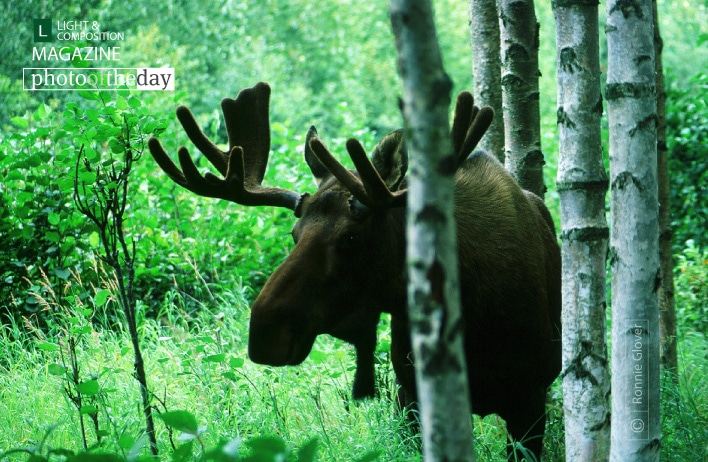
Captured within the urban wilderness of Anchorage, this striking portrait of a bull moose highlights the majesty of one of North America's most formidable creatures. The photographer navigated the local woodlands with patience and caution, maintaining a respectful distance to document the animal's impressive stature and the distinct architecture of its antlers. This image succeeds by balancing the raw, untamed essence of the moose with a clear, deliberate composition. It serves as a testament to the photographer's ability to find profound wildlife encounters in unexpected places, turning a routine observation into a compelling study of nature's strength and seasonal cycles.
Ronnie Glover
Based in Gig Harbor, Washington, Ronnie Glover is a dedicated photographer whose artistic journey was shaped by formal training at the Southeastern Center for the Arts in Atlanta. His extensive fourteen-year residency in Alaska provided a profound foundation for his wildlife and nature photography, fostering a deep appreciation for the natural world. Beyond his work in the wilderness, Glover explores the dynamism of sports and travel, while also embracing contemporary trends through mobile photography. His imagery serves as a bridge, inviting viewers to engage with the beauty of diverse cultures and the inspiration found in physical human pursuits.
Resonance Score Breakdown
Transparency Note: The resonance score (12.9/20) is calculated based on social engagement metrics collected before the award announcement.
Expert Photography Reviews · 7
The Weight of Silence
In the quiet corners of the northern woods, there is a language spoken without a single syllable. It is a heavy, deliberate sort of communication, built on the slow shifting of weight and the rhythmic intake of cold, thin air.
Read the reflection →The Weight of the Wild
Why do we insist that the wild must be somewhere else, tucked away in a distant, unmapped corner of the map? We build our walls and pave our paths, convinced that we have successfully partitioned the world into the civilized and the untamed.
Read the reflection →Reviews & Comments
Share your thoughts about this award-winning photograph. Your reviews contribute to the community engagement score.
The low, raking light of an Alaskan morning catches the velvet on those antlers, turning the moose into a cathedral of bone and muscle. It’s quiet here. I’ve felt that same stillness, the way the air holds its breath when a creature acknowledges your presence. Glover didn’t just snap a frame; he waited until the woods allowed him to see. It’s a humbling reminder that we’re merely guests in these wild, urban spaces. I’m truly moved.
Velvia film renders the moose’s coat with a suffocating, unnatural density, yet it’s the encroaching gloom of the Alaskan brush that truly haunts me. Glover doesn’t just frame a beast; he traps a primordial silence within the frame’s edges. I’ve spent hours staring into those velvet antlers, feeling the weight of the shadows pressing against the creature’s flank. It’s a cold, existential confrontation. When the light fails, the animal finally begins to tell the truth.
Velvia is a demanding mistress, and here, she’s been treated with the respect she deserves. One suspects Glover didn’t just stumble upon this bull while walking the dog. That stillness in the antlers suggests a long, shivering wait in the Alaskan slush. I’ve spent enough mornings freezing in similar brush to recognize the commitment required to get this close without spooking the beast. It’s a proper bit of work. He clearly earned every frame.
The Nikon N2000’s focal plane renders the moose’s velvet-covered antlers with startling micro-contrast. Using Velvia, Glover captured a spectral density that digital sensors often struggle to replicate. I’m genuinely moved by how the light scatters across those tines; it’s a masterclass in managing diffraction limits without sacrificing texture. The bokeh, a function of the lens’s wide aperture, isolates the subject perfectly. It’s rare to see such raw, optical honesty in an urban wilderness portrait.
Before the eye identifies the antlers, something in the chest tightens. It’s a sudden, primal activation—the recognition of a wildness that shouldn’t be here, in the city’s quiet edges. I feel a strange, cold shiver looking at that velvet-heavy gaze. When I return to this frame a year later, the moose’s stillness feels less like a portrait and more like a warning. It’s the weight of the woods, breathing right against our glass.
The ochre of the moose’s coat, a shade reminiscent of Morandi’s dust-laden clay, anchors this frame against the cold, desaturated slate of the Alaskan undergrowth. It’s a chromatic collision that makes my heart ache, for the Fujichrome Velvia renders the shadows with such a bruised, melancholic violet that one feels the biting frost. I’m utterly captivated by how the creature’s velvet antlers bleed into the muted, wintry atmosphere, creating a harmony that feels ancient and inevitable.
Most wildlife shots are just trophies, but this moose feels like a ghost haunting the suburbs. Of the thousands I’ve reviewed, few capture that specific, heavy stillness of Velvia film. The way the antlers frame the encroaching shadows makes me feel the cold air of that Anchorage morning. It’s not just a portrait; it’s a record of a wild world shrinking. I’m glad this exists because it reminds us exactly what we’re losing to the pavement.