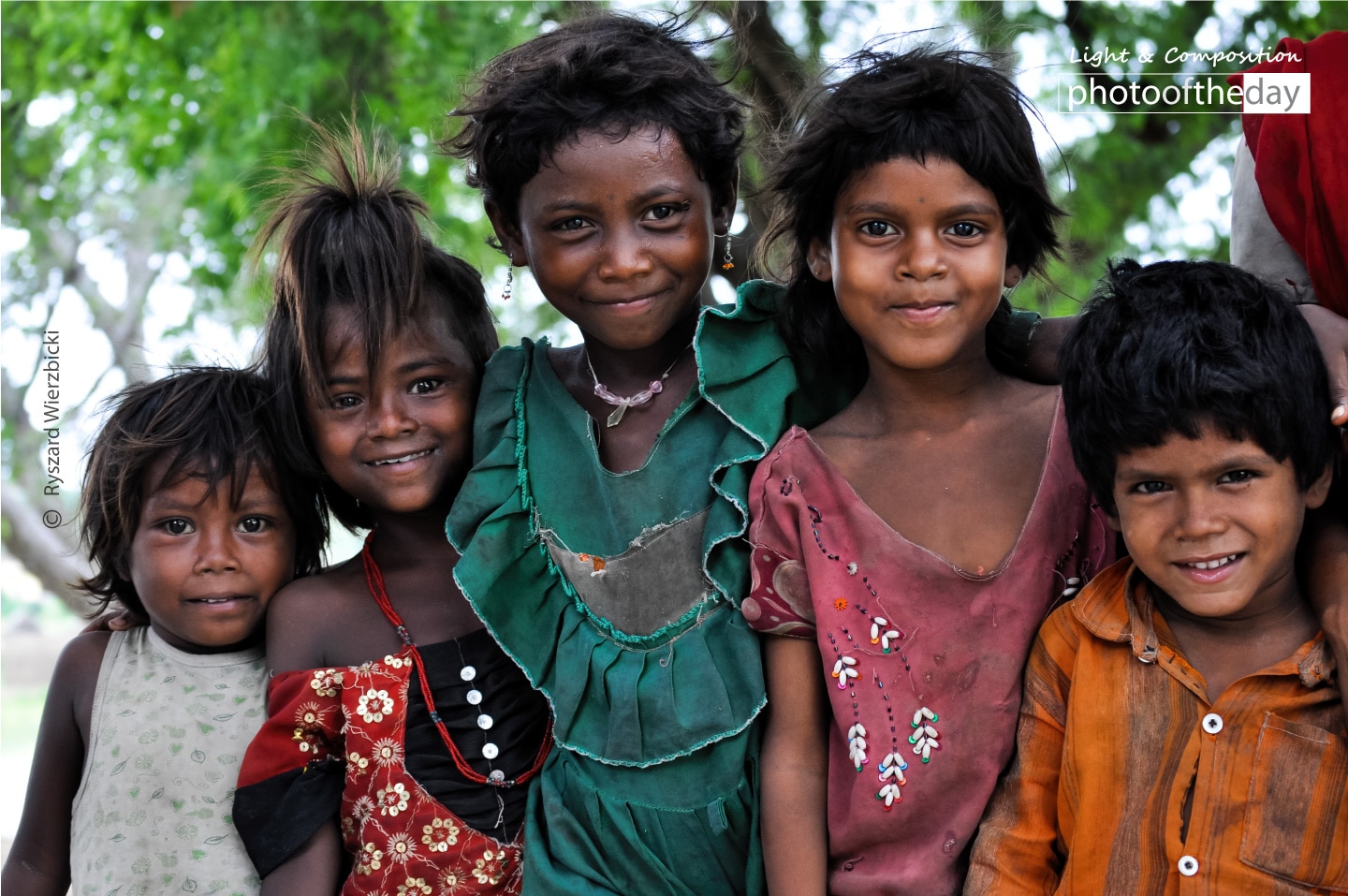
Bodh Gaya Gang of Friends by Ryszard Wierzbicki
In the rural outskirts of Bodh Gaya, the photographer encountered a spirited group of local children whose natural curiosity created an immediate, vibrant connection. Rather than avoiding the attention, the photographer chose to embrace the interaction, turning a potentially distracting situation into a collaborative portrait session. This approach allowed for an authentic, candid moment of human connection that radiates warmth and spontaneity. The image is award-worthy for its ability to capture the genuine joy and uninhibited spirit of the subjects, demonstrating how a photographer’s willingness to engage with their environment can transform a simple encounter into a compelling narrative of childhood and cultural discovery.
Ryszard Wierzbicki
Born in 1963, Ryszard Wierzbicki is a dedicated photographer and traveler currently based in Swindon, United Kingdom. After a diverse professional career in social sciences and marketing, he transitioned into full-time exploration, focusing his lens on the cultures and landscapes of South-East Asia. His work is deeply informed by his background in child care and his commitment to humanitarian efforts, such as his volunteer work with orphans in Thailand and Burma. Through his photography and travel forums, Wierzbicki shares his passion for documenting the human experience with an empathetic and observant eye.
Resonance Score Breakdown
Transparency Note: The resonance score (11.7/20) is calculated based on social engagement metrics collected before the award announcement.
Expert Photography Reviews · 7
The Geometry of Belonging
In the quiet corners of a village, there is a specific kind of gravity that pulls people together.
Read the reflection →The Currency of Laughter
Childhood is a country where the borders are drawn in chalk and erased by the first rain. It is a place where time does not tick; it only pulses in the rhythm of running feet and the sudden, sharp intake of breath before a secret is shared.
Read the reflection →Reviews & Comments
Share your thoughts about this award-winning photograph. Your reviews contribute to the community engagement score.
Sunlight in Bodh Gaya doesn’t just illuminate; it interrogates. These children aren’t merely posing; they’re caught in a violent struggle between the harsh glare of the present and the encroaching, velvet silence of the periphery. I’ve stared at their eyes, and it’s haunting—the way the darkness behind them refuses to be ignored. It’s not just joy here; it’s a desperate, fleeting defiance against the void. It doesn’t invite us in; it demands we acknowledge the abyss.
The children occupy the threshold between the harsh, sun-bleached masonry and the encroaching dust of the rural periphery. It’s a raw, unmediated space where the architecture—or lack thereof—defines their movement. I’m struck by how the light rakes across their faces, emphasizing the solid mass of the wall behind them. It’s not just a portrait; it’s a study of how human presence reclaims a void. I find myself wishing I could see what lies beyond that frame.
There’s a refreshing lack of the staged exoticism that plagued colonial-era ethnographic studies. Wierzbicki’s framing echoes the candid, democratic spirit of Helen Levitt’s New York street work, yet it’s grounded in the humid, textured light of Bihar. I’m genuinely moved by the unforced geometry of their limbs; it’s a chaotic, kinetic joy that feels entirely modern. He’s sidestepped the trap of the picturesque, finding a raw, human rhythm that’s rarely captured with such genuine, unpretentious grace.
Most street portraits of children are cloying, but this one avoids the trap by refusing to sanitize the chaos. The way the boy in the center locks eyes with the lens while his friends tumble into the frame creates a kinetic tension that feels honest. I’ve seen thousands of these encounters, yet this one makes me smile every time. It’s the raw, unscripted friction between subject and observer that ensures it’ll still matter in thirty years.
The dust of Bodh Gaya settles in the late afternoon, catching that golden, heavy light that feels like a benediction. I’ve stood in such heat, waiting for the air to soften. These children aren’t just subjects; they’re part of the earth itself. It’s a quiet, sacred communion. Looking at their faces, I feel a sudden, sharp ache for the simplicity of that moment. He didn’t rush them. He simply listened until the light and the laughter aligned.
The frame erupts. It’s a kinetic explosion of limbs and grins, a sequence captured mid-beat before the chaos settles. Wierzbicki didn’t just point a lens; he caught the rhythm of a scene that refuses to sit still. I’ve spent hours watching frames like this, and honestly, it makes me miss the dust of the road. The cut would’ve been a mistake. He held the shutter open just long enough to let the joy breathe. It’s pure cinema.
You didn’t just point a lens at these kids; you let them into your space. I can feel the dust and the heat, but mostly, I feel that sudden, chaotic joy they’re throwing at you. It’s messy and loud, exactly how childhood should be. You waited for the moment they stopped posing and started living. Honestly, looking at their faces makes me miss the simplicity of being that young. You were really there with them.