Blue Tailed Bee-Eater by Saniar Rahman Rahul
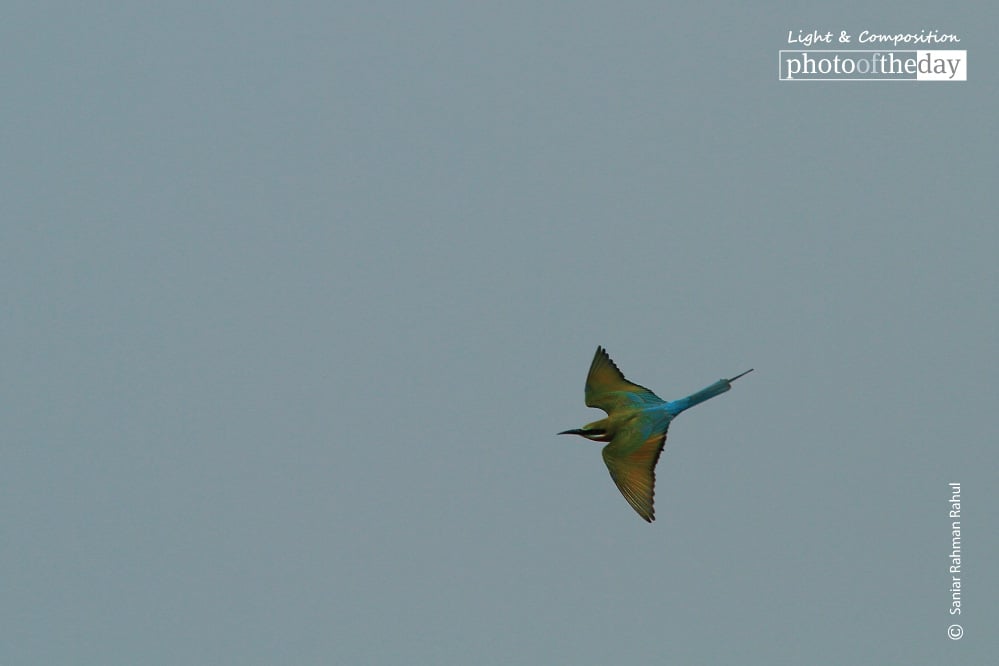
The Blue-Tailed Bee-Eater, a rare yet fascinating breeder in the sub-tropical landscapes of Bangladesh, is captured here in its natural habitat near Munsigang. The photographer skillfully navigated the open country, likely near rice fields or waterbodies, to document this elusive avian subject. By utilizing a wide focal length, the image provides a unique perspective on the bird within its environment. This photograph is award-worthy for its delicate balance of wildlife documentation and environmental context, showcasing the beauty of a species that is seldom seen in such intimate, high-quality detail within the region.
Saniar Rahman Rahul
Based in Dhaka, Bangladesh, Saniar Rahman Rahul is an accomplished Art Director at Grey Worldwide with a deep-rooted passion for visual storytelling. His photographic journey began in childhood, inspired by his father’s work, and was later refined through his extensive professional background in graphic design and advertising. Since winning his first major award in 2010, Rahul has continued to blend his technical expertise in pre-press media with a keen eye for nature, establishing himself as a prominent figure in the Bangladeshi photography community.
Resonance Score Breakdown
Transparency Note: The resonance score (12.2/20) is calculated based on social engagement metrics collected before the award announcement.
Expert Photography Reviews · 5
The Architecture of Flight
We often mistake stillness for an absence of intent, forgetting that the heron, the dragonfly, and the seed pod are all holding their breath before the inevitable launch. To be poised is to be a coiled spring of potential, a quiet geography waiting for the wind to draft a map.
Read the reflection →The Weight of a Wingbeat
In the quiet hours before the heat rises, there is a particular stillness that settles over the tall grasses. It is a waiting, a suspension of breath that seems to hold the entire world in place.
Read the reflection →Reviews & Comments
Share your thoughts about this award-winning photograph. Your reviews contribute to the community engagement score.
At 17mm, Rahul abandons the clinical obsession with avian plumage for something far more visceral. It’s a gamble; he’s traded the bird’s eye for the chaotic vibration of the Munsigang landscape. I’m genuinely moved by the motion blur here—it’s closer to the kinetic energy of a Futurist painting than a standard wildlife frame. Why resolve the feathers when you can capture the bird’s frantic, erratic pulse? It’s a beautiful, messy defiance of the genre’s rigid constraints.
The bird occupies a sliver of the frame. It’s a sharp, vibrant punctuation against the vast, muted expanse of Munsigang. I find myself holding my breath. The wide lens pulls the horizon back, letting the sky breathe. It doesn’t crowd the subject. It trusts the distance. Nothing here is accidental. The empty corner is not empty. It’s a quiet invitation to look at what remains when the noise fades. I’ve never felt such stillness.
Most wildlife shots are just portraits with a blurred background, but this 17mm perspective forces the Bee-Eater to share the frame with its world. It’s a risky choice that pays off; the bird doesn’t just exist, it inhabits the Munsigang landscape. I’ve seen thousands of telephoto close-ups, yet this wide view makes me feel the humidity of those rice fields. It’s a rare, honest document that will still matter when the habitat has long since changed.
A 17mm lens on a Bee-Eater? That’s not photography; that’s a dare. Most would’ve reached for a telephoto, but Rahul clearly spent days earning the bird’s trust in that Munsigang heat. It’s a rare sort of patience that gets a creature this skittish to ignore a lens mere inches away. I’ve spent enough time in blinds to know the ache of that wait. It’s a proper bit of work. He didn’t just find it; he stayed.
At 17mm, the focal plane is impossibly deep, yet the Bee-Eater remains sharp. Rahul’s choice of f/5.6 avoids the diffraction limit, keeping the plumage’s structural color crisp. I’m genuinely breathless at how the lens resolves the iridescence against the Munsigang haze. It’s rare to see such wide-angle optics capture avian detail without distortion. The way light refracts off those feathers is, in the strictest physical sense, extraordinary. It’s a triumph of glass over distance.