Black-throated Forktail by Saniar Rahman Rahul
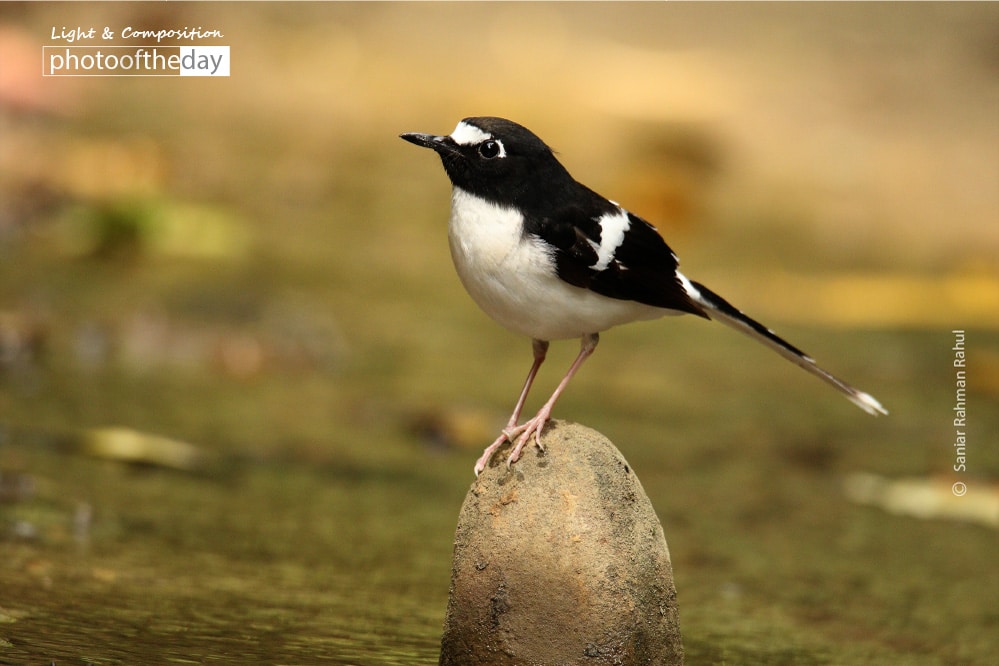
Captured within the lush, temperate surroundings of Kaptai National Park, this portrait of a Black-throated Forktail showcases the bird’s elegant plumage and alert demeanor. The photographer utilized a long telephoto lens to isolate the subject against the soft, natural backdrop of the forest, capturing the intricate details of the bird's feathers and its distinct markings. This image is award-worthy for its exceptional clarity and the photographer's patience in documenting a species native to the moist lowland forests of the Indian subcontinent, highlighting the delicate balance of life within its natural habitat.
Saniar Rahman Rahul
Based in Dhaka, Bangladesh, Saniar Rahman Rahul is an accomplished Art Director at Grey Worldwide with a deep-rooted passion for visual storytelling. His journey into photography began in childhood, inspired by his father’s work, and was later refined through his extensive professional background in graphic design and advertising. A distinguished talent in the field, Rahul has been recognized for his creative eye, notably earning the inaugural Photo of the Month Award in June 2010 for his evocative wildlife and nature imagery.
Resonance Score Breakdown
Transparency Note: The resonance score (10.9/20) is calculated based on social engagement metrics collected before the award announcement.
Expert Photography Reviews · 8
The Architecture of Stillness
The black-throated forktail thrives in the spray of mountain streams, its life dictated by the rhythm of rushing water and the moss-slicked stones that serve as its only stage.
Read the reflection →The Quiet Watcher
There is a profound grace in simply being. We often rush through the forest of our days, eyes fixed on the horizon, missing the small, steady heartbeats that pulse in the shadows.
Read the reflection →Reviews & Comments
Share your thoughts about this award-winning photograph. Your reviews contribute to the community engagement score.
The forest here acts as a complex, organic fenestration, filtering light into a soft, dappled datum behind the subject. It’s a study in scale; the bird’s sharp, monochromatic geometry contrasts against the chaotic, blurred void of the jungle. I’m struck by how the shallow depth of field mimics the way our eyes prioritize a single threshold in a vast, dense space. It’s a quiet, structural elegance that makes me want to step right into that canopy.
Of the thousands of wildlife frames I’ve reviewed, most are just sharp records of biology. Rahul’s work avoids that trap. The way the Black-throated Forktail’s tail feathers slice through the negative space creates a tension that feels alive. It’s not just a bird; it’s a portrait of stillness. I’ll admit, the stark clarity of that eye actually made me hold my breath. It’s a rare, enduring capture that will still command respect thirty years from now.
You waited in that humid silence of Kaptai, didn’t you? It’s easy to get lost in the gear, but you didn’t. You caught that Forktail mid-breath, its posture so sharp it’s almost nervous. I’ve spent enough time in the brush to know that stillness isn’t easy. And honestly, looking at the way you’ve isolated that tiny, alert life against the forest, I feel the damp heat of the jungle. You were truly there. Nice work.
The Black-throated Forktail sits in perfect, clinical isolation. It’s a sharp portrait, yet I feel a strange coldness looking at it. Why does the forest blur into such a generic, soft-focus void? By stripping away the context of Kaptai National Park, does Rahul prioritize aesthetic perfection over the bird’s actual reality? I’m left wondering if we’re documenting a species or merely consuming a trophy. Is this nature, or is it just a staged, sterile encounter?
The bird sits. It doesn’t ask for the frame. The forest behind it dissolves into a soft, green blur. I find myself holding my breath, waiting for a movement that won’t come. It’s quiet here. The space around the tail feathers isn’t just background. It’s a deliberate pause. Nothing here is accidental. The empty corner is not empty. It’s the weight of the silence that stays with me. I’ve never felt so still.
The Black-throated Forktail’s stark, monochromatic plumage here echoes the high-contrast precision of early wet-plate collodion studies, yet Rahul’s 600mm compression flattens the depth in a way that feels distinctly modern. It’s a sharp, clinical observation of avian anatomy. While it lacks the painterly, atmospheric blur of Eliot Porter’s dye-transfer prints, I’m genuinely struck by the bird’s alert, piercing gaze. It’s a rare, quiet moment of stillness that makes me forget the mechanical nature of the 7D Mark II.
The forest floor in Kaptai doesn’t give up its secrets easily. Rahul must have waited in the damp, breathless silence, listening for the soft rustle of the Black-throated Forktail. It’s the stillness that strikes me; he’s captured a moment where the bird and the shadows are in perfect accord. I feel a sudden, quiet ache for that humid, green solitude. He didn’t chase this shot; he let the forest reveal its inhabitant to him.
The bird’s placement creates a precarious spatial tension. It’s anchored by the diagonal branch, yet the negative space above threatens to collapse the frame. The plumage detail is sharp, but the background bokeh lacks the necessary structural depth to ground the subject. It’s technically precise, sure, but the composition doesn’t quite resolve. I’ve seen better balance in the wild, yet the fork of the tail provides a necessary, sharp fulcrum that almost saves the shot.