Balancing on the Wall by Ryszard Wierzbicki
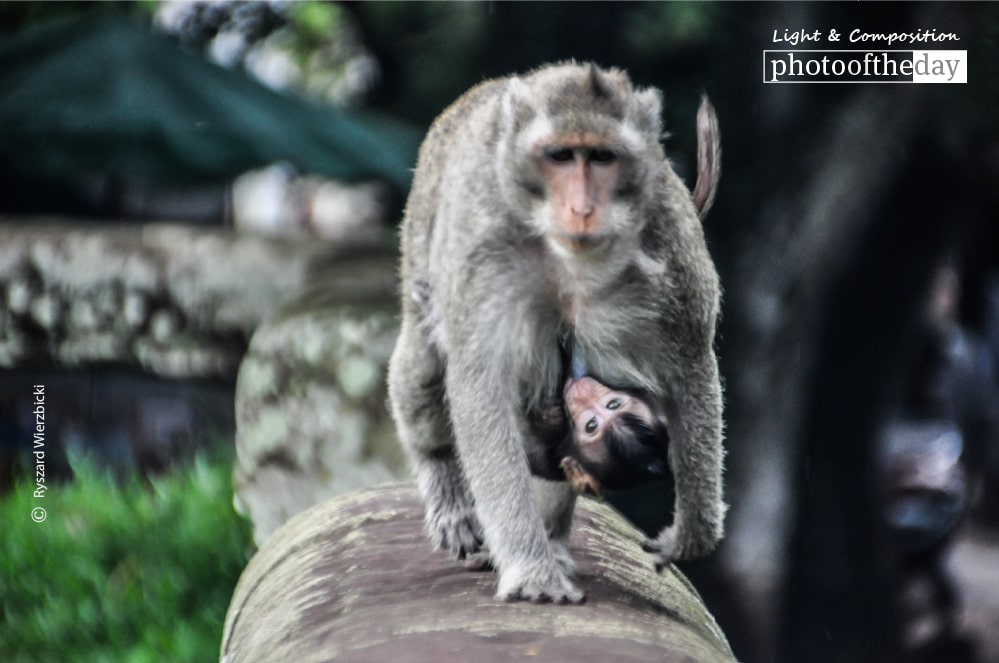
Captured amidst the ancient splendor of the Angkor Wat temple complex, this image documents a tender moment between a mother monkey and her infant. Following a sunrise shoot, the photographer observed the pair navigating the historic stone walls, their silhouettes framed against the weathered architecture. The photograph is award-worthy for its intimate portrayal of wildlife behavior, masterfully balancing the raw, textured history of the site with the delicate, fleeting connection of the subjects. It serves as a poignant reminder of the vibrant life that continues to inhabit these sacred, timeless spaces.
Ryszard Wierzbicki
Born in Poland in 1963, Ryszard Wierzbicki transitioned from a diverse career in education and marketing to a life dedicated to global exploration and photography. After emigrating to the United Kingdom in 2006, he channeled his passion into documenting the landscapes and wildlife of South-East Asia while supporting charitable causes for orphaned children. As the founder of the Instant Travelling and World Around forums, he has established himself as a committed storyteller who captures the intersection of human travel and the natural world with a seasoned, adventurous perspective.
Resonance Score Breakdown
Transparency Note: The resonance score (12.0/20) is calculated based on social engagement metrics collected before the award announcement.
Expert Photography Reviews · 4
The Weight of Softness
There is a quiet endurance in the way stone meets life. We build monuments to outlast our own fleeting presence, carving history into rock, believing that permanence is the only way to be remembered.
Read the reflection →The Weight of History
I remember sitting on a low stone wall in Siem Reap, watching a local guide named Sothea trace the carvings of a thousand-year-old dancer with his thumb.
Read the reflection →Reviews & Comments
Share your thoughts about this award-winning photograph. Your reviews contribute to the community engagement score.

The focal plane here is razor-thin, isolating the mother’s fur against the stone’s porous texture. I’m mesmerized by how the lens resolves the infant’s grip; it’s a perfect marriage of glass and biology. While the diffraction limit softens the distant temple, the micro-contrast on the monkey’s tactile skin is breathtaking. It’s rare to see such optical precision capture a heartbeat. I’ve spent hours staring at these textures, and honestly, it’s just beautiful physics in motion.
The juxtaposition of primate silhouettes against Angkor’s sandstone echoes the colonial-era fascination with ruins, yet Wierzbicki avoids the trap of mere picturesque documentation. It’s a delicate dance between the eternal stone and the ephemeral pulse of life. While the framing recalls the stark, high-contrast clarity of early 20th-century travel photography, the intimacy here is startling. I’ve seen thousands of temple shots, but this tender connection actually made me catch my breath. It’s a rare, quiet triumph.
Before the eye identifies the monkeys, a sudden stillness settles in the chest. It’s the weight of those ancient, porous stones pressing against the fragility of the infant’s grip. I feel a sharp, protective ache in my own shoulders watching them navigate that ledge. When I return to this a year later, the stone feels colder, but the mother’s silhouette remains a steady, rhythmic pulse against the history of the wall. It’s hauntingly quiet.
The stone masonry creates a rigid grid, forcing the subjects into a precarious diagonal. It’s a brutal geometry. The negative space above the wall provides the only relief from the heavy, weathered textures. While the narrative is sentimental, the structural tension holds. I’ve grown weary of such predictable subjects, yet the alignment of the monkeys against the vertical stone fulcrum is undeniably precise. It’s a rare instance where the frame doesn’t collapse under the weight.