Asian Openbills by Masudur Rahman
Captured in the wetlands of Nowapara, this striking image documents a group of Asian Openbills in their natural habitat. The photographer utilized a high shutter speed of 1/8000sec to freeze the birds' movement, highlighting the unique, specialized structure of their bills, which remain partially open to better manipulate snails. This photograph is award-worthy for its technical precision and its ability to capture a rare, intimate glimpse into the behavioral adaptations of these fascinating avian subjects. The composition emphasizes the birds' distinct silhouettes against the environment, offering both scientific interest and aesthetic appeal.
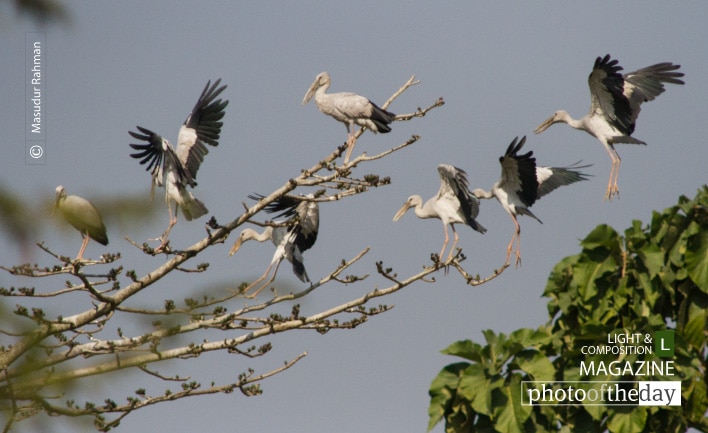
Exposure 1/8000sec @ f/6.3 | ISO 1000 | Focal Length 600mm
Masudur Rahman
Born in 1967, Masudur Rahman is a dedicated photographer based in Chittagong, Bangladesh, who holds a post-graduate degree in Marketing from Chittagong University. His photographic journey began with film portraiture in 1998, eventually evolving into a deep specialization in wildlife and bird photography after he established his own business in 2007. As an active member of the Chittagong Bird Club, Rahman frequently travels across the country to document avian life, sharing his observations and imagery through local weekly publications to promote environmental awareness and creative expression.
Resonance Score Breakdown
Transparency Note: The resonance score (12.5/20) is calculated based on social engagement metrics collected before the award announcement.
Expert Photography Reviews · 8
The Geometry of Flight
I remember sitting on a wooden pier in the Mekong Delta, watching a flock of egrets rise in unison. An old fisherman beside me didn't even look up from his nets. He told me that birds don't decide to fly; they simply agree to it.
Read the reflection →The Geometry of Waiting
There is a specific, quiet geometry to the way things gather. If you watch a flock of birds settling into a marsh, you notice they do not simply land; they negotiate.
Read the reflection →Reviews & Comments
Share your thoughts about this award-winning photograph. Your reviews contribute to the community engagement score.
Of the thousands of wildlife frames I’ve reviewed, most are just sharp snapshots. What separates this from the pack is the brutal clarity of those specialized bills. At 1/8000sec, Rahman caught the exact mechanical purpose of the species. It’s rare to see such clinical precision feel this alive. I’ll admit, the sight of them mid-hunt makes me hold my breath. In thirty years, this won’t just be a bird photo; it’ll be a vital biological record.
The shutter speed is a violent, beautiful freeze-frame. At 1/8000th, Rahman kills the motion entirely, turning the Asian Openbills into a jagged, rhythmic sequence of silhouettes. It’s a high-stakes edit. I’m struck by the tension in those beaks; it’s a predatory stillness that makes my pulse jump. The cut would’ve been a mistake if he’d blurred a single feather. He caught the exact moment the frame demanded. It’s a perfect, silent take.
We look at these Asian Openbills and we aren’t just seeing birds; we’re witnessing a silent, ancient dialogue. Masudur Rahman caught them in a moment of quiet purpose, their beaks parted as if sharing a secret about the wetlands. I feel a sudden, deep stillness watching them. It’s a portrait of survival, isn’t it? They’ve let us into their rhythm, and honestly, it’s a photograph that asks to be returned to, again and again.
One suspects Rahman spent a fair few mornings shivering in the Chittagong mud to get this. Freezing movement at 1/8000sec is a technical flex, but it’s the patience required to let these birds ignore his presence that earns my respect. I’ve spent enough time in wetlands to know that birds don’t just pose for the sake of it. He didn’t find this shot; he waited until the birds finally decided he wasn’t a threat.
At 600mm, the diffraction limit is a constant threat, yet Rahman’s capture of the Asian Openbills remains remarkably crisp. The 1/8000sec shutter speed effectively halts the motion, allowing the lens to resolve the intricate, specialized geometry of those mandibles against the bokeh. I’m genuinely moved by how the light catches the plumage’s texture; it’s a rare moment where the optics don’t just record, they reveal the biological necessity of that gap. It’s a beautiful, precise optical achievement.
The sky is a pale, thin sheet. It doesn’t crowd the birds. It lets them breathe. I’ve spent minutes watching the gaps between their wings. The space isn’t just air. It’s a weight. It’s the quiet before the migration. I feel a sudden, sharp loneliness looking at the open bills. Nothing here is accidental. The empty corner is not empty. It’s where the silence lives. It’s enough.
1/8000sec at f/6.3, 600mm, ISO 1000. That shutter speed is overkill, even for avian flight. It’s a brute-force solution to motion blur that forces an unnecessary ISO 1000, introducing noise into the plumage. I’m genuinely annoyed by the wasted light. You’ve traded signal-to-noise ratio for safety. The optics are sharp, but the technical overhead is sloppy. It’s a functional capture, but it doesn’t demonstrate a sophisticated understanding of the exposure triangle. You’ve played it too safe.
The palette here evokes the dusty, muted ochres of a Morandi still life, where the Asian Openbills’ plumage dissolves into the hazy, sun-bleached atmosphere of the Nowapara wetlands. It’s a delicate, chalky grey that I find utterly haunting; it doesn’t merely depict birds, but rather suspends them in a suspended, monochromatic reverie. One feels the humidity clinging to the air, a soft, pale suspension of light that makes my own heart ache with its quiet, tonal restraint.