Around St. Vitus Cathedral by Mirka Krivankova
I took this photo one summer when I was walking through Prague. I love ordinary life in the streets.St. Vitus Cathedral is the largest and most important church in Prague. Located within the Prague Castle complex, it is a masterpiece of Gothic architecture with a history spanning more than 600 years. The cathedral is the resting place of many Bohemian kings and Holy Roman Emperors, including St. Wenceslas. Its stunning stained glass windows, intricate stone carvings, and soaring spires make it one of the city’s most iconic landmarks. From the top of its Great South Tower, visitors can enjoy breathtaking views of Prague.
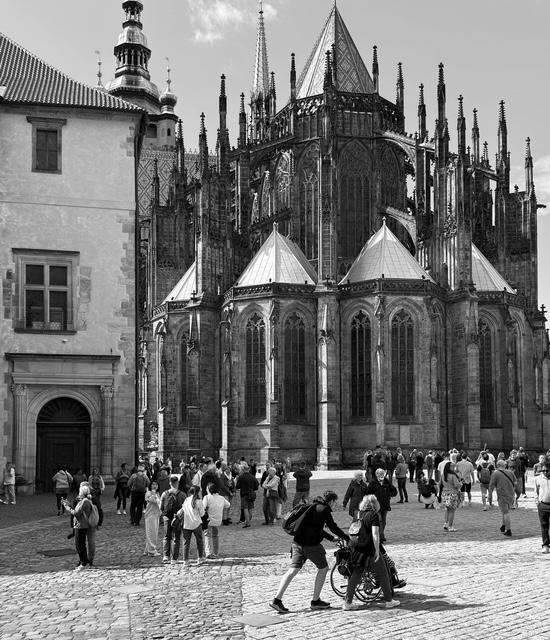
Mirka Krivankova
Mirka Krivankova is a very promising photographer from Mestec Kralove in the Czech Republic. The photographs on her website depict everything from the gorgeous Czech countryside, to wonderful and interesting portraits of people at work and at play, and even include some documenting of a concert or two. Her use of formalism combined with the natural lighting and shadows in her portraits is absolutely wonderful. The combination helps add interest to the already eye-catching surroundings of her subjects, as well as the subjects themselves, while also leading the viewer’s eye entirely throughout the photographs. Mirka has a strong portfolio, but she feels as though it could be stronger if she removed the concert photos. Currently, they are the first series of photographs you see when you enter her site, and because they look more like out-of-place snapshots, rather than photographs taken by a skilled photographer, it lowered her first impression of her work. With that being said, Mirka’s portfolio is becoming stronger and stronger by the day. As she has been writing this review, she has updated it several times with new photographs as well as re-organizing the ones she has into more comprehensive bodies of work. She seems to be constantly adding to her portfolio, and I look forward to following her work as it continues to evolve.
Resonance Score Breakdown
Transparency Note: The resonance score (5.8/20) is calculated based on social engagement metrics collected before the award announcement.
Expert Photography Reviews · 6
The Architecture of Echoes
History is not a book kept on a shelf, but a sediment that settles in the marrow of a city. We walk over cobblestones polished by the friction of centuries, unaware that our own footsteps are merely the latest layer of a long, rhythmic conversation between the earth and the sky.
Read the reflection →Shadows of the Stone
I spent this morning trying to find a misplaced key, turning over old books and shifting cushions until I felt like I was excavating my own living room.
Read the reflection →Reviews & Comments
Share your thoughts about this award-winning photograph. Your reviews contribute to the community engagement score.
The runner’s stride is caught mid-air, but it’s a fraction late. The lead leg has already begun its descent, losing the tension of the full extension. I’ve spent my life chasing that singular, weightless millisecond where the body defies gravity, and this isn’t it. It’s a decent record of a jog, but it lacks the explosive apex I’m looking for. I wanted to feel the snap of the calf muscle, but it’s just gone.
Of the thousands of street shots I’ve reviewed, most drown in the cathedral’s shadow. Mirka’s work succeeds because she ignores the architecture to capture the mundane rhythm of the sidewalk. It’s the way the light catches the pedestrian’s stride that makes me stop; it feels like a secret Prague kept just for her. I’d bet on this surviving thirty years because it’s about the life beneath the stone, not the stone itself. That’s rare.
Prague’s streets are a tourist’s playground, and it shows. One suspects this was captured during a casual stroll, likely between a coffee and a souvenir shop. It’s a pleasant enough snapshot, but it lacks the grit of a morning spent shivering against a stone wall. I’ve spent weeks waiting for light to hit those spires properly. This didn’t cost the photographer a sleepless night, and frankly, it’s all the poorer for it.
f/1.9 at 23mm on a mobile sensor. It’s a wide, flat compromise. The tiny aperture forces a deep depth of field that renders the cathedral’s intricate Gothic stone as mere texture. There’s no separation here. I’m tired of seeing such monumental architecture flattened by computational optics. It’s technically lazy. You’ve captured the scale, sure, but you’ve lost the soul of the masonry. I’d have preferred a real lens. It’s just a snapshot, really.
Prague’s Gothic weight presses down, yet the frame feels strangely hollow. Why does the iPhone lens flatten such deep history into a tourist’s casual glance? It’s a postcard view that ignores the people living in the shadow of those spires. I’ve walked these stones, and I feel a sharp, cold detachment here. Whose city are we actually seeing? Does the photographer care about the life beneath the architecture, or just the aesthetic of the landmark?
There’s a distance here that feels like a missed opportunity. You’ve captured the architecture beautifully, but the person in the frame feels like a prop rather than a participant. I don’t see the collaboration that turns a street shot into a portrait. It’s a shame, because that face has a whole life in it. I’d love to see you stop, introduce yourself, and let them choose how they want to be seen next time.