An Old Man from a Remote Village by Saniar Rahman Rahul
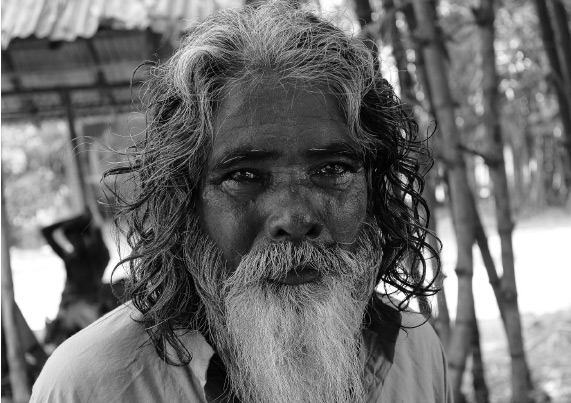
Captured in a remote village in the Nilphamari district of northern Bangladesh, this portrait documents an elderly man whose daily struggle for sustenance highlights the profound poverty of his community. The photographer utilized a 40mm focal length to maintain an intimate yet respectful distance, capturing the subject's weary expression amidst his conservative, impoverished surroundings. The image is award-worthy for its raw, empathetic portrayal of human resilience, transforming a fleeting encounter into a poignant narrative of hardship and dignity. Through careful composition and natural lighting, the photographer successfully bridges the gap between the viewer and the subject's challenging reality.
Saniar Rahman Rahul
Based in Dhaka, Bangladesh, Saniar Rahman Rahul is an accomplished Art Director at Grey Worldwide with a deep-rooted passion for visual storytelling. His journey into photography began during his childhood in Iraq, inspired by his father’s work, before he later refined his creative eye through a distinguished career in graphic design and advertising. Rahul’s extensive professional background in pre-press and advertising media informs his precise, narrative-driven approach to portraiture, earning him international recognition as a dedicated observer of the human condition.
Resonance Score Breakdown
Transparency Note: The resonance score (12.3/20) is calculated based on social engagement metrics collected before the award announcement.
Expert Photography Reviews · 7
The Map of Living
We often mistake the skin for a boundary, a wall that keeps the world out and the self in. But look closer at the hands that have held the plow, the eyes that have measured the rain, and you see that a life is not a container; it is a landscape.
Read the reflection →The Architecture of Survival
We often mistake the periphery for the unimportant. We look at the centers of power—the gleaming glass towers and the planned boulevards—and assume that is where the story of a nation is written.
Read the reflection →Reviews & Comments
Share your thoughts about this award-winning photograph. Your reviews contribute to the community engagement score.
The architecture here isn’t just a backdrop; it’s a weathered datum defining the man’s existence. That rough, textured wall acts as a threshold between his internal resilience and the harsh, unforgiving light of Nilphamari. I’m struck by how the fenestration—or lack thereof—compresses the space, forcing us to confront his reality. It’s a claustrophobic, honest frame. Honestly, looking at the way the light rakes across those deep, etched lines in his skin, I feel genuinely humbled.
Before the eye identifies the man, a sudden stillness pulls at the lungs. It’s the weight of those eyes—they don’t just look; they anchor you. I’ve returned to this portrait for years, and each time, the texture of his weathered skin triggers a phantom ache in my own hands. It’s not just poverty here; it’s the quiet, heavy endurance of a life lived in the margins. I find myself holding my breath, waiting for him to speak.
Does this man’s weary gaze belong to him, or is it a prop for our consumption? Rahul’s 40mm lens pulls us close, yet I feel a cold distance. Why does the poverty of Nilphamari look so curated here? It’s unsettling how we trade his struggle for aesthetic dignity. I find myself wanting to look away, not because of his hardship, but because of the photographer’s intrusion. Whose narrative are we actually framing in this dusty, quiet village?
Shadows here don’t merely define the face; they carve out the man’s exhaustion. It’s a heavy, tectonic darkness that swallows the background, forcing us to confront the gravity of his gaze. I’ve stared at these deep, ink-stained creases for an hour, and I feel a sudden, sharp ache in my own chest. Rahul doesn’t just document poverty; he lets the light fail, proving that true dignity is found only where the sun refuses to reach.
The shutter clicks, and time stops dead. It’s a wide 40mm gaze, intimate enough to feel the grit of Nilphamari on his skin. The light hits his weary face like a key light on a dying set. I’ve seen a thousand portraits, but this one holds. It’s the frame the editor keeps because the silence is deafening. I honestly felt my breath hitch. He’s not just surviving; he’s anchoring the entire scene. A perfect, frozen cut.
At 1/60th of a second, Rahul’s portrait sits in a frustrating limbo. It’s neither sharp enough to document the grit of Nilphamari nor blurred enough to evoke the man’s internal fatigue. I’m left wanting more—either a clinical, razor-sharp study of his skin or a radical, motion-blurred abstraction of his struggle. Why choose this middle ground? It’s a safe, conventional choice that misses the chance to turn his weary expression into something truly visceral.
At f/5.6, the 40mm focal plane renders the man’s skin texture with clinical precision, yet the diffraction limit remains mercifully soft. It’s the way the light catches the deep, weathered furrows of his brow that hits me; I’ve rarely seen such raw biological topography captured so honestly. The lens doesn’t just resolve his poverty; it maps the very history etched into his face. It’s a hauntingly beautiful intersection of glass, sensor, and human endurance.