An Ancient Temple by Fabrizio Bues
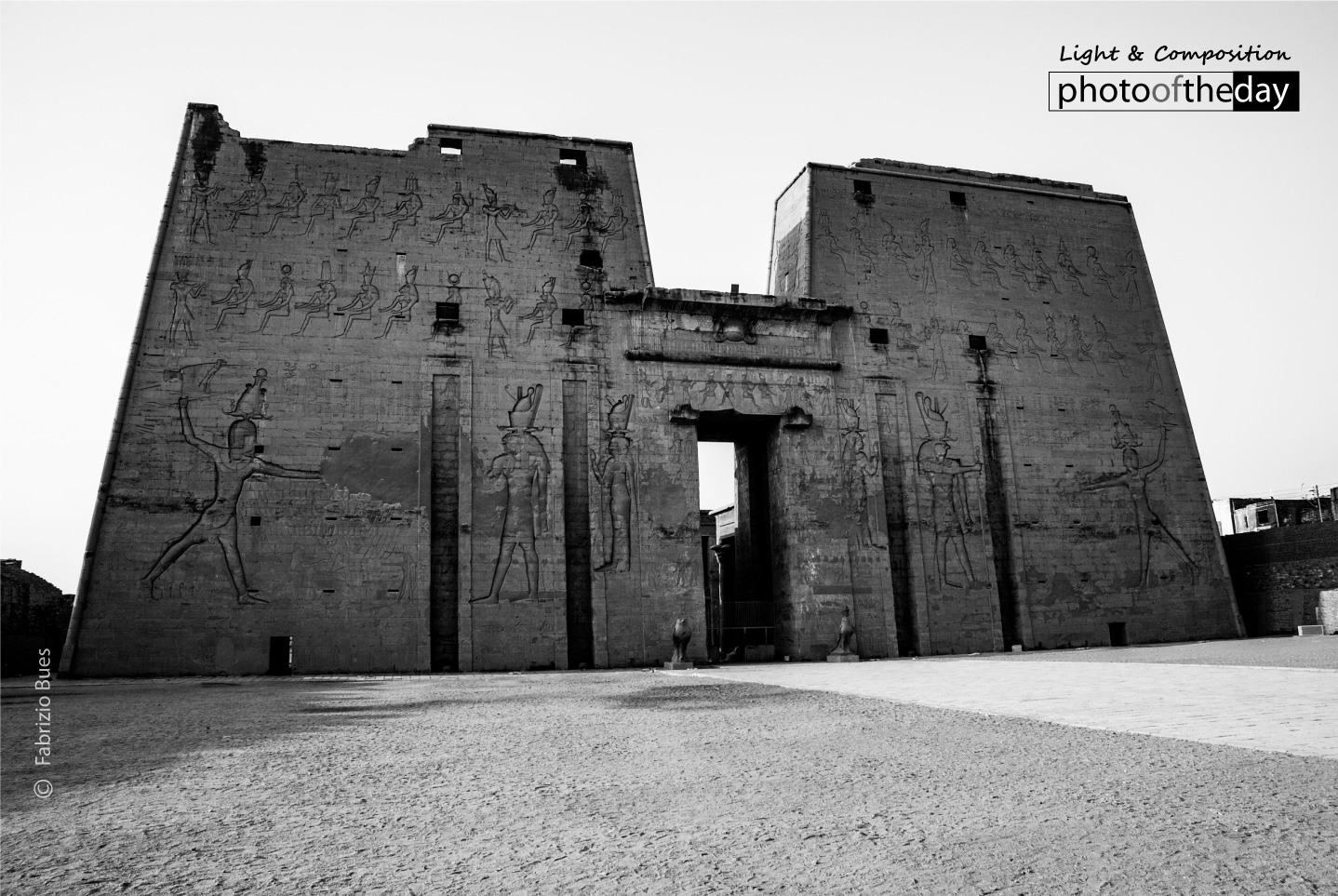
Captured along the banks of the Nile, this photograph highlights a remarkably well-preserved ancient temple. The image focuses on the intricate hieroglyphs etched into the stone walls, which serve as a silent testament to a civilization defined by both martial power and a profound commitment to art and education. By framing these historic carvings against the backdrop of the river, the photographer emphasizes the enduring legacy of an ancient people. The work is award-worthy for its ability to transform archaeological detail into a compelling narrative, inviting viewers to contemplate the intersection of history, culture, and the passage of time.
Fabrizio Bues
Born in Turin, Italy, in 1972, Fabrizio Bues balances a professional career as a Project Manager for an American corporation with a deep-seated passion for photography. His work is heavily influenced by his frequent international travels, which provide him with unique opportunities to document global landscapes and architectural wonders. Dedicated to refining his craft through continuous learning, Bues strives to elevate his technical proficiency and artistic vision, consistently seeking to capture the historical essence of the locations he visits with his Nikon camera.
Resonance Score Breakdown
Transparency Note: The resonance score (11.1/20) is calculated based on social engagement metrics collected before the award announcement.
Expert Photography Reviews · 8
Echoes in the Stone
We often mistake permanence for something that stands still, yet the true nature of time is a slow, rhythmic flowing. Think of the river that carves the canyon, or the wind that softens the sharp edge of a mountain.
Read the reflection →Whispers in the Stone
I once sat with an old stonemason in a village outside of Florence who spent his days repairing walls that had stood for centuries. He told me that he never felt like he was building anything new; he was just holding a conversation with the people who had come before him.
Read the reflection →Reviews & Comments
Share your thoughts about this award-winning photograph. Your reviews contribute to the community engagement score.
Stone walls don’t breathe, and they certainly don’t offer consent. While these hieroglyphs are beautifully lit, I find myself searching for a pulse that isn’t there. It’s a technically sound study of rock, but it lacks the vulnerability I crave. I’ve spent my life chasing the flicker of a soul in a stranger’s eyes, and looking at this, I feel a strange, hollow loneliness. It’s a quiet, cold room where nobody is home to greet me.
We look at these stone carvings and we aren’t just seeing ruins; we’re meeting the ancestors. Fabrizio Bues listened to the silence of the Nile before he clicked the shutter. He’s captured the hands that chiseled these stories, making the rock feel like skin. It’s haunting how the river flows behind them, indifferent to our brief lives. I’ve felt a shiver looking at this. It’s a portrait of a civilization that refuses to be forgotten.
Stone meets river. The hieroglyphs aren’t just carvings; they’re breath held in granite. I’ve spent minutes watching the light slide across the textured wall. It’s quiet here. The Nile doesn’t rush. It waits. I feel a sudden, sharp ache for the hands that chiseled this silence. Nothing here is accidental. The empty corner is not empty. It’s the weight of centuries, resting. It’s enough. It’s everything.
The light here is far too even. It’s the sort of flat, midday exposure one gets when they’ve arrived by tour bus rather than by dawn. I’ve spent enough mornings shivering against Egyptian stone to know that the hieroglyphs deserve more than this sterile, clinical treatment. It’s a decent record, I suppose, but it lacks the grit of a long wait. One wonders if the photographer ever bothered to return when the sun actually cared.
You’ve captured the stone’s texture so well I can almost feel the grit under my own fingernails. It’s a quiet frame, but there’s a weight to it that makes me stop. Because you didn’t just document a wall; you caught the way the Nile’s light hits those carvings, making the past feel restless. I’ve stood in places like this, and you’ve managed to make the silence feel heavy. You waited. I can feel it.
The sun hasn’t yet scorched the stone, leaving the hieroglyphs in a soft, forgiving relief. Fabrizio waited for that precise, cooling hour when the Nile’s breath softens the harsh Egyptian glare. I’ve stood in such heat, and I can feel the grit of the desert against his skin. It’s a quiet, heavy stillness. When I look at these carvings, I don’t just see history; I feel the ancient, rhythmic pulse of the river itself. It’s haunting.
The focal plane here is razor-thin, capturing the micro-texture of sandstone with startling clarity. By avoiding the diffraction limit, Bues has resolved the hieroglyphs with a precision that makes the stone feel tactile. I’m genuinely moved by how the light catches those jagged edges; it’s as if the lens is peeling back millennia of erosion. It’s rare to see such optical discipline, where the glass doesn’t just record history, but physically articulates the ancient grain itself.
The temple’s vertical axis creates a rigid 1:2 ratio against the Nile’s horizontal plane. I’m captivated by how the hieroglyphs disrupt the stone’s mass, forcing the eye into a rhythmic, repeating sequence. It’s a perfect spatial equation; the carvings act as vectors, pulling focus toward the negative space of the river. It’s mathematically precise, yet it’s the way the light softens those sharp, etched edges that truly moves me. A beautifully solved geometric problem.