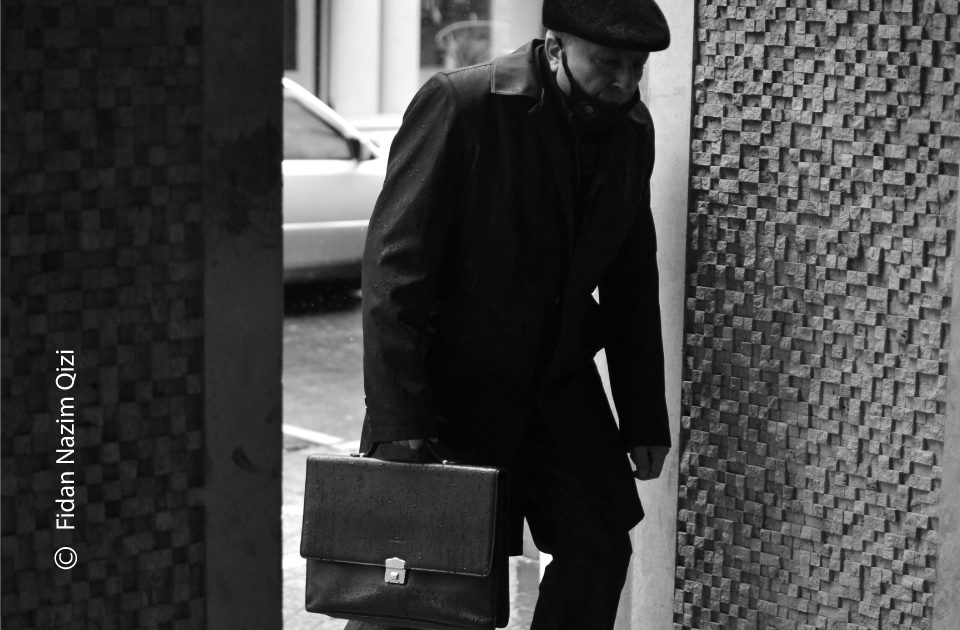
A Rainy Day by Fidan Nazim Qizi
Captured during a downpour, A Rainy Day explores the intersection of human urgency and atmospheric beauty. The photographer observed the city's inhabitants as they hurried to escape the elements, finding a compelling irony in their frantic movements against the backdrop of heavy rain. By focusing on the contrast between the chaotic rush of the crowd and the stillness of the falling water, the image transforms a mundane commute into a poignant narrative. This photograph is award-worthy for its keen ability to find aesthetic grace in a fleeting, everyday moment, elevating a simple urban scene into a striking study of human behavior.
Fidan Nazim Qizi
Born in Baku, Azerbaijan, Fidan Nazim Qizi maintains a deep connection to her home city while frequently traveling to explore diverse landscapes. Her photographic journey was ignited by the evocative work of Vivian Maier, which inspired her to master the black and white medium. A passionate hiker and nature enthusiast, she views photography as a vital source of energy and inspiration. Her work reflects a commitment to capturing authentic human feelings, constantly seeking to translate the world's beauty into compelling visual stories.
Resonance Score Breakdown
Transparency Note: The resonance score (6.9/20) is calculated based on social engagement metrics collected before the award announcement.
Expert Photography Reviews · 7
The Geometry of Shelter
There is a peculiar geometry to how we navigate a sudden downpour. We become smaller, pulling our shoulders toward our ears, tucking our chins into the warmth of our own collars. It is a universal instinct, this folding of the self against the sky’s sudden insistence.
Read the reflection →The Weight of Grey Rain
There is a specific, heavy grey that arrives when the sky loses its capacity to hold water. It is not the sharp, clean grey of a winter storm, but a thick, muted tone that presses against the windows and turns the streets into mirrors of slate.
Read the reflection →Reviews & Comments
Share your thoughts about this award-winning photograph. Your reviews contribute to the community engagement score.
The shutter speed freezes the downpour into a thousand silver needles. It’s a frantic, kinetic sequence caught in a single blink. I love how the 35mm lens keeps the chaos intimate, turning a Baku commute into a desperate chase scene. The motion blur would’ve ruined the tension; instead, the sharp focus on the rain makes the urgency feel heavy, almost tactile. It’s the frame the editor keeps because it’s where the story finally stops breathing.
At f/1.8, the focal plane is razor-thin, isolating the rain’s trajectory against the urban blur. The Nikon’s sensor struggles with the ISO 800 noise, yet it’s precisely this grain that renders the water droplets as tangible, suspended light. I’m genuinely moved by how the lens resolves those chaotic streaks into a coherent, rhythmic geometry. It’s a rare instance where the diffraction limit doesn’t stifle the scene, but instead grants the falling rain a haunting, ethereal weight.
The frame operates on a strict 1:2 vertical division, where the blurred rain vectors intersect the sharp, static architecture of Baku. It’s a compelling spatial equation; the crowd’s chaotic kinetic energy occupies the lower-left quadrant, perfectly balanced by the heavy, dark negative space above. I’m genuinely thrilled by how the 35mm focal length compresses these distances. It’s not just a commute; it’s a precise calculation of movement against a rigid, geometric grid. A beautifully solved problem.
It’s easy to snap a shutter when the sky opens up, but capturing the rhythm of a Baku downpour requires more than just a dry coat. One suspects Fidan stood there until the cold seeped into her bones, waiting for the crowd’s frantic geometry to align. I’ve spent enough hours shivering in similar rain to appreciate the patience here. It’s a decent study of human urgency, though I’d have preferred a bit more grit in the shadows.
The rain here isn’t just weather; it’s a textured veil, blurring the sharp lines of Baku’s architecture into a soft, impressionistic charcoal wash. I love how the slick pavement reflects the city’s frantic energy, grounding the subjects in their cold, wet reality. The environment dictates their posture—shoulders hunched, heads bowed. It’s a beautiful, rhythmic struggle. Without this deluge, we’d lose the urgency that defines them. It’s not just a commute; it’s a dance with the elements.
Rain blurs Baku’s streets, yet I’m troubled by the distance here. Why does the photographer treat these commuters as mere aesthetic props against the downpour? It’s a classic framing, but it feels detached, almost voyeuristic. Does the urgency belong to the subjects, or is it imposed by the lens? I find myself wanting to know who these people are, not just how they look in the grey light. Is beauty worth the cost of their anonymity?
Baku’s stone facades usually demand a rigid, static reading, but here, the rain dissolves that permanence. The fenestration becomes a blurred rhythm, softening the harsh datum of the street. I’m struck by how the downpour turns the solid urban mass into a fluid, shifting void. It’s a rare, honest look at how weather redefines our thresholds. I’ve walked these streets, and honestly, the way the light catches the slick pavement makes me miss the city’s cold, damp embrace.