A Horseman by Ilyas Yilmaz
During the extraordinary winter snowfall of 2022 in Gaziantep, the city came to a standstill as roads were buried and transportation paralyzed. While walking toward the market, the photographer encountered a striking scene: a lone horseman navigating the desolate, snow-covered landscape. This moment of quiet resilience amidst the chaos of a paralyzed city highlights the photographer's keen eye for contrast and narrative. The image is award-worthy for its ability to transform a challenging weather event into a timeless, evocative portrait of life continuing against the backdrop of nature's overwhelming force.
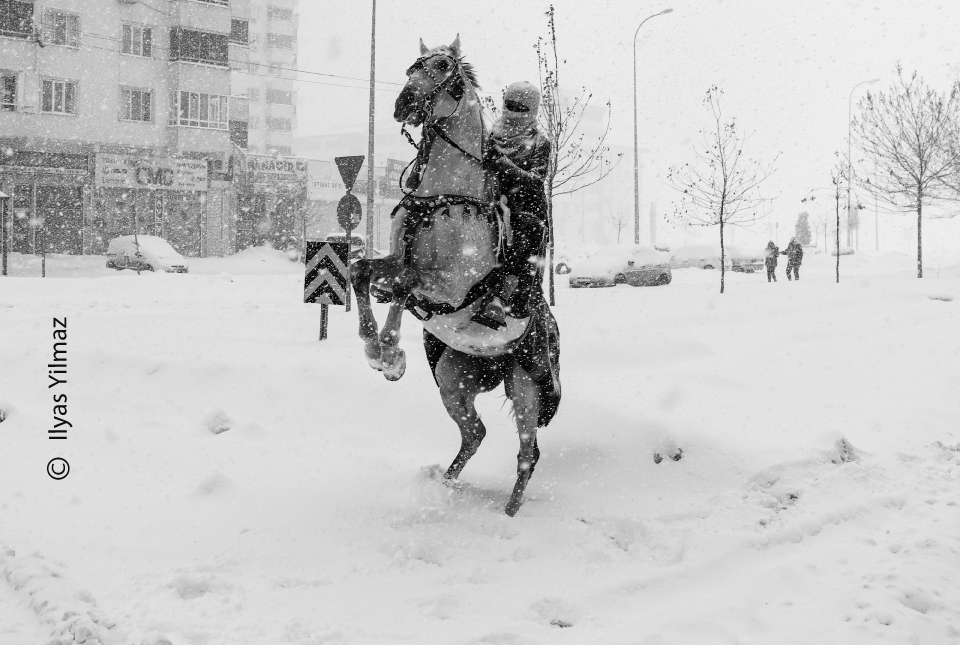
Exposure 1/800sec @ f/5.6 | ISO 100 | Focal Length 18mm
Ilyas Yilmaz
Ilyas Yilmaz is a dedicated teacher and photographer based in Gaziantep, Turkey. Utilizing a versatile kit that includes the Canon 250D alongside various lenses such as the 18-55mm and 24mm pancake, he captures compelling moments that reflect his surroundings. His work is driven by a profound passion for storytelling, aiming to evoke deep emotions and convey the human experience through his artistic lens.
Resonance Score Breakdown
Transparency Note: The resonance score (7.9/20) is calculated based on social engagement metrics collected before the award announcement.
Expert Photography Reviews · 8
The Unmapped Path
Cities are often defined by their infrastructure—the rigid grids, the asphalt arteries, and the transit lines that dictate how we move from one point to another.
Read the reflection →The Path Through Silence
I keep a small, rusted iron key in my desk drawer that no longer fits any lock I own. It is heavy, cold to the touch, and carries the faint, metallic scent of a house that has long since been reclaimed by the weeds.
Read the reflection →Reviews & Comments
Share your thoughts about this award-winning photograph. Your reviews contribute to the community engagement score.

Stripped of chromatic distraction, one finds the silvered greys of this Gaziantep winter possess a haunting, Morandi-esque restraint, where the horseman’s silhouette cuts through the frozen air like charcoal dragged across vellum. It’s a shivering, monochromatic ache that I’ve felt in my own bones; the way the light bleeds into the snow creates a tactile, velvet silence that makes me want to reach out and touch the cold, breathless stillness of that singular, lonely journey.
The horse is mid-stride, but the timing is off. You want the moment of maximum extension, where the lead hoof bites the snow and the muscles ripple under tension. Instead, the legs are bunched, caught in a transition that lacks the explosive grace of a gallop. It’s a decent shot, but it’s not the peak. I’ve spent my life chasing that perfect millisecond; this one just misses the mark of true athletic power.
It’s a strange shift for me to look at land, where light doesn’t vanish into the blue. I’m used to fighting the refractive index of water, where red light is stolen within meters. Here, the stark monochrome of Gaziantep’s snow feels like a deep-sea abyss, devoid of backscatter. I find myself holding my breath, waiting for the horseman to drift into the current. It’s hauntingly still—a rare, quiet clarity I rarely find beneath the waves.
Before the eye identifies the horseman, a sudden chill settles in the chest. It’s the silence of the snow, that heavy, muffling weight that forces your breath to shallow. I feel a strange, phantom ache in my own shoulders looking at his posture. When I return to this a year later, the isolation doesn’t feel lonely; it feels like endurance. It’s the quiet rhythm of a heartbeat persisting against a world that’s gone completely still.
1/800sec at f/5.6, 18mm. The shutter speed is overkill for a walking horse, but it freezes the falling snow effectively. At 18mm, the distortion is managed well enough. It’s a safe, clinical choice that keeps the focus sharp across the frame. I’ve seen enough blurry snow shots to appreciate the discipline here. The technical execution is sound, even if the kit lens lacks the micro-contrast I’d prefer. It’s a competent, cold, and calculated capture.
At 18mm, the Canon’s glass struggles with the diffraction limit, yet it captures the horseman’s silhouette with surprising clarity. The f/5.6 aperture keeps the focal plane wide enough to render the falling snow as soft, atmospheric noise rather than distracting artifacts. I’m genuinely moved by how the high-contrast monochrome isolates the rider against that vast, frozen void. It’s a rare moment where the lens’s inherent limitations actually enhance the stark, biting reality of the winter air.
It’s a haunting frame, but I can’t help but wonder about the horse. That animal is navigating deep, frozen drifts while the photographer stands by with an 18mm lens. Was the horseman stopped for a portrait, or was he forced to keep moving through the biting cold for the sake of the composition? I feel a sharp chill looking at the beast’s fatigue. If that proximity was forced, the aesthetic success doesn’t justify the animal’s exhaustion.
The horseman moves through a silence that feels older than the stones of Aspendos. At 1/800sec, Yilmaz has frozen a fleeting human breath against the vast, indifferent cold of a winter storm. I’ve spent my life chasing photons that traveled eons to reach my lens, yet here, the stillness is just as profound. It’s a quiet reminder that we’re all just passing through the dark. Honestly, it makes my own heart ache a little.