A Fruit of Abelmosk by Siew Bee Lim
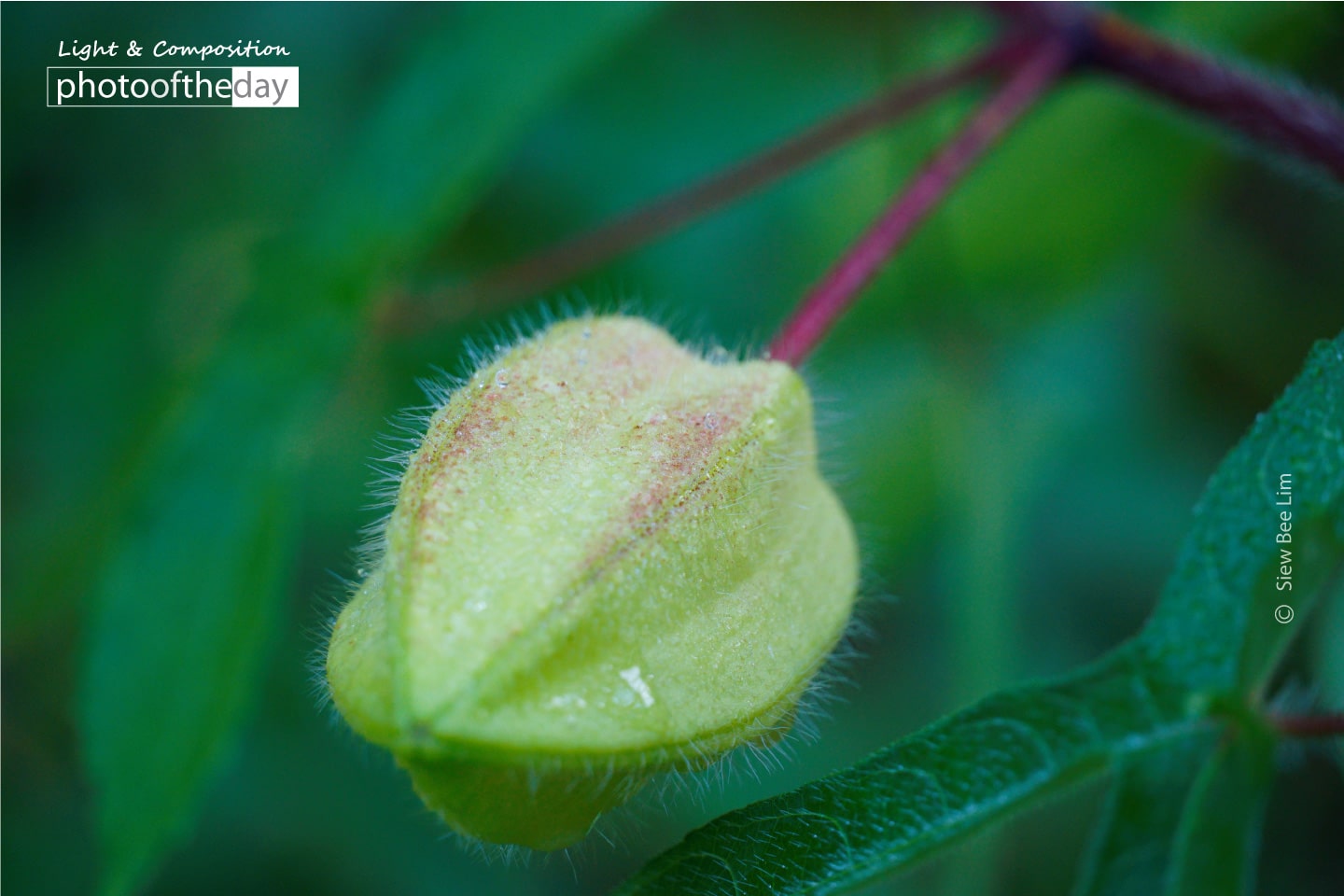
Captured in the soft light of an early February morning, this close-up study of an Abelmosk fruit highlights the intricate textures of nature. The photographer meticulously framed the subject to emphasize its unique star-shaped geometry, while delicate beads of morning dew cling to the vibrant red stem and ripening skin. By focusing on the interplay of light and moisture, the image reveals a hidden dimension in botanical forms. This photograph is award-worthy for its technical precision and the photographer's ability to transform a simple garden specimen into a compelling, tactile exploration of natural beauty.
Siew Bee Lim
Born in 1965 in Singapore, Siew Bee Lim is a dedicated photographer who balances a professional background in programming with a growing passion for the visual arts. Though she initially explored photography as a young adult, her journey has evolved into a formal pursuit of excellence through the Light & Composition platform. Drawing inspiration from a lifelong appreciation for Chinese painting and a keen eye for natural detail, she continues to refine her technical skills and artistic vision, proving that it is never too late to master the craft.
Resonance Score Breakdown
Transparency Note: The resonance score (11.6/20) is calculated based on social engagement metrics collected before the award announcement.
Expert Photography Reviews · 3
The Architecture of Small Things
I often find myself wandering the back alleys of the mind, looking for the places where the city’s frantic pulse slows down to a rhythmic hum.
Read the reflection →The Geometry of Being
Seneca once observed that nature does not hide her secrets, but rather waits for the patient observer to notice them. We often rush through our days, convinced that the significant events of our lives must be loud, grand, or transformative.
Read the reflection →Reviews & Comments
Share your thoughts about this award-winning photograph. Your reviews contribute to the community engagement score.
The star-shaped geometry anchors the frame with necessary rigor. It’s a disciplined study of mass, where the red stem acts as a vertical fulcrum against the ripening skin. The dew isn’t mere decoration; it provides essential tonal contrast. I’ve grown tired of botanical sentimentality, yet the spatial tension here holds. It doesn’t collapse into chaos. The composition demands attention because it refuses to be soft. It’s a rare instance where structure finally outweighs the subject.
You waited for the light to hit those dew drops just right, didn’t you? It’s quiet work, standing there in the morning damp while the world wakes up. I’ve spent enough time in the field to know that patience isn’t just a technical choice; it’s a form of respect. Because you slowed down, I can feel the stillness of that garden. There’s something honest happening here. You didn’t just document a fruit; you felt the morning.
The Abelmosk’s pentagonal symmetry anchors the frame, creating a perfect radial balance that draws the eye inward. I’m struck by how the stem’s diagonal vector bisects the negative space, establishing a precise 1:3 ratio against the blurred background. It’s a beautifully solved spatial equation. The dew droplets act as micro-lenses, repeating the primary form in miniature. I’ve rarely seen such rigid botanical geometry rendered with this much tactile grace. It’s a triumph of structural clarity.