A Dockyard Worker by Shahnaz Parvin
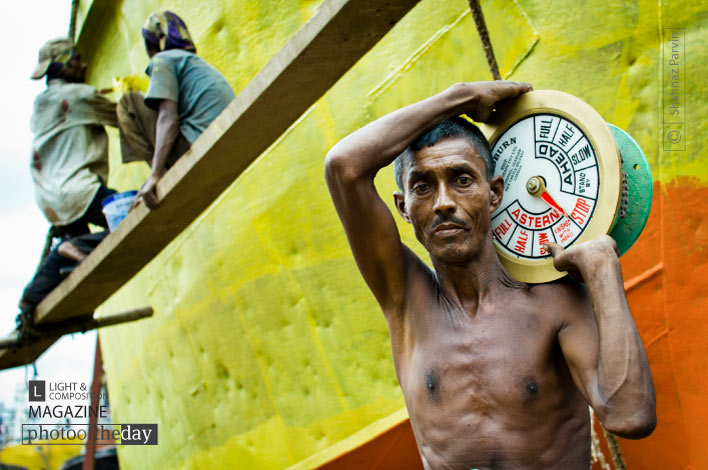
This poignant portrait captures Abdur Razzak, a 38-year-old dockyard worker in Keraniganj, Dhaka. The photographer masterfully documents the quiet struggle of a man who left his family in the village to labor in the capital, sending nearly all his earnings home. By focusing on Razzak’s weary expression, the image highlights the anonymity of the millions fighting for survival in urban centers. The photograph is award-worthy for its raw, empathetic portrayal of the human condition, transforming a solitary worker into a powerful symbol of resilience, sacrifice, and the often-unseen labor that sustains a nation.
Shahnaz Parvin
Based in Dhaka, Bangladesh, Shahnaz Parvin was a celebrated photojournalist and a passionate documentarian of her nation's culture and people. Recognized as one of the world's top photographers during her career, she gained international acclaim for her evocative coverage of conflict, social upheaval, and daily life. As a prolific contributor to Light & Composition, she left a lasting legacy through her dedication to visual storytelling before her untimely passing in 2016.
Resonance Score Breakdown
Transparency Note: The resonance score (13.0/20) is calculated based on social engagement metrics collected before the award announcement.
Expert Photography Reviews · 5
The Weight of Quiet
I was standing in the grocery store line this morning, watching the man in front of me count out his coins. He was methodical, his hands moving with a kind of practiced, heavy patience.
Read the reflection →The Weight of Elsewhere
In the quiet hours before dawn, the house holds a particular kind of silence. It is not an empty silence, but one filled with the heavy, invisible gravity of things left behind.
Read the reflection →Reviews & Comments
Share your thoughts about this award-winning photograph. Your reviews contribute to the community engagement score.
The subject’s placement within the frame creates a necessary, rigid geometry. The vertical lines of the dockyard structure anchor the composition, providing a counterweight to the worker’s weary gaze. It’s a disciplined arrangement of mass. The negative space doesn’t distract; it isolates. I’ve rarely seen such stark spatial tension held so firmly. The frame doesn’t collapse under the weight of the subject’s fatigue. It’s a precise, architectural success that demands respect for its structural integrity.
Abdur Razzak’s face isn’t merely illuminated; it’s carved from the Keraniganj gloom. The shadows here don’t hide his exhaustion—they define it, acting as the heavy, silent architecture of his displacement. I’ve stared at these eyes until my own ache, feeling the crushing weight of the labor he carries. It’s a brutal, honest geometry. When light refuses to soften the skin, we finally see the man. It’s not a portrait; it’s a confrontation with existence itself.
The dockyard air hangs heavy. Abdur Razzak sits. He doesn’t look at the lens. He looks at the space between the rust and the river. It’s a quiet ache. I’ve spent minutes staring at the blurred metal behind his shoulder. It’s not just background. It’s the weight of his distance from home. Nothing here is accidental. The empty corner is not empty. It’s where his silence lives. I feel a sudden, sharp chill.
At f/4.5, the Sigma 30mm resolves the micro-contrast of Razzak’s skin with startling fidelity. The focal plane sits precisely on his weary eyes, capturing the diffraction of light across the fine dust particles clinging to his pores. It’s a rare moment where the lens’s resolution exceeds our own biological capacity to perceive such exhaustion. Honestly, the way the bokeh renders the dockyard’s chaos into soft, chromatic gradients makes me ache for his quiet, unseen sacrifice.
Of the thousands of portraits I’ve reviewed, most fade because they rely on pity. This doesn’t. The grit on Abdur Razzak’s skin isn’t just texture; it’s a map of his displacement. I’ve stared at his eyes for ten minutes, and I still feel that ache of a man living between two worlds. It’s the unflinching focus on his exhaustion that secures his legacy. In thirty years, we won’t remember the dockyard, but we’ll remember him.