A bug’s POV by Ruben Alexander
Captured at the Republic Day Flower Show in Bangalore’s Lalbagh Botanical Gardens, this macro photograph invites viewers into an unexplored, miniature world. By utilizing a 50mm prime lens in a reverse mount, the photographer achieved a unique, intimate perspective that mimics the vision of a tiny insect. This technical challenge—locking the aperture at f/8.0 without electronic communication—demands immense patience and precision. The resulting image is award-worthy for its ability to transform the mundane into the extraordinary, showcasing the hidden beauty of nature through a creative, experimental lens that highlights the photographer’s dedication to mastering complex macro techniques.
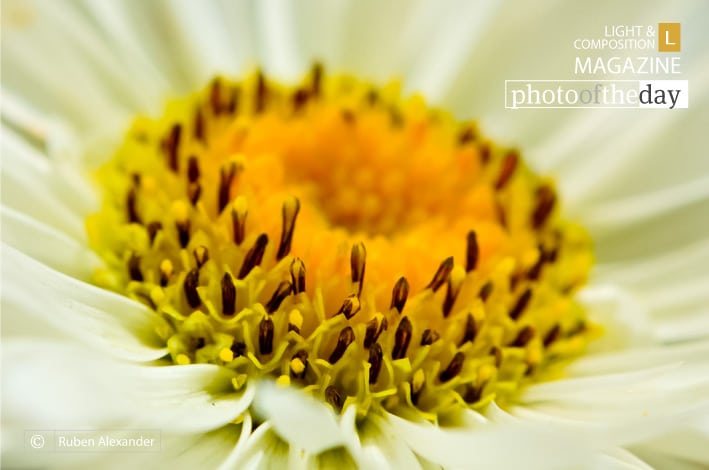
Exposure 1/160sec @ f/8 | ISO 100 | Focal Length 50mm
Ruben Alexander
Based in Bangalore, India, Ruben Alexander balances a professional career in the IT industry with a passionate pursuit of photography. As a self-taught artist, he views the camera as a vital outlet for creativity and a therapeutic escape from his technical day-to-day work. His portfolio focuses primarily on nature and macro photography, though he is actively expanding his expertise into landscape, portrait, travel, and street genres as he continues his artistic journey.
Resonance Score Breakdown
Transparency Note: The resonance score (13.4/20) is calculated based on social engagement metrics collected before the award announcement.
Expert Photography Reviews · 5
The Velvet Underneath
The smell of damp earth after a sudden monsoon downpour always brings me back to the garden floor. If you press your cheek against the soil, you can feel the cool, gritty pulse of the world beneath your skin.
Read the reflection →The Architecture of the Unseen
We walk through the world with our heads held high, measuring life by the height of the trees and the breadth of the horizon, rarely considering the empires that thrive beneath our heavy tread.
Read the reflection →Reviews & Comments
Share your thoughts about this award-winning photograph. Your reviews contribute to the community engagement score.
Reverse-mounting a fifty-millimeter prime is a tedious, fiddly business that usually results in nothing but frustration and a sore back. One suspects Alexander spent a fair bit of time belly-down in the dirt at Lalbagh, wrestling with manual focus while the light shifted. It’s a stubborn piece of work, and I’ve a begrudging respect for anyone willing to endure such mechanical misery. He didn’t just find this; he clearly earned every bit of it.
The verdant, chlorophyll-drenched saturation here evokes a Morandi-esque stillness, where the lime-tinted veins of the petal pulse against a shadow of bruised, deep-sea indigo. It’s a chromatic fever dream that makes one’s breath hitch; I’ve rarely seen such a visceral, humid intimacy in macro work. The way those golden, pollen-dusted highlights catch the light—it’s like watching a Turner sunrise trapped within a microscopic, dew-slicked cathedral of organic, pulsing, and utterly breathless botanical wonder.
To look at this is to shrink oneself. I’ve spent hours waiting for the light to settle, but Ruben found a cathedral in a petal. He stood in the humid heat of Lalbagh, manually coaxing focus from a stubborn lens. It’s quiet work, isn’t it? I feel a sudden, sharp ache of humility seeing such vastness in a tiny bloom. He didn’t just take a picture; he listened to the garden until it finally whispered its secrets.
Most macro work I’ve seen this year is just clinical documentation, but this shot actually pulls me into the dirt. By reverse-mounting that 50mm, Alexander forced a perspective that feels genuinely alien. It’s the depth of field that wins me over; that razor-thin focus on the petal’s texture makes me feel small in the best way. It’s a rare, tactile piece of work I’ll still be thinking about in thirty years. It’s simply honest.
Macro photography often feels like a parlor trick, yet here, the darkness between the petals isn’t mere negative space. It’s a suffocating, velvet void that forces the eye to confront the fragility of the bloom. I’ve spent hours staring into that blackness, and it’s unsettling—it doesn’t invite, it demands. Alexander has captured the terror of the infinitesimal. When we look this closely, we aren’t seeing nature; we’re seeing the silence that eventually swallows us all.
Gut art…