Navigating Lifes Crossroads by Wilfried Claus
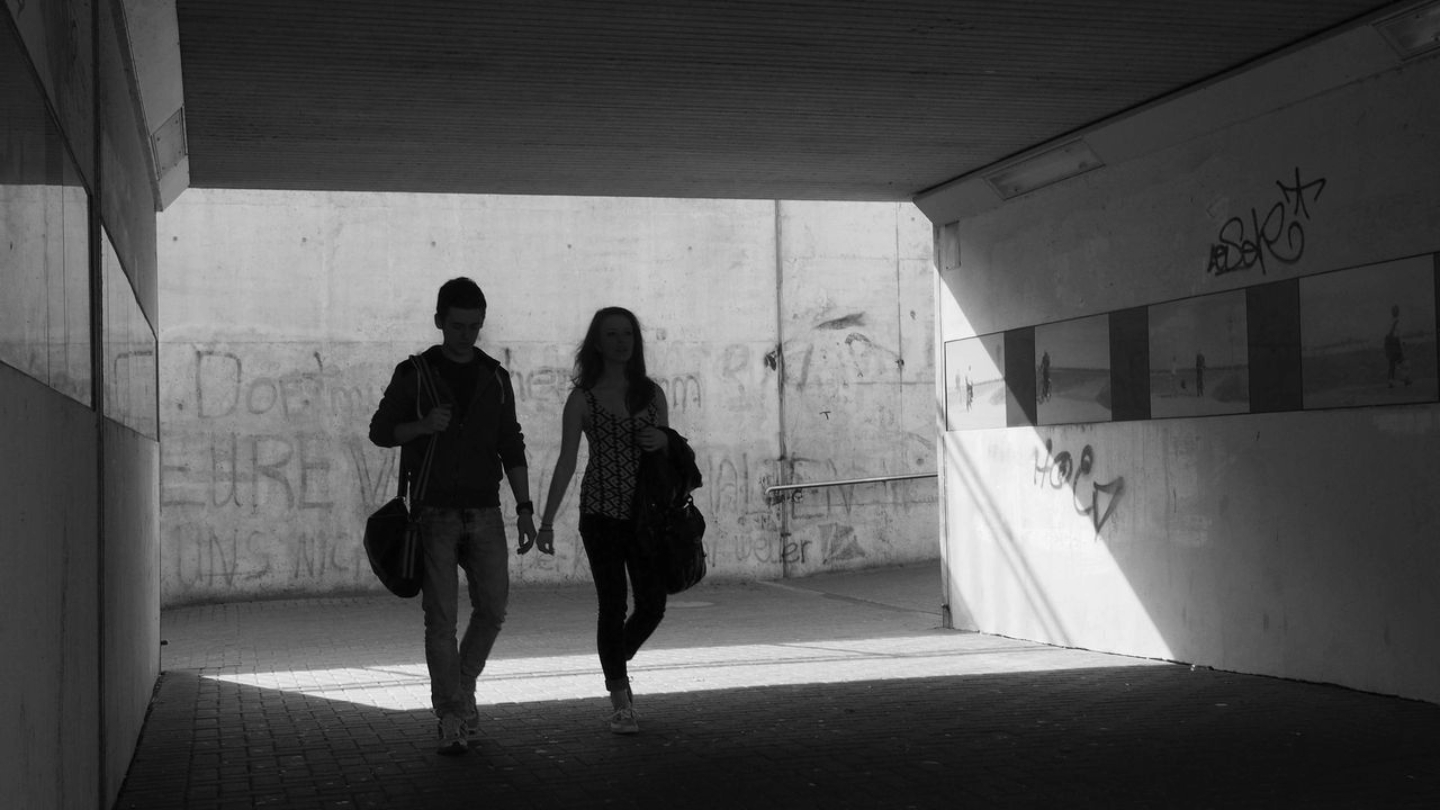
In the pedestrian tunnel of the Pulheim station, Wilfried Claus captures a fleeting, ambiguous moment as a young couple passes by, their hands nearly touching. The photographer masterfully utilizes the tunnel's shadows to render the subjects as silhouettes, creating a striking visual parallel to the art installation by Sigrid Lange that adorns the walls. This composition elevates a mundane transit space into a narrative of human connection and coincidence. The image is award-worthy for its keen observation of light and geometry, transforming an ordinary urban commute into a poetic, cinematic encounter that invites the viewer to wonder about the story unfolding between the two figures.
Wilfried Claus
Born in Cologne in 1947, Wilfried Claus transitioned from a dedicated career as a teacher and headmaster to a life of creative exploration following his retirement in 2009. He has since established a professional studio and diversified his portfolio, ranging from intimate portraiture and architectural documentation of historic manor houses to the dynamic world of theatre photography. His work is deeply rooted in his local community, often intersecting with art exhibitions and cultural projects, reflecting a lifelong commitment to capturing the human experience through a refined, technical lens.
Resonance Score Breakdown
Transparency Note: The resonance score (7.1/20) is calculated based on social engagement metrics collected before the award announcement.
Expert Photography Reviews · 6
The Architecture of Near Misses
I often find myself standing on the platform at Gare du Nord or waiting for the last tram in Lisbon, watching the way strangers navigate the narrow geography of a public space.
Read the reflection →The Space Between Us
I was walking through the subway station this morning, clutching my bag and checking my watch, when I saw two people standing near the stairs. They weren't talking, and they weren't touching, but there was a strange, magnetic tension in the way they stood.
Read the reflection →Reviews & Comments
Share your thoughts about this award-winning photograph. Your reviews contribute to the community engagement score.
Stripped of chromatic warmth, this tunnel’s grayscale palette achieves a Morandi-esque austerity, where the absence of hue forces one to confront the heavy, velvet charcoal of the shadows. It’s a haunting, monochromatic ache; I’ve found myself shivering at the way the light bleeds into the concrete, turning the couple’s silhouettes into ghosts of graphite. One doesn’t miss the colour when the tonal range is this precise, this cold, this utterly, devastatingly quiet in its transit.
The tunnel’s rigid geometry and Sigrid Lange’s rhythmic wall patterns dictate the pace here, forcing the eye to dance along the concrete before finding the couple. It’s a cold, industrial stage, yet the way the light carves their silhouettes against the mural makes their near-touching hands feel electric. I’m genuinely moved by how the architecture traps them in this fleeting, lonely transit. They aren’t just passing through; they are part of the tunnel’s own quiet, structural heartbeat.
The tunnel’s vanishing point anchors the frame, creating a rigid 1:1 symmetry that forces the eye toward the center. The silhouettes function as variables in a linear equation, their proximity disrupting the wall’s rhythmic, geometric patterns. It’s a precise calculation of negative space against the repetitive verticality of the installation. I’m genuinely struck by how the couple’s slight tilt breaks the rigid grid. It’s a perfect, elegant solution to the problem of static urban architecture.
Before the eye identifies the tunnel, a sudden stillness settles in the chest. It’s the tension of that near-touch, a suspended gravity that makes me catch my breath. I’ve seen this silhouette a dozen times, yet it still pulls at my own buried memories of missed connections. When you return to it, the shadows feel heavier, more permanent. It’s not just a transit space; it’s the ache of a choice you didn’t know you were making.
Why resolve the couple’s faces when the tunnel’s geometry already dictates their isolation? Claus treats the station like a stage, echoing Sugimoto’s long-exposure voids rather than chasing street-photography clarity. I’m genuinely moved by how he lets the shadows swallow their features, turning a mundane commute into a Rorschach test of human connection. It’s a brave refusal to over-explain. Why demand sharpness when the blur of their near-touching hands tells the entire story?
These two are ghosts in a tunnel, silhouettes defined by geometry rather than humanity. I don’t see a gift here; I see a photographer waiting for a shape to pass through his frame. It’s technically sharp, sure, but it’s cold. I’ve spent my life looking for the spark of a soul in a stranger’s eyes, and here, there’s nothing but shadow. It’s a pretty pattern, but it doesn’t tell me who they are.