Quite an Illusion by Fidan Nazim Qizi
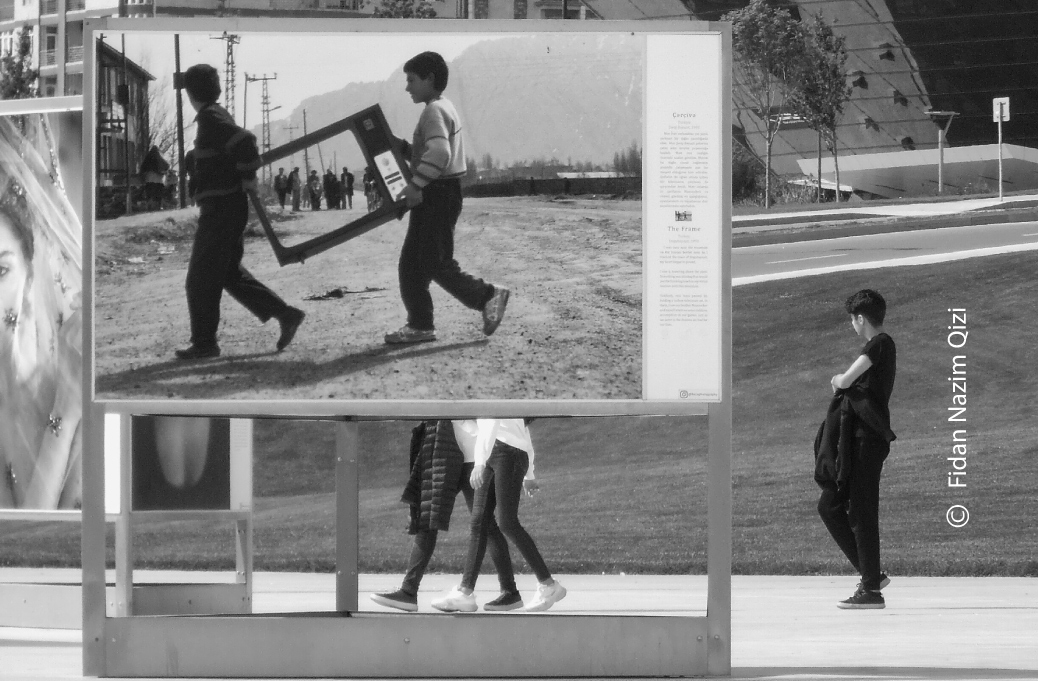
Captured during an exhibition, this photograph masterfully plays with perspective and reality. The photographer was drawn to a portrait by renowned artist Reza Deghati, where the juxtaposition of the depicted subjects and the real children walking nearby created a compelling visual illusion. By framing the scene to include the children's legs alongside the printed image, the photographer blurred the lines between the two-dimensional display and the living environment. This creative decision transforms a simple gallery visit into a sophisticated commentary on presence and perception, earning recognition for its unique ability to turn a static exhibition into a dynamic, multi-layered narrative.
Fidan Nazim Qizi
Born in Baku, Azerbaijan, Fidan Nazim Qizi is a dedicated photographer who balances her life in her home city with frequent international travels. Deeply inspired by the evocative black-and-white works of Vivian Maier, she has developed a profound appreciation for the medium as a source of energy and emotional resonance. Her photography is driven by a passion for nature, hiking, and the pursuit of inspiration, allowing her to capture the world with a unique, contemplative perspective that seeks to uncover the hidden stories within everyday scenes.
Resonance Score Breakdown
Transparency Note: The resonance score (7.9/20) is calculated based on social engagement metrics collected before the award announcement.
Expert Photography Reviews · 8
The Shadow of the Real
Epictetus famously reminded his students that we are not disturbed by things themselves, but by the views we take of them.
Read the reflection →The Overlap of Shadows
In the deep forest, the mycelial network connects the roots of disparate trees, creating a hidden, subterranean bridge where the nutrients of one become the sustenance of another.
Read the reflection →Reviews & Comments
Share your thoughts about this award-winning photograph. Your reviews contribute to the community engagement score.
Before the eye identifies the gallery, a sudden stillness pulls at the diaphragm. It’s the jarring friction between those static, printed faces and the blurred, kinetic legs of the children passing by. I feel a strange, phantom ache in my own shins, a desire to step into the frame and bridge that gap. When I return to this later, the illusion persists; it’s a haunting reminder that we’re all just ghosts haunting our own history.
We walk through a gallery and suddenly, the past steps into the present. Fidan Nazim Qizi catches children’s legs walking past Reza Deghati’s portrait, blurring where the art ends and life begins. It’s a quiet, clever trick of the eye. I’m struck by how the living rhythm of these small steps breathes air into the static faces on the wall. It’s a photograph that asks to be returned to, because it’s really about who we become.
Stripped of chromatic warmth, this monochrome study evokes the dusty, melancholic greys of a Morandi still life, where the absence of pigment forces one to confront the stark, skeletal geometry of the children’s limbs against the printed portrait. It’s a haunting, tactile tension; I’ve found myself shivering at the way the silver-toned light bleeds into the gallery floor, turning living skin into paper, a ghostly alchemy that feels, quite frankly, like a beautiful, lingering ache.
The gallery floor meets the print. Two worlds collide at the ankles. I’ve spent minutes watching those small, moving feet against the static faces of the portrait. It’s unsettling. The void between the living and the captured doesn’t exist here. It’s a quiet erasure of distance. Nothing here is accidental. The empty corner is not empty. It’s a breath held in a room full of ghosts. I find myself holding my own breath, too.
The juxtaposition of Reza Deghati’s subjects against the children’s legs feels clever, but it leaves me uneasy. Why do we treat these living children as mere props for a gallery illusion? By reducing them to limbs, the frame strips away their agency. It’s a slick visual trick, yet it ignores the power imbalance inherent in the gaze. Does the art matter more than the people walking through it? I find the erasure of their humanity deeply unsettling.
1/640sec at f/5.8, ISO 400, 32mm. The Fujifilm JZ100 sensor struggles here; the noise at ISO 400 is an unnecessary tax on the image’s clarity. Stopping down to f/5.8 was a mistake. It’s too narrow for this sensor’s diffraction limits yet too wide to isolate the subjects effectively. I’m genuinely frustrated by the lack of sharpness on the children’s legs. It’s a clever concept, but the hardware choices have undermined the execution. It’s technically hollow.
Baku’s gallery floor turns into a playground of perception. I love how Fidan caught those real legs crossing the printed portrait. It’s a sharp, playful collision of worlds. One tenth of a second later and the alignment would’ve shattered, the illusion lost to the static wall. She didn’t hesitate. She saw the geometry, trusted her gut, and clicked. It’s that rare, fleeting synchronicity that makes me want to grab my camera and hit the pavement immediately.
It’s a clever echo of the meta-narratives explored by Lee Friedlander in his reflections, yet here, the juxtaposition feels sharper. By aligning the children’s stride with Deghati’s portrait, the frame collapses the distance between the gallery wall and the street. I’ve spent decades tracing how we flatten space, but this layering genuinely startled me. It’s a rare, witty tension that forces the viewer to question where the representation ends and the living, breathing Baku begins.