The Way of Light by Kirsten Bruening
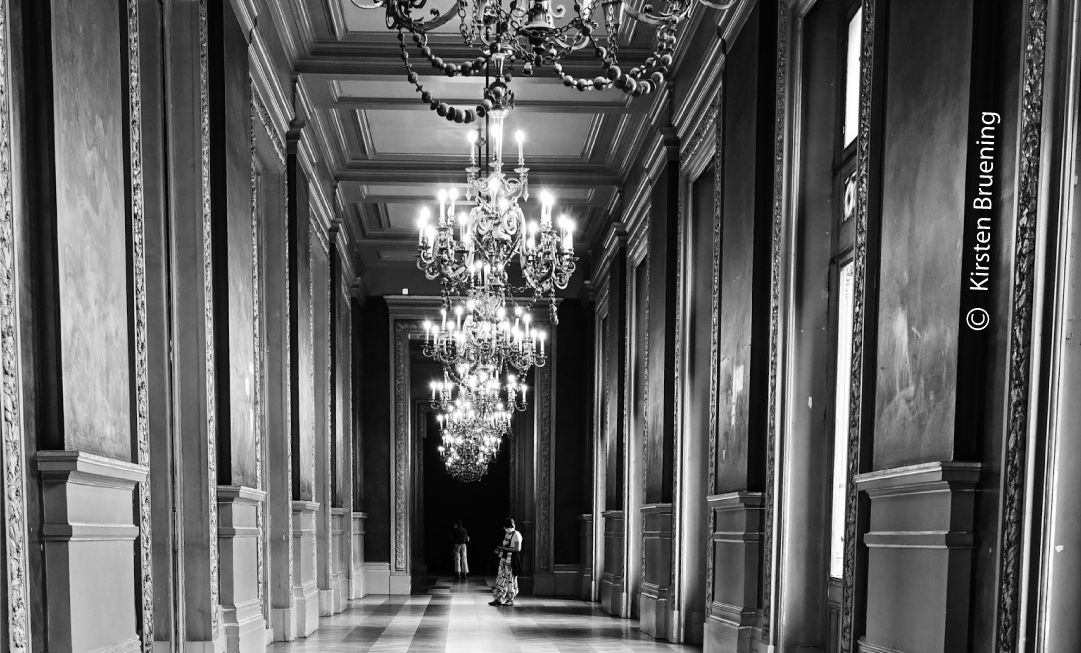
The Way of Light captures a masterful interplay of shadow and illumination, transforming architectural form into a monochromatic symphony. By focusing on the dramatic contrast of light within the Opera Garnier, the photographer highlights the structural elegance of the space, turning a static building into a dynamic expression of artistic vision. The image succeeds through its deliberate composition and the nuanced handling of grayscale tones, which elevate the subject beyond mere documentation. It stands as a testament to the photographer’s ability to find profound beauty in the subtle dance of light, creating an evocative piece that resonates with emotional depth and technical precision.
Kirsten Bruening
Based near Cologne, Germany, Kirsten Bruening is a dedicated photographer whose creative journey began in childhood with the tactile exploration of analogue film. Following a fifteen-year hiatus, she returned to the craft with a renewed focus on the evocative power of black and white imagery across nature, portraiture, and wildlife genres. Currently pursuing formal studies to further refine her technical expertise, she is driven by a profound belief that monochromatic photography offers the most authentic medium for capturing the intricate beauty of light and shadow.
Resonance Score Breakdown
Transparency Note: The resonance score (7.8/20) is calculated based on social engagement metrics collected before the award announcement.
Expert Photography Reviews · 7
The Echo of Footsteps
The velvet rope at the theater entrance is gone, and with it, the specific friction of a silk dress against a plush seat.
Read the reflection →The Weight of Echoes
The air in a cavernous hall has a specific density, a coolness that clings to the back of the throat like damp stone. I remember standing in such a place, the floor beneath my feet vibrating with the ghost of a thousand footsteps.
Read the reflection →Reviews & Comments
Share your thoughts about this award-winning photograph. Your reviews contribute to the community engagement score.
The velvet shadows of the Opera Garnier don’t just frame the space; they breathe life into the architecture. I’m struck by how the light carves out the gilded curves, turning stone into a living, breathing entity. It’s a haunting, silent dialogue where the environment isn’t merely a backdrop, but the protagonist itself. I find myself longing to step into those deep, monochromatic recesses. It’s a gorgeous, lonely dance between history and the present moment.
You’ve captured the Opera Garnier’s bones, but I’m looking for the ghost in the room. It’s technically sharp, sure, but where’s the pulse? I’ve spent years in Paris, and the light there usually tells a story about the people who built it. Because you focused so hard on the geometry, the humanity feels locked out. I wanted to feel the weight of the history, not just the shadows. You’ve got the eye, but let the people in.
At f/5.6, the Z7’s focal plane slices through the Opera Garnier’s ornate geometry with clinical precision. I’m genuinely moved by how the lens resolves the micro-contrast in those gilded moldings; it’s a rare moment where the diffraction limit hasn’t yet softened the intricate textures. The light’s transition into shadow is rendered with such mathematical grace that it feels almost tactile. It’s not just architecture; it’s the physics of light finally behaving exactly as it should.
The Opera Garnier’s grandeur is usually lost to its own excess, but here, the light carves through the void, defining the datum of the balcony with startling clarity. It’s a rare moment where the fenestration doesn’t just admit light; it choreographs it across the stone. I’m genuinely moved by how the shadow anchors the mass, making the space feel breathable. It’s a lie, of course, but it’s the only way to truly feel the architecture’s weight.
Staring at these Opera Garnier shadows, I’m struck by how much I crave the unpredictability of a living subject. It’s technically precise, sure, but it feels sterile. In my world, if you don’t respect the creature’s boundaries, you’ve failed. Here, the architecture doesn’t mind the intrusion, yet I find myself bored by the lack of struggle. I’d trade all this perfect, static light for one frame where the subject actually had a choice.
Most architectural shots of the Opera Garnier are just postcards. What separates this from the thousands I’ve reviewed is the way the light doesn’t just hit the stone; it carves it. I’ve spent years looking at these arches, but this composition makes me feel the weight of the silence in that room. It’s a rare, quiet triumph. Thirty years from now, people won’t just see a building; they’ll feel the air inside it. That’s why it won.
The Opera Garnier’s geometry demands absolute order. Here, the vertical thrust of the columns anchors the frame, while the light’s diagonal trajectory creates a necessary spatial tension. It’s a rigid, calculated architecture. I’ve grown weary of soft, sentimental interiors, but this structure holds. The negative space doesn’t collapse; it breathes. It’s rare to find such discipline in a frame that doesn’t surrender to chaos. The composition is precise. It’s cold, yes, but it’s entirely correct.