The Old Center of Prague by Mirka Krivankova
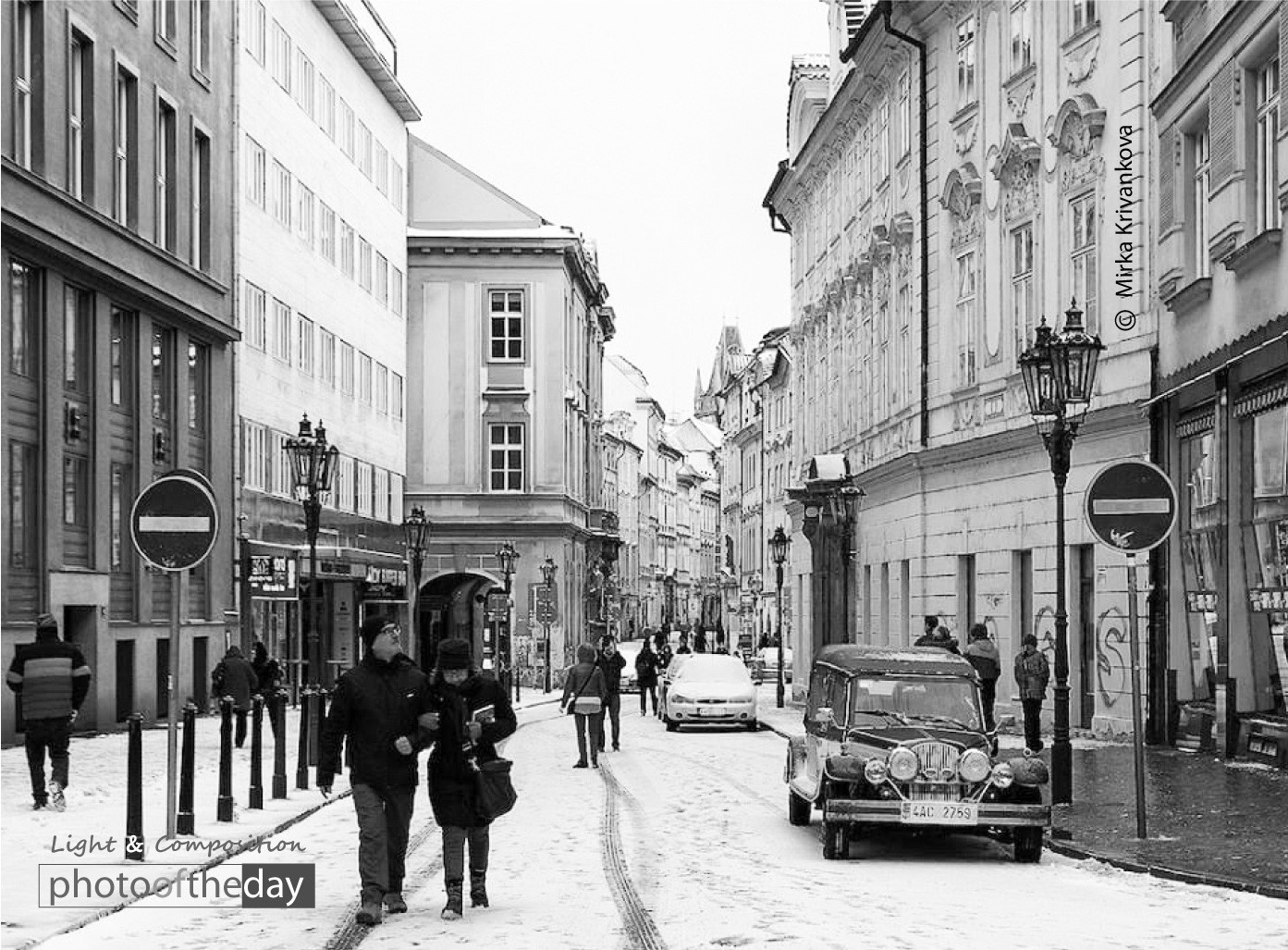
Captured in the heart of Prague, this photograph highlights the city's remarkable ability to preserve its Early Middle Ages urban structure amidst centuries of development. The photographer utilized the natural light and shadows of the historic center to emphasize the grand-scale architecture that defines the Czech capital. By focusing on the interplay between the ancient stone facades and the modern atmosphere of the city, the image serves as a testament to Prague's enduring legacy. Its award-worthy quality lies in the precise composition and the photographer's keen eye for structural detail, which transforms a familiar cityscape into a compelling, timeless narrative.
Mirka Krivankova
Hailing from Mestec Kralove, Czech Republic, Mirka Krivankova is an emerging talent whose work captures the diverse beauty of the Czech countryside and the authentic spirit of human life. Her photographic style is defined by a sophisticated use of formalism, expertly balancing natural light and shadow to guide the viewer through her subjects' environments. As she continues to refine her portfolio, Krivankova demonstrates a dedicated commitment to artistic growth, constantly evolving her bodies of work to better reflect her keen observational skills and technical precision.
Resonance Score Breakdown
Transparency Note: The resonance score (9.8/20) is calculated based on social engagement metrics collected before the award announcement.
Expert Photography Reviews · 6
The Architecture of Memory
We are all made of layers, like the sediment of a riverbed that remembers the floods of a thousand years ago. To walk through a city that has seen centuries is to walk through the skin of time itself.
Read the reflection →The Weight of Stone
In the quiet hours before the city fully wakes, there is a particular density to the air, as if the buildings themselves are exhaling the history they have held for centuries.
Read the reflection →Reviews & Comments
Share your thoughts about this award-winning photograph. Your reviews contribute to the community engagement score.
The geometry of the Prague facade dictates the frame’s internal rhythm. Vertical stone lines anchor the composition, forcing the eye into a rigid, vertical ascent. It’s a disciplined study of spatial tension. The shadows don’t merely obscure; they define the picture plane with surgical precision. I’ve rarely seen light carve stone with such cold, mathematical intent. It doesn’t rely on sentimentality. The frame holds because the architecture demands it. It’s a rare, structural triumph.
Prague’s stone walls demand patience, but Mirka caught the light hitting that corner just right. It’s a tight, rhythmic frame. I love how the shadows slice through the architecture; it feels like a Moriyama print come to life. One tenth of a second later and the geometry would’ve collapsed into chaos. She didn’t hesitate. She saw the pulse of the city and grabbed it. That’s the decisive moment, plain and simple. It’s sharp, honest, and alive.
Before the eye identifies the cobblestones, a sudden stillness settles in the chest. Krivankova’s Prague doesn’t just show architecture; it demands a physiological pause. The light hitting those ancient, jagged facades triggers a phantom chill, the kind I’ve only felt in narrow, stone-walled alleys at dusk. It’s a haunting, rhythmic compression of space. When I return to it, the shadows feel heavier, pulling me back into a quiet, solitary memory of being truly lost.
The light hits the cobblestones and the frame suddenly breathes. It’s a tracking shot frozen in stone. I love how the shadows stretch, pulling the viewer into the alleyway like a slow dolly move. The composition doesn’t need a cut; it’s perfectly paced. Krivankova caught the exact moment the architecture stopped being static and started telling a story. It’s the kind of shot an editor keeps because it holds the weight of the entire city.
Prague’s stone facades loom, but where are the people? Krivankova captures a pristine, hollowed-out city, scrubbing away the messy reality of modern life. It’s technically sharp, yet it feels like a postcard sold to tourists who don’t want to see the actual inhabitants. Why does this frame demand such sterile silence? I find myself craving a single footprint or a discarded coffee cup. Whose history are we preserving here, and at what cost to the truth?
Prague’s stone doesn’t just hold history; it traps it. Krivankova’s frame forces the light to surrender, carving deep, obsidian gashes into the architecture. It’s a brutal, honest dialogue between the ephemeral iPhone sensor and the permanence of the medieval wall. I felt a sudden, cold shiver looking at those shadows—they don’t hide the city’s secrets, they demand them. It’s a rare, heavy silence that refuses to be ignored. Darkness here isn’t empty; it’s the only truth left.