Calm by Kirsten Bruening
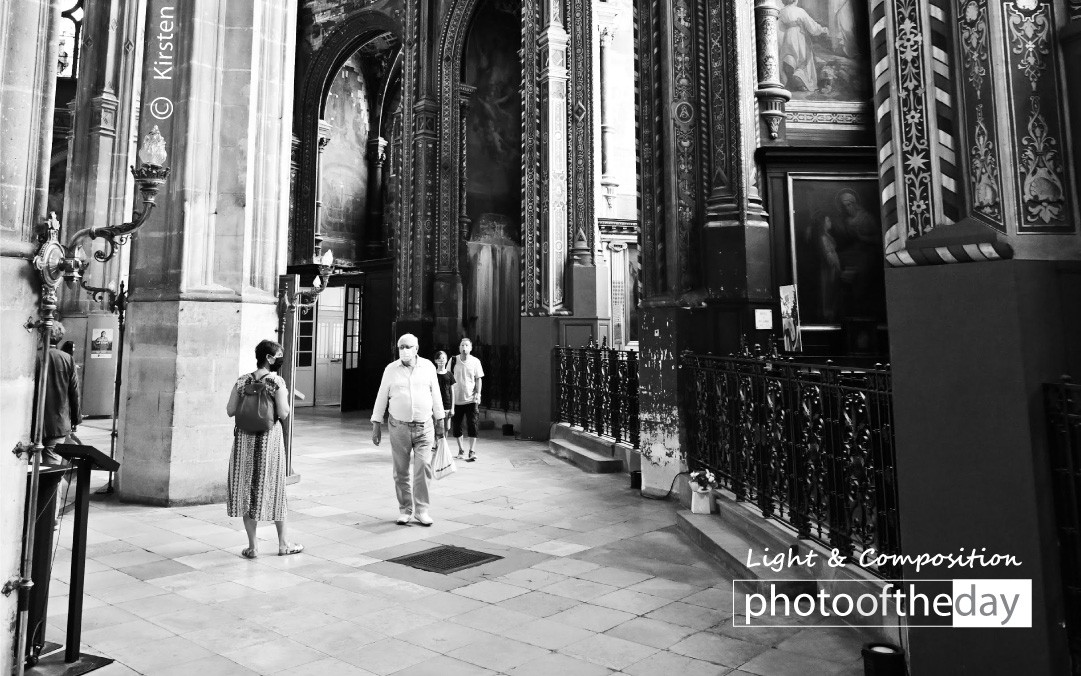
In this evocative architectural study, Kirsten Bruening captures the profound serenity found within the hallowed walls of a church. By focusing on the interplay of natural light as it illuminates sacred statuary, the photographer highlights the timeless ingenuity of historical architecture. The image serves as a meditation on the church as a sanctuary of peace, transcending its physical structure to become a vessel for quiet reflection. The composition is award-worthy for its ability to transform a static interior into a narrative of stillness, where the deliberate balance of light and shadow emphasizes the enduring spiritual weight of the space.
Kirsten Bruening
Based near Cologne, Germany, Kirsten Bruening is a dedicated photographer whose creative journey began in childhood with the tactile exploration of analogue film. After a fifteen-year hiatus, she returned to the medium with a renewed focus on the expressive power of black and white imagery, particularly within nature, portraiture, and wildlife. Her work is defined by a deep fascination with the interplay of light and shadow, and she continues to refine her technical expertise through ongoing formal studies in photography.
Resonance Score Breakdown
Transparency Note: The resonance score (10.0/20) is calculated based on social engagement metrics collected before the award announcement.
Expert Photography Reviews · 8
The Weight of Quiet
I remember ducking into a small stone chapel in the backstreets of Lyon to escape a sudden, biting rain. Inside, the air was thick with the scent of cold wax and centuries of held breath.
Read the reflection →The Weight of Silence
I spent this morning trying to fix a leaky faucet in the kitchen. It was a small, rhythmic drip that had been driving me crazy for days. I kept turning the wrench, frustrated by the stubborn metal, until I finally stopped.
Read the reflection →Reviews & Comments
Share your thoughts about this award-winning photograph. Your reviews contribute to the community engagement score.
At 1/6th of a second, Bruening flirts with the threshold of motion, softening the church’s rigid geometry into something more ethereal. It’s a relief to see architecture treated as a fluid state rather than a static blueprint. I’m genuinely moved by the way the light bleeds into the stone, refusing to resolve into sharp edges. Why demand clarity when the mystery of the space is so much more compelling? It’s a beautiful, deliberate surrender.
Before the eye identifies the stone, something in the chest softens. It’s the way the light hits the statue, a slow, tactile warmth that forces my own breath to hitch. I’ve returned to this frame three times today, and each time, the silence feels heavier, more deliberate. It doesn’t just capture a Parisian church; it pulls the quiet out of the walls and places it directly into my pulse. It’s a rare, haunting stillness.
The verticality of the stone columns dictates the frame’s rhythm. It’s a rigid geometry that anchors the light, preventing the composition from dissolving into mere atmosphere. The negative space surrounding the statuary creates a necessary fulcrum, balancing the heavy masonry against the soft illumination. I’ve rarely seen such disciplined spatial tension. It doesn’t rely on sentimentality to function. The architecture holds its own weight. It’s a rare, precise alignment that finally satisfies my eye.
Light pools over stone, yet I feel a cold detachment here. Bruening frames this Parisian interior as a vacuum, scrubbed clean of the messy, breathing humanity that actually sustains such spaces. Why does she insist on this sterile silence? By erasing the congregation, she turns a living sanctuary into a museum exhibit. It’s technically precise, sure, but whose peace are we consuming? I find the exclusion of the present moment deeply unsettling. Is this worship or just aesthetic consumption?
The stone here doesn’t merely exist; it breathes in the muted, chalky ochre of a Morandi still life, bathed in the pale, bruised violet of a Parisian twilight. It’s a quietude that aches, honestly, making my own pulse slow to match the light’s descent. One finds the shadows aren’t absences but velvet depths, cradling the statuary in a cool, silvered grey that feels like the very texture of ancient, hushed prayer. It’s simply sublime.
Architecture doesn’t move, but light does. Bruening caught the sun hitting the statuary at the exact millisecond the shadows anchored the space. It’s not about the stillness; it’s about the precise alignment of exposure and geometry. I’ve spent my life chasing that one perfect frame where everything clicks into place. Looking at this, I actually felt my own heart rate drop. It’s the right frame. Not the one before. Not the one after. This one.
Paris is a chaotic beast, but Bruening found the eye of the storm. That 1/6sec exposure is gutsy; it turns the light into a soft, holy weight. I’m holding my breath looking at it. It’s quiet, sure, but is it decisive? If a stray tourist had walked through that beam, the frame would’ve collapsed. She caught the stillness before the world rushed back in. It’s a rare, fragile slice of silence. I love it.
We step into this Parisian sanctuary and find the stone saint waiting. Kirsten didn’t just photograph architecture; she listened to the silence held by those cold, carved features. It’s a portrait of stillness itself. When I look at the way the light rests on the statue’s brow, I feel a sudden, heavy peace settle in my own chest. It’s a photograph that asks to be returned to, a quiet conversation between the past and us.