Shinjuku by Morgan Price-King
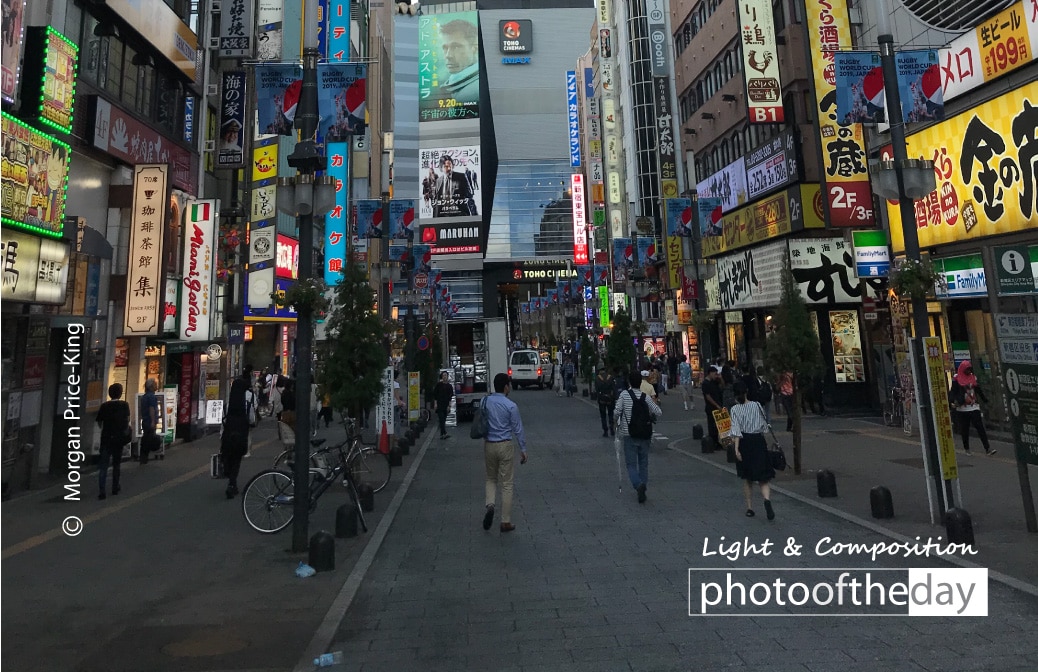
While exploring the vibrant streets of Shinjuku in October, the photographer ventured beyond the main square to discover this unique urban perspective. The composition leverages the natural horizontal lines of the architecture to guide the viewer's eye toward a subtle focal point, rewarding the observant observer with the hidden silhouette of Godzilla nestled among the buildings. This image is award-worthy for its masterful use of leading lines and its playful, unexpected integration of iconic pop culture within a dense, realistic cityscape, demonstrating a keen eye for finding narrative depth in the mundane.
Morgan Price-King
Born in England, Morgan Price-King is a 28-year-old photographer currently pursuing a master's degree in Sports Medicine. His work is defined by a deep curiosity for global cultures and landscapes, with a portfolio that spans major international hubs like Tokyo, New York, and Paris, alongside a dedicated appreciation for the scenic beauty surrounding his home in London. Through his lens, he captures the essence of his travels, balancing his academic pursuits with a growing reputation for observant and evocative street photography.
Resonance Score Breakdown
Transparency Note: The resonance score (9.7/20) is calculated based on social engagement metrics collected before the award announcement.
Expert Photography Reviews · 7
The Giants Among Us
I often find myself wandering the labyrinthine alleys of memory, where the scale of a city shifts depending on the hour.
Read the reflection →The Architecture of Spectacle
Cities are rarely just collections of concrete and glass; they are stage sets for the stories we tell ourselves about modernity. We build these dense, vertical labyrinths to maximize efficiency, yet we inevitably crave the mythic.
Read the reflection →Reviews & Comments
Share your thoughts about this award-winning photograph. Your reviews contribute to the community engagement score.
Shinjuku’s density usually suffocates, but here, the fenestration creates a rhythmic datum that pulls the eye through the urban void. It’s a clever play on scale, though the frame omits the crushing humidity and the hum of the city that truly define this threshold. I’ll admit, spotting that Godzilla silhouette made me grin—it’s a rare, honest wink at the absurdity of Tokyo’s layered, chaotic architecture. It doesn’t just document; it captures the city’s playful, kinetic soul.
Shinjuku’s concrete canyons are impressive, but I’m looking for a pulse. The Godzilla silhouette is a clever wink, sure, but it’s a tourist’s observation, not a human one. Where are the people? I’ve spent my life chasing the weight behind a stranger’s gaze, and this frame feels hollow without it. It’s technically sharp, but it doesn’t breathe. I find myself craving a face, a story, anything that isn’t just cold steel and plastic monsters.
f/8 at 1/125s, ISO 800, 35mm. A standard street configuration, yet it’s technically sound. The depth of field holds the architectural geometry rigid, ensuring Godzilla’s silhouette doesn’t dissolve into the noise of the Shinjuku skyline. I’ve spent years staring at these sensors, and it’s rare to see a photographer actually respect the diffraction limit of their lens. It’s sharp. It’s precise. I’m genuinely annoyed I didn’t catch that framing myself. A correct technical execution.
Looking at these Shinjuku lines, I’m struck by the total absence of the refractive distortion I’m used to. There’s no suspended particulate matter here, no backscatter to ruin the depth of field. It’s unnervingly sharp. While I usually fight to reclaim red light stolen by the water column, here the artificial glow is crisp and unmuted. It’s a strange, dry relief to see Godzilla without a strobe angle creating a mess of marine snow.
Shinjuku’s neon chaos usually demands a wide lens and a lack of shame. Price-King, however, chose restraint. Finding that Godzilla silhouette requires more than a casual stroll; it demands one actually look at the concrete instead of the crowds. I’ve spent enough damp nights in Tokyo to know how easily one misses such details. It’s a quiet, clever bit of observation. I’m genuinely impressed they didn’t just settle for the usual tourist clutter.
Shinjuku’s concrete veins hum with a restless, electric fatigue. I’ve spent hours watching such urban canyons, waiting for the light to soften the steel. Morgan found a quiet rhythm here, letting the architecture breathe before the shutter fell. That hidden silhouette of Godzilla feels like a secret shared between the city and the lens. It’s a playful, haunting stillness. Honestly, it makes me miss the damp, neon-soaked air of Tokyo more than I care to admit.
Before the eye identifies the architecture, something in the chest tightens. The horizontal lines pull you into a rhythmic, claustrophobic pulse. Then, the silhouette emerges—that playful, jagged Godzilla. It’s a sudden, sharp shift in cognitive load. I’ve returned to this three times today, and each time, the scale feels more menacing. It doesn’t just capture a city; it captures the specific, quiet dread of being small in a place that’s always watching you.