Jetty Ruins by Farhat Memon
Captured under challenging conditions, this aerial photograph of the Jetty Ruins represents a triumph of persistence over environmental adversity. Battling 32 km/hour winds and blinding sand, the photographer initially struggled to frame the shot effectively. Returning for a second attempt, she successfully navigated the drone through the elements to secure this striking composition. The image is award-worthy for its technical precision despite the harsh overhead sun and the sheer determination required to capture the scene, transforming a moment of blind faith into a serene, balanced study of coastal decay and natural beauty.
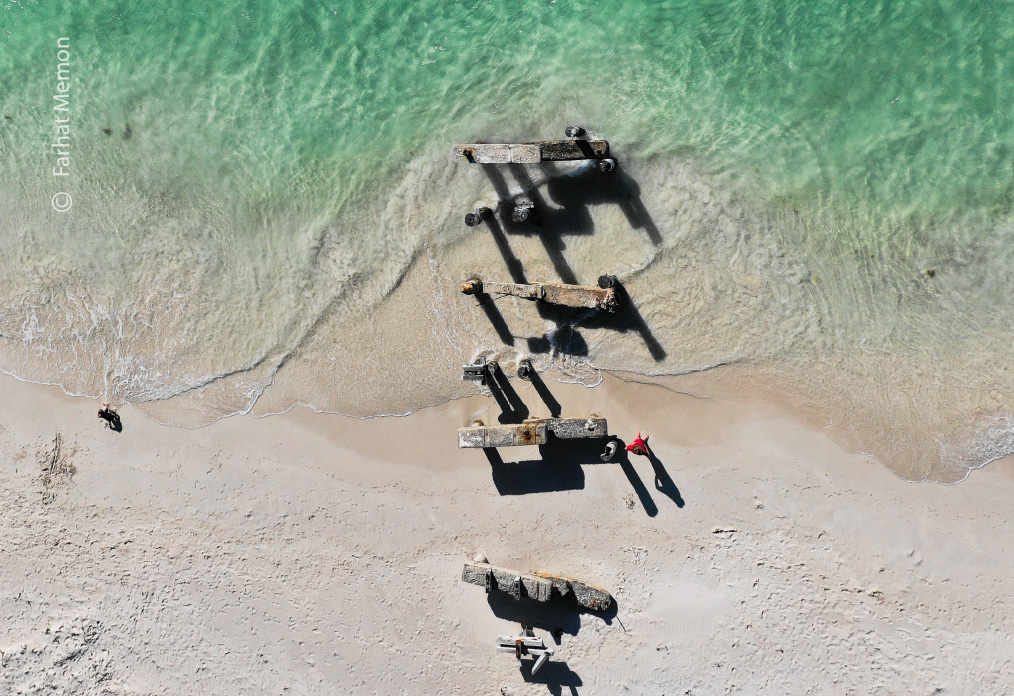
Exposure 3.2sec @ f/5.0 | ISO 100 | Focal Length 35mm
Farhat Memon
Born in Mumbai and raised in Dubai, Farhat Memon is a dedicated photographer currently based in Melbourne, Australia. Driven by a profound sense of wanderlust and a passion for nature, she balances her professional career as an Executive Assistant with her growing commitment to landscape and travel photography. Her work is deeply influenced by her global travels and her love for mountain hiking, as she steadily transitions her creative focus toward establishing a professional career in the field.
Resonance Score Breakdown
Transparency Note: The resonance score (9.5/20) is calculated based on social engagement metrics collected before the award announcement.
Expert Photography Reviews · 8
The Bones of the Shore
I spent this morning trying to fix a broken wooden chair in my kitchen. It had been wobbling for weeks, and today, I finally decided it was time to let it go.
Read the reflection →The Architecture of Absence
Why do we feel a strange comfort when we look upon the things that have been surrendered to time? We build with such certainty, stacking stone upon stone, convinced that our presence is a permanent mark upon the earth.
Read the reflection →Reviews & Comments
Share your thoughts about this award-winning photograph. Your reviews contribute to the community engagement score.
The shutter stays open for three seconds, turning the Jurien Bay tide into a ghost. It’s a long take that breathes. I feel the grit of that sand in my own teeth just looking at it. The composition holds the ruins in perfect, suspended animation; any movement here would have ruined the stillness. It’s the frame the editor keeps because it’s the only one that tells the truth about time. A beautiful, lonely cut.
The wind at Jurien Bay doesn’t just howl; it erases. Farhat stood against that stinging grit, waiting for the sea to settle into a rhythm. I feel a strange ache in my chest looking at these skeletal pilings, abandoned to the relentless, flat noon light. It’s a quiet defiance. She didn’t just fight the elements; she listened until the chaos yielded this stillness. It’s a haunting, lonely grace that I’ve spent my own life chasing.
At f/5.0, the lens avoids the diffraction limit, preserving the crisp, granular texture of the Jurien Bay sand. The focal plane remains remarkably flat across the ruins, capturing the decay with a clinical sharpness that reveals every salt-worn crevice. I’m genuinely moved by how the light refracts through the shallow, turquoise water; it’s a beautiful, precise interaction of photons and depth. It’s rare to see such technical clarity survive the turbulence of a coastal gale.
The tide doesn’t care about your drone’s battery. Farhat caught the ruins at the exact pulse where the water mirrors the decay. It’s a clean, geometric exhale. I’ve spent years chasing that stillness in the chaos of a city, and honestly, it makes me want to pack my bag and head to the coast. One tenth of a second later and the light would’ve flattened the texture. She nailed the timing. It’s sharp, honest, and perfectly balanced.
Thirty-two kilometers of wind is enough to make any drone pilot reconsider their life choices. Most would have packed up and retreated to the nearest pub, yet Memon returned. It’s a rare thing to see such composure in a frame that clearly fought back. I’ve spent enough mornings shivering in the dunes to respect that level of stubbornness. She didn’t just find the ruins; she earned them. A fine, gritty piece of work.
The cerulean depths of Jurien Bay bleed into the pale, calcified ochre of the ruins, creating a chromatic tension that feels like a Morandi still life dissolved by the tide. It’s a haunting, salt-crusted palette; I’m genuinely breathless at how the turquoise whispers against the sun-bleached timber. One finds the light here isn’t merely illuminating the decay, but rather orchestrating a melancholic, liquid symphony of blues that makes the heart ache with quiet, coastal longing.
Most drone shots are just maps with a filter, but this one captures the precise geometry of erosion. The way the jetty’s spine breaks against the turquoise tide creates a rhythm that feels permanent, not fleeting. I’ve seen thousands of coastal shots, yet this one makes me want to stand on that sand myself. It’s the restraint in the color palette that saves it from being another postcard; it’s a quiet, enduring study of inevitable decay.
The ruins anchor the frame with geometric precision, forcing the eye to navigate the rhythmic decay of the pylons. It’s a masterclass in spatial tension. The negative space of the water provides a necessary fulcrum, balancing the heavy, linear debris against the horizon. I’ve rarely seen such cold, structural discipline in coastal work. It doesn’t rely on the narrative of the storm. The architecture of the frame holds, and frankly, it’s a relief to witness.