It’s a Race to the Finish Line by Farhat Memon
Captured at Lake Ruataniwha in New Zealand’s Mackenzie Basin, this photograph highlights the deceptive natural beauty of a man-made reservoir. The photographer was struck by the serene landscape while driving, prompting an immediate return to document the scene. The composition is elevated by the perfectly timed arrival of a flock of birds, which adds a dynamic, living element to the tranquil waters. This image is award-worthy for its ability to transform a functional hydroelectric site into a breathtaking, ethereal landscape, demonstrating a keen eye for spontaneous moments and the inherent majesty of the natural world.
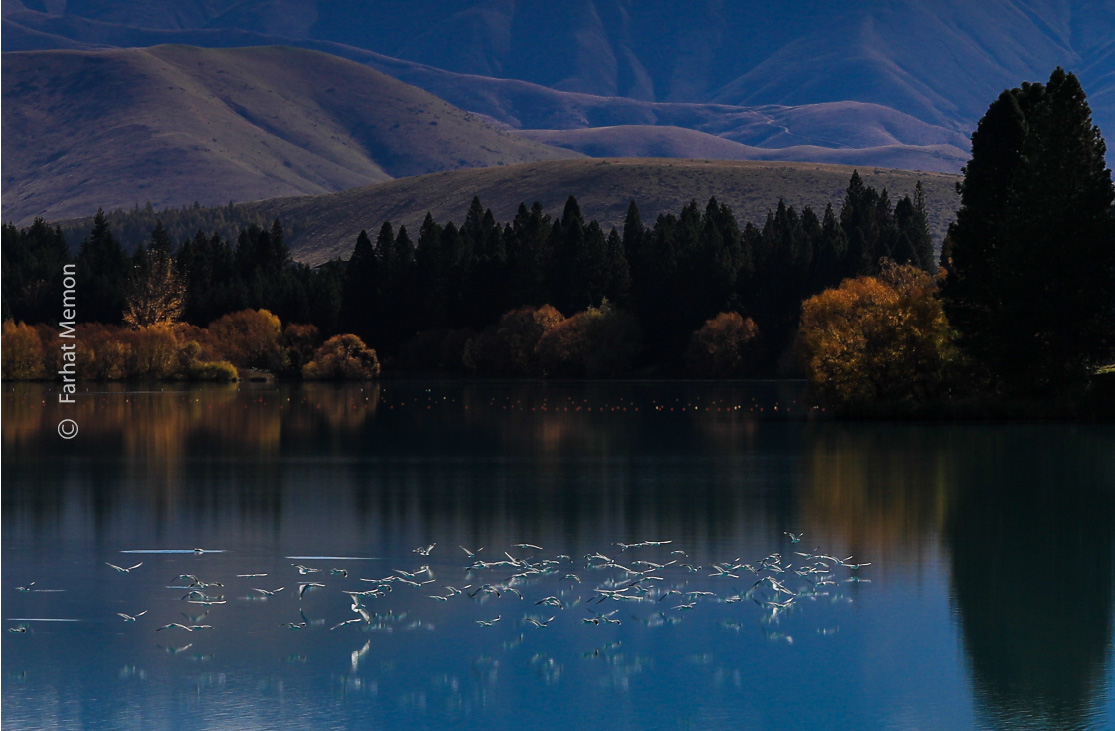
Exposure 1/640sec @ f/6.3 | ISO 100 | Focal Length 94mm
Farhat Memon
Born in Mumbai and raised in Dubai, Farhat Memon is a dedicated photographer currently based in Melbourne, Australia. Driven by a deep-seated wanderlust and a passion for hiking, she specializes in capturing the raw beauty of landscapes and travel destinations across the globe. While balancing a career as an executive assistant, she is actively refining her craft with the professional goal of transitioning into a full-time career as a landscape and travel photographer.
Resonance Score Breakdown
Transparency Note: The resonance score (1.0/20) is calculated based on social engagement metrics collected before the award announcement.
Expert Photography Reviews · 4
The Geometry of Migration
When a flock of geese takes flight, they do not move as individuals, but as a single, fluid organism governed by the invisible currents of the air. Each bird adjusts its position by mere inches, sensing the wake of the one ahead to conserve energy, a phenomenon known as drafting.
Read the reflection →The Weight of Migration
I keep a small, silver thimble in my desk drawer that once belonged to my grandmother. It is worn smooth on one side, a testament to the thousands of times she pushed a needle through heavy wool, mending the lives of those she loved.
Read the reflection →Reviews & Comments
Share your thoughts about this award-winning photograph. Your reviews contribute to the community engagement score.
The shutter fires, and the silence of Lake Ruataniwha breaks. It’s a tracking shot frozen in time. Those birds aren’t just background; they’re the kinetic energy that saves the frame from being too static. I’ve spent hours watching rushes, and I’d kill for a cut this clean. It’s the perfect edit. The 94mm focal length compresses the distance, making the finish line feel inevitable. Honestly, it makes me want to pack my bags and just drive.
Most landscapes I review are static, postcard-perfect traps. What separates this from the thousands of similar reservoir shots is the timing of those birds. They aren’t just decoration; they break the glass-like stillness of Lake Ruataniwha, injecting a frantic, fleeting energy into an otherwise industrial basin. It honestly makes me hold my breath. In thirty years, we won’t care about the Canon settings, but we’ll still feel that sudden, sharp collision between the man-made and the wild.
1/640sec at f/6.3, 94mm. The shutter speed is overkill for a static reservoir, but it’s the only way to freeze those birds. At f/6.3, the lens finds its sweet spot, keeping the distant mountains sharp without introducing diffraction. I’ve spent years looking at landscapes, and honestly, the crispness here actually caught me off guard. It’s a calculated, clinical execution. The technical choices don’t just support the composition; they define the entire frame’s success.
Lake Ruataniwha’s stillness echoes the sublime, yet it’s the avian geometry that arrests me. It’s reminiscent of Peter Henry Emerson’s pursuit of naturalism, though here the birds provide a kinetic disruption to the reservoir’s engineered silence. I’ve spent decades cataloging such intersections, but the way these wings slice the light at 94mm feels startlingly fresh. It’s a rare, genuine thrill to see a man-made basin hold its own against the weight of such deep, historical stillness.