The Cyclist by Jabbar Jamil
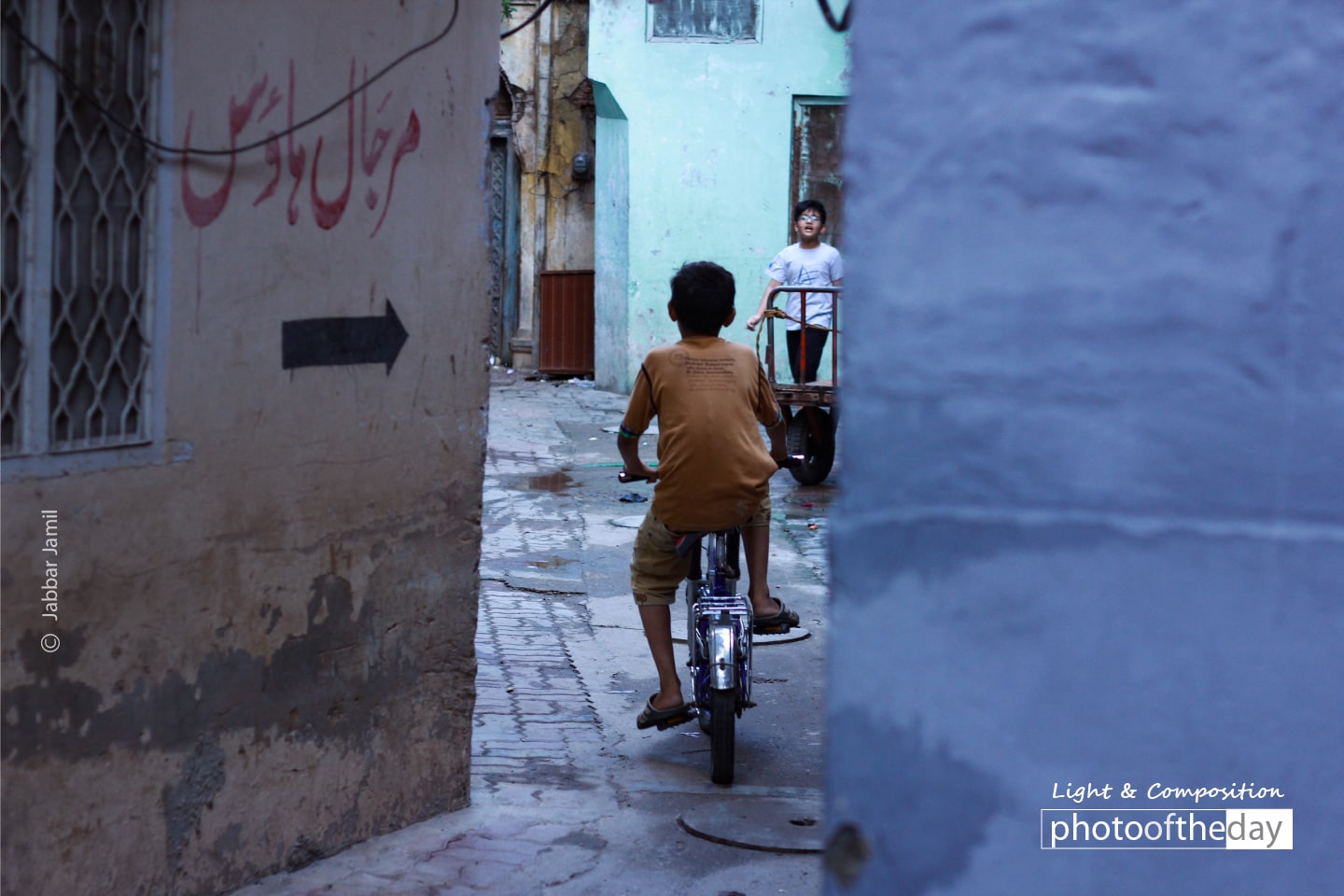
Captured on a quiet, closed street in Sialkot, The Cyclist depicts a spontaneous moment of local life. The photographer had long admired the narrow path, waiting for the perfect opportunity to frame the scene. The image captures a young cyclist riding toward a friend, inviting him to join a group ride. By focusing on the simplicity of the interaction and the geometry of the path, the photographer transforms an everyday neighborhood occurrence into a compelling narrative. The work is award-worthy for its authentic portrayal of human connection and the serene, candid atmosphere preserved within a familiar urban setting.
Fereshteh Sami
Im a Persian photographer and I love photograph. I love nature so I love to taking photo of nature I have studio too. I always travel around Iran to take a amazing shots . Iran is the best place for taking photo.if you like Asian cultures you should visit Iran. I hope you enjoy it and like my photos too Current Location Tehran, Iran Instagram https://www.instagram.com/p/Br3JlhoFT9O/?igshid=1vtcvujufhipo Best Achievements & Exhibitions None Award Winner Photo of the Day Camera Canon 5Dmark lv Canon7D Lenses and Gears None
Resonance Score Breakdown
Transparency Note: The resonance score (11.7/20) is calculated based on social engagement metrics collected before the award announcement.
Expert Photography Reviews · 7
The Rhythm of Returning
There is a quiet grace in the way a path waits for us. We often think of our journeys as lines drawn from one point to another, a constant striving to reach a destination. Yet, the most profound movements are those that circle back toward connection.
Read the reflection →The Geometry of Movement
When a river meets a bend in the landscape, it does not fight the resistance of the bank; instead, it slows, deepens, and finds a new rhythm that carries the silt forward.
Read the reflection →Reviews & Comments
Share your thoughts about this award-winning photograph. Your reviews contribute to the community engagement score.
The vanishing point sits perfectly at the frame’s golden section, anchored by the cyclist’s trajectory. The converging walls create a sharp, forced perspective that compresses the street into a precise corridor. It’s a beautiful spatial equation where the cyclist acts as the variable solving the negative space. I’m genuinely thrilled by how the vertical shadows balance the horizontal path. It’s rare to see such rigid geometry feel this fluid. The math here is simply impeccable.
The frame breathes. It’s a tracking shot frozen in the Sialkot heat, the cyclist leaning into the curve of the alley. I love the way the light hits the spokes; it’s kinetic, a silent momentum that refuses to settle. The composition holds the tension of the impending reunion perfectly. A cut here would’ve been a mistake. It’s the frame the editor keeps because it’s not just a street scene; it’s the start of a story.
One suspects the light cooperated on the first attempt. It often does, for the patient. Jamil clearly didn’t just stumble upon this Sialkot alley; he’s mapped the geometry of those walls until the cyclist became an inevitability rather than a chance encounter. I’ve spent enough damp mornings waiting for a frame to fill to know when someone’s put in the hours. It’s a quiet, earned bit of stillness. I find myself wishing I’d been there.
Sialkot’s narrow geometry pulls the eye, but Jamil’s timing is what hooks me. He didn’t wait for the bike to hit the center; he caught the cyclist leaning into the frame, mid-motion. It’s that kinetic energy that matters. One tenth of a second later and the tension vanishes, the frame collapses into a static alleyway. I love the way the light hits those spokes. He was paying attention. That’s the street, raw and unrepeatable.
The ochre dust of Sialkot’s alleyway, reminiscent of a Morandi still life, breathes with a heat that’s almost tactile, grounding the cyclist’s vibrant, sun-drenched shirt against the muted, chalky walls. It’s a chromatic dialogue of earth and light that makes my heart ache for the stillness of a fading afternoon. One finds the harmony here isn’t merely decorative; it’s a profound, resonant vibration of pigments that captures the very soul of a fleeting, golden encounter.
The focal plane here is razor-thin, isolating the cyclist against the Sialkot street’s receding geometry. Jamil’s aperture choice creates a bokeh that doesn’t just blur; it renders the background into a soft, atmospheric diffusion of light. I’m genuinely moved by how the lens resolves the texture of the bicycle’s frame against the diffraction limit of the ambient haze. It’s a rare, precise capture where the physics of glass finally meets the quiet, human pulse of the moment.
The street in Sialkot isn’t just stone and shadow. It’s a vessel. The cyclist enters the frame, yet the architecture holds the weight. I’ve spent minutes watching that sliver of light against the wall. It’s quiet. It’s heavy. Nothing here is accidental. The empty corner is not empty. It’s the breath before the boy speaks. I feel a sudden, sharp ache for this stillness. It’s rare to find such peace in a busy world.