Land’s End by Jabbar Jamil
Capturing the dramatic essence of the British coastline, this photograph was taken at Land's End, where the photographer ventured beyond the popular clifftop trails to discover a more compelling perspective. By descending the hill, the photographer sought a unique vantage point that emphasized the rugged scale of the headland against the vast ocean. The resulting image is a testament to the patience and curiosity required to find beauty in the landscape, showcasing a masterful balance of light and composition that transforms a familiar tourist destination into a striking, award-worthy study of natural form and atmosphere.
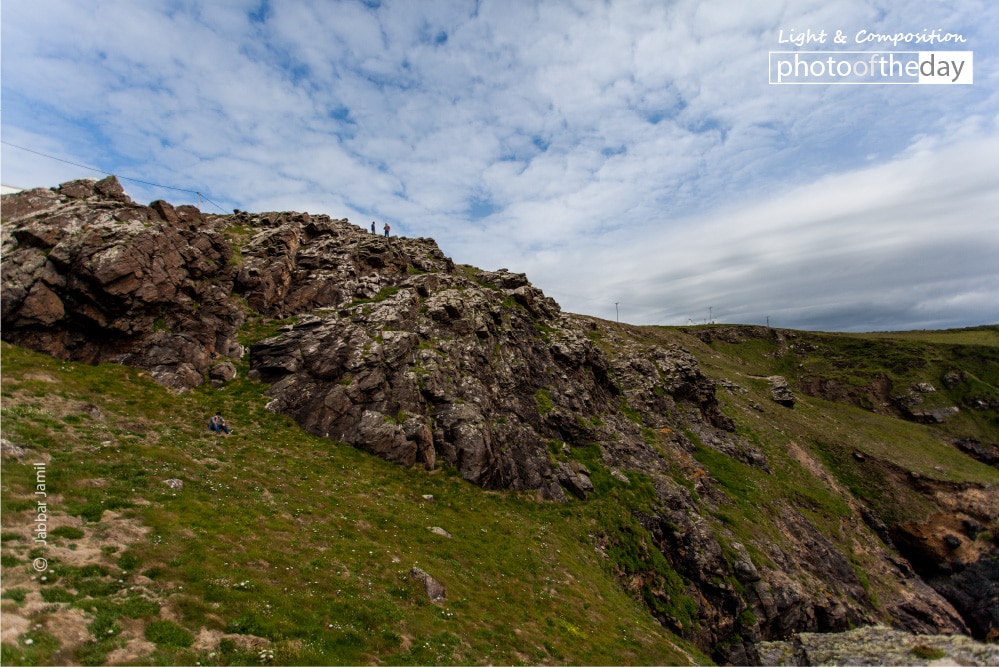
Exposure 1/4000sec @ f/4 | ISO 250 | Focal Length 17mm
Jabbar Jamil
Based in Sialkot, Pakistan, Jabbar Jamil is a dedicated street photographer who uses his craft to step outside his comfort zone and engage deeply with the world around him. His work serves as both a creative outlet and a meditative practice, allowing him to document the raw, unfiltered realities of his environment. Through his lens, Jamil explores the connection between the observer and the observed, finding profound meaning in the everyday scenes that others might overlook.
Resonance Score Breakdown
Transparency Note: The resonance score (10.8/20) is calculated based on social engagement metrics collected before the award announcement.
Expert Photography Reviews · 7
Where the Earth Stops
We are taught to fear the edge. We build fences, we plant hedges, we stay well back from the drop. But there is a specific gravity to the place where the solid ground finally gives way to the grey, indifferent weight of the sea.
Read the reflection →The Edge of Belonging
We often speak of the city as a dense web of stone and steel, yet our geography is defined just as much by where we stop. There is a profound social weight to the boundary—the point where the pavement ends and the wild, untamed space begins.
Read the reflection →Reviews & Comments
Share your thoughts about this award-winning photograph. Your reviews contribute to the community engagement score.
The horizon line doesn’t divide the frame. It anchors it. I’ve spent minutes watching the grey water meet the granite. It’s quiet here. The descent was worth it. Most eyes rush to the cliff edge, but Jamil found the stillness below. The vast, pale sky isn’t just air. It’s weight. I feel a sudden, sharp ache in my chest looking at that expanse. Nothing here is accidental. The empty corner is not empty. It is breath.
Land’s End is a graveyard of clichés, yet Jamil’s descent yields a perspective that echoes Bill Brandt’s stark, sculptural approach to the British coast. By dropping the horizon, he avoids the postcard trap, finding a jagged geometry that feels genuinely fresh. It’s rare to see this site stripped of its tourist veneer. I’ll admit, the way the 17mm lens distorts the granite’s weight against the Atlantic actually made me catch my breath. It’s a sharp, necessary revision.
At 17mm, the Canon’s glass renders the Cornish granite with a crispness that defies the atmospheric haze. Shooting at f/4, Jamil’s focal plane is razor-thin, yet he’s managed to resolve the micro-textures of the rock face against the ocean’s vastness. It’s a delicate dance with diffraction limits. I’m genuinely moved by how the light catches those jagged edges; it’s a rare, visceral reminder of why we push our optics to their absolute physical threshold.
Most tourists at Land’s End are content with the gift shop view. Jamil, however, clearly scrambled down the scree to earn this perspective. It’s a cold, salt-sprayed effort I’ve made myself, and my knees ache just looking at the result. He didn’t settle for the postcard; he waited for the tide to carve the frame. One suspects he spent a miserable afternoon getting soaked, but frankly, it’s the only way to do it properly.
Descending the cliff doesn’t erase the tourist gaze; it just shifts the angle. Jamil captures the granite’s jagged edge, but why does the ocean feel so empty? It’s technically sharp, yet it lacks a pulse. I find myself craving a human presence to anchor this vast, lonely rock. Does the frame exclude the crowds to manufacture a solitude that doesn’t exist? It’s a pretty postcard, but it feels like a performance of wildness rather than the truth.
The shutter snaps at 1/4000th, freezing the Atlantic’s violence into a jagged, silent monolith. It’s a wide-angle master shot that refuses to blink. I’m struck by the scale; it feels like the opening sequence of a noir set at the edge of the world. Jamil didn’t just find a vantage point; he found the cut that keeps the audience breathless. It’s a frame that doesn’t need a sequel. I’d watch this for hours.
We stand at the edge of the world, where the granite meets the churning grey. Jabbar didn’t just look at Land’s End; he listened to the silence of the stone. By descending, he found the earth’s own pulse. It’s a lonely, rugged face, isn’t it? I feel a sudden, sharp ache for the wind on my own skin. We aren’t just seeing a landscape here; we are meeting a giant that has been waiting for us.