Playing a Game by Siew Bee Lim
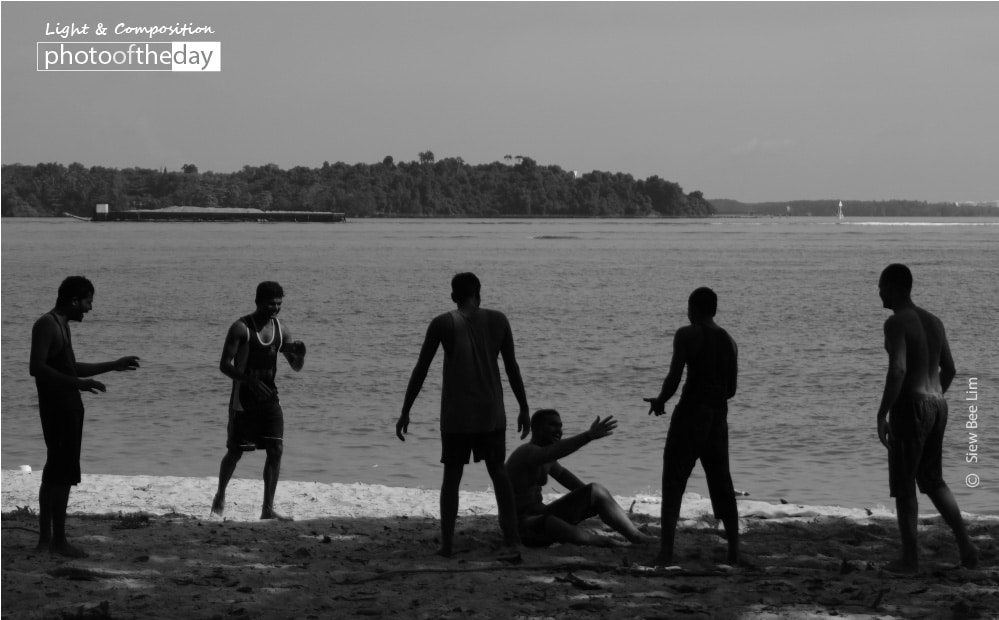
Captured on the morning of Deepavali at a beach park, this image freezes a spontaneous moment of joy among a group of adults enjoying a holiday outing. The photographer observed the group as they tossed an object into the air, reacting quickly to capture the peak of their playful interaction. The composition is elevated by the candid nature of the subjects, whose genuine expressions and dynamic movement transform a simple leisure activity into a compelling narrative of connection and celebration. The photographer's ability to anticipate the action and frame the scene with technical precision highlights the beauty found in everyday human experiences.
Siew Bee Lim
Born in 1965 in Singapore, Siew Bee Lim has long nurtured a passion for photography as a creative outlet. Embracing the philosophy that it is never too late to refine one's craft, she has dedicated herself to formalizing her skills through the Light & Composition platform. Her work reflects a keen interest in capturing the authentic, candid moments of daily life, demonstrating a growing eye for storytelling and composition within the travel photography genre.
Resonance Score Breakdown
Transparency Note: The resonance score (11.9/20) is calculated based on social engagement metrics collected before the award announcement.
Expert Photography Reviews · 4
The Weight of Levity
In the physics of childhood, gravity is merely a suggestion. We spend our early years trying to defy it, leaping from low walls or hanging from branches, convinced that if we could only time our ascent perfectly, we might stay suspended in the air.
Read the reflection →The Right to Play
Henri Lefebvre argued that the city is not merely a collection of buildings, but a social product—a space that we collectively produce through our presence and our actions.
Read the reflection →Reviews & Comments
Share your thoughts about this award-winning photograph. Your reviews contribute to the community engagement score.
At f/5.6, the 50mm focal length renders the subjects with a crispness that pushes against the sensor’s resolution limits. The light’s diffraction across the airborne object is, in the strictest physical sense, extraordinary. It’s a fleeting intersection of physics and joy. I’m genuinely moved by how the lens captures that precise, suspended micro-second of kinetic energy. They’ve managed to resolve the human spirit through a standard kit lens, proving that optics, when wielded with intent, transcend mere glass.
Joy is a fragile, fleeting architecture. In this frame, the tossed object hangs suspended, yet it’s the encroaching shadows beneath the figures that anchor the scene in reality. They’ve caught a moment of levity, but I’m haunted by the darkness clinging to their feet. It’s a reminder that even in celebration, we are tethered to the earth. It doesn’t just capture play; it acknowledges the gravity that eventually pulls every light-filled gesture back into the void.
The ochre sand, reminiscent of a sun-bleached Morandi still life, anchors these figures in a light that’s almost liquid. It’s the golden, humid warmth of a Singaporean morning, where the shadows aren’t merely absences of light but deep, bruised violets. I’m utterly captivated by how the vibrant, saturated garments quarrel with the pale, washed-out sky; it’s a collision of joy that feels like a sudden, sharp intake of breath against the humid, salt-heavy air.
At 1/1000sec, Lim has surgically excised a moment from time, yet I find this clinical stillness exhausting. Why freeze the joy so aggressively? It’s a conservative choice that strips the movement of its kinetic soul. I’d have preferred a long exposure, blurring the tossed object into a streak of light, closer to Sugimoto’s ethereal theatres than this literalism. It’s technically sharp, sure, but it doesn’t feel like anything. Where’s the risk? It’s just too safe.