You’ve Got Mail by Andrea Migliari
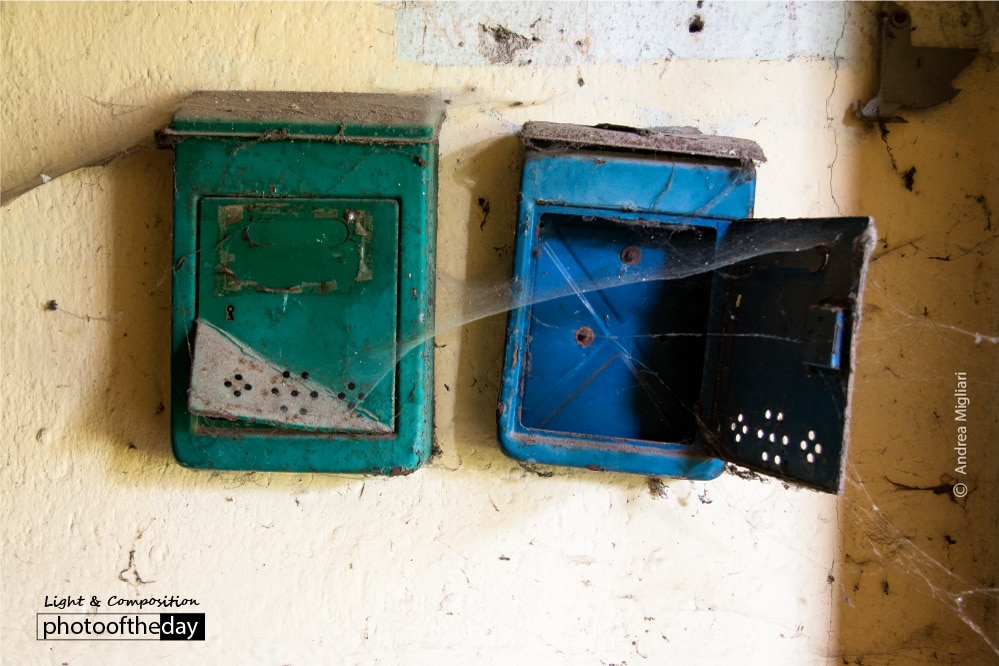
In this evocative still life, Andrea Migliari captures the quiet decay of urban infrastructure. Drawn to the vibrant, contrasting colors of a cluster of post boxes, the photographer highlights the intricate, delicate detail of a spider web draped across the weathered metal. By focusing on these overlooked remnants of communication, Migliari transforms a mundane street corner into a compelling study of texture and time. The image is award-worthy for its keen eye for composition and the ability to find profound visual interest in the subtle, often ignored stories of the urban environment.
Andrea Migliari
Born in Italy in 1981, Andrea Migliari is a passionate photographer currently based near Bergamo. His creative journey began with film photography and darkroom processing before he transitioned to digital media, eventually developing a refined workflow that spans from raw capture to final output. Migliari’s diverse portfolio, which includes landscapes, portraits, and live music, has earned him recognition in prestigious Italian art publications and photography competitions. He remains dedicated to the philosophy that beauty is often hidden in plain sight, waiting to be discovered just around the corner.
Resonance Score Breakdown
Transparency Note: The resonance score (12.3/20) is calculated based on social engagement metrics collected before the award announcement.
Expert Photography Reviews · 6
The Weight of Waiting
There is a specific grit to old metal that stays under your fingernails long after you have pulled your hand away. It tastes of iron and cold rain, a sharp, metallic tang that lingers on the tongue like a forgotten promise.
Read the reflection →The Architecture of Waiting
Orb-weaver spiders construct their webs with a precise, radial geometry, anchoring silk threads to whatever substrate is available—a twig, a stone, or the rough bark of a tree.
Read the reflection →Reviews & Comments
Share your thoughts about this award-winning photograph. Your reviews contribute to the community engagement score.
The grid of post boxes creates a rigid, rhythmic matrix, yet the spider web introduces a chaotic, non-Euclidean vector that disrupts the vertical axis. It’s a fascinating tension between industrial order and organic entropy. I’m genuinely captivated by how the web’s delicate, radial geometry anchors the composition, pulling the eye away from the predictable rectangular masses. It’s a perfectly solved spatial equation where the fragility of the silk effectively balances the heavy, weathered metal of the frame.
The grid of post boxes creates a rigid, geometric anchor. It’s a necessary ballast against the chaotic, organic sprawl of the spider web. The web’s diagonal tension disrupts the frame’s verticality, forcing the eye into a restless loop. It’s structurally sound, yet I’m bothered by the lack of a singular focal point. The composition doesn’t quite resolve its own internal conflict. It’s a near miss, but the spatial tension holds just enough to remain relevant.
The shutter clicks and the world stops breathing. It’s a tight, claustrophobic frame. That spider web isn’t just detail; it’s the film’s opening title sequence, fragile and trembling against the rusted metal. I’ve spent hours staring at these post boxes, feeling the weight of the silence they hold. The cut would’ve been a mistake here. Migliari knows exactly when to hold the shot. It’s a gorgeous, decaying rhythm that makes me want to reach out and touch it.
Rusting mailboxes in Treviglio don’t just decay; they signal a collapse of connection. Why does Migliari frame this abandonment as aesthetic beauty? It’s a comfortable, safe way to view urban neglect. I feel a sharp, cold irritation looking at that spider web. Does the photographer see the people who once relied on these boxes, or are they just textures in a composition? We shouldn’t romanticize the silence of a dying public service. It’s too easy.
The ochre of these rusted post boxes, a shade reminiscent of Morandi’s dust-choked palettes, vibrates against the silver-grey silk of the spider’s architecture, creating a tension that’s frankly intoxicating. It’s a quiet, chromatic ache I’ve felt before in the corners of old Italian piazzas, where the light doesn’t just illuminate but bruises the metal. One finds oneself breathless, watching how the decay’s warmth refuses to surrender to the cool, indifferent shadows of the urban afternoon.
These post boxes aren’t just objects; they’re the threshold of a forgotten communication network. The light raking across the weathered metal reveals a tactile history, yet I’m struck by how the spider web disrupts the rigid geometry of the fenestration. It’s a poignant reminder that nature eventually reclaims our urban datums. I find myself wanting to reach out and touch that decay, feeling the cold steel against the fragile, silken geometry of the web.