Leave a Reply
Want to join the discussion?Feel free to contribute!

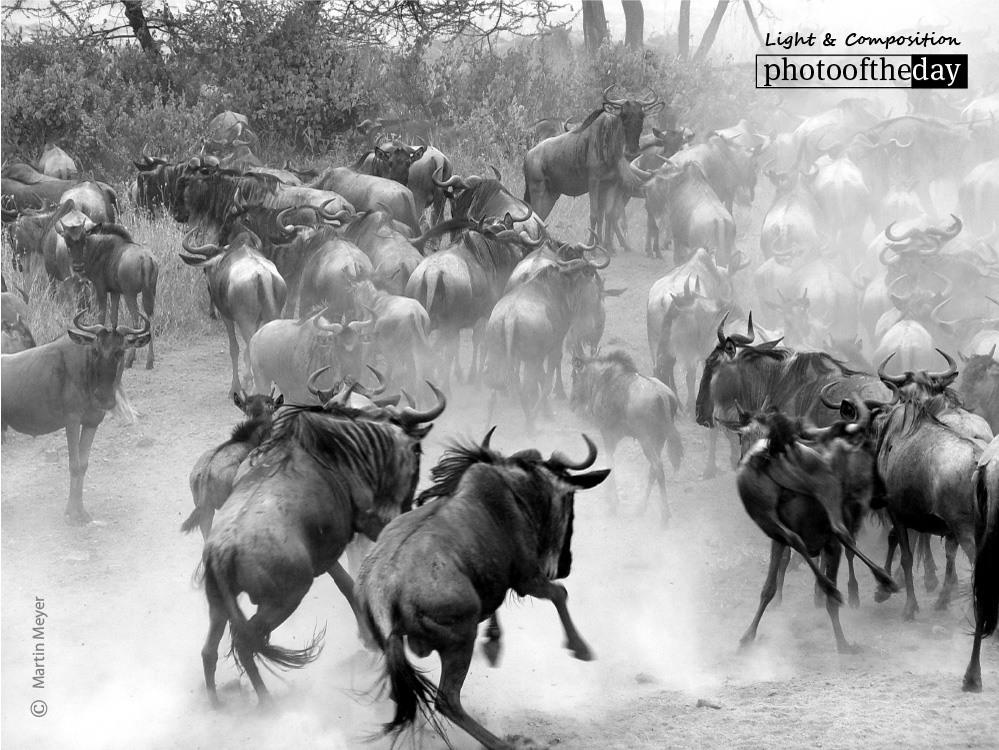
The Ultimate Thrill captures the raw, kinetic energy of the great wildebeest migration across the northern Serengeti plains. By tracking the herds along the Seronera River, the photographer successfully framed the immense scale of the spectacle, where dust and thundering hooves dominate the landscape. The image stands out for its ability to distill the chaotic, overwhelming nature of the migration into a singular, cohesive composition. It is a testament to the photographer's patience and deep understanding of wildlife behavior, transforming a fleeting moment of natural history into a powerful, award-worthy visual narrative that conveys the true intensity of the African wilderness.
Based in Cape Town, South Africa, Martin Meyer has spent over a decade building a reputation as a specialist in photographic safaris and wildlife documentation. As a qualified field guide and internationally accredited emergency responder, he possesses a deep, technical understanding of the African wilderness, which informs his unique approach to capturing natural history. Alongside his wife, Nicole, he operates a multi-faceted business that blends customized safari experiences with high-end stock photography, reflecting his commitment to both local expertise and a global perspective on wildlife conservation and storytelling.
Transparency Note: The resonance score (11.1/20) is calculated based on social engagement metrics collected before the award announcement.
Why do we feel a sudden, inexplicable pull toward the wild, even when we are anchored in the quiet of our own rooms? Perhaps it is because we recognize in the collective movement of others a mirror to our own internal migrations.
Read the reflection →We often speak of the city as a static container, a collection of bricks and mortar designed to keep the wild at bay. Yet, if we look closer at the history of human settlement, we see that we are merely another species in constant, rhythmic motion.
Read the reflection →
 Shelter in the Brightness
Share your thoughts about this award-winning photograph. Your reviews contribute to the community engagement score.