The Great Thick Knee by Saniar Rahman Rahul
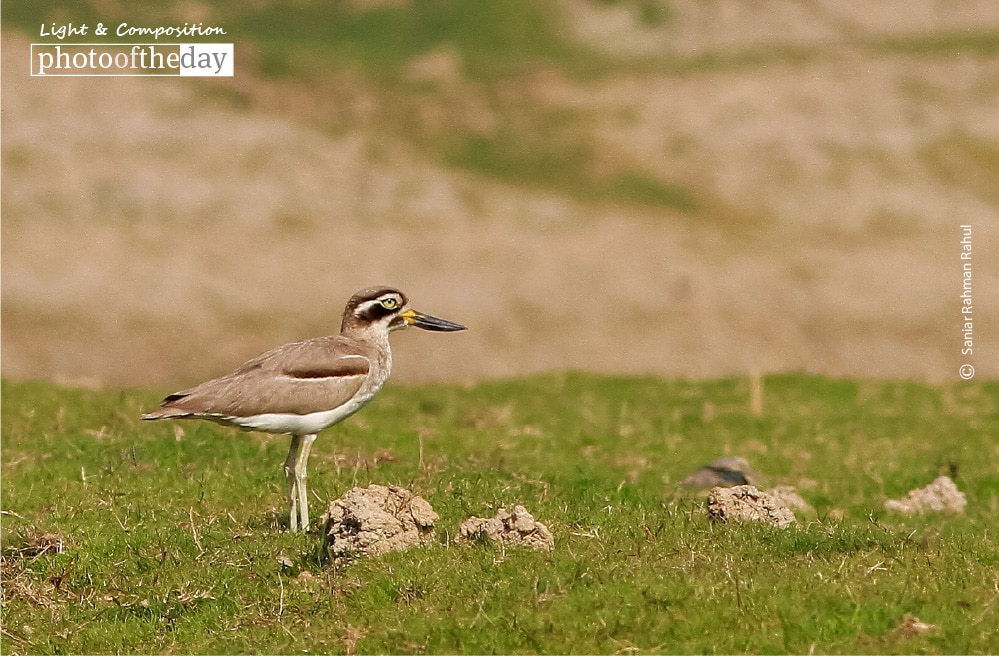
Captured at the serene Pashuar Haor in Sunamganj, this striking image features the great thick-knee, a large wader native to the tropical landscapes of southern Asia. The photographer skillfully documents this resident breeder in its natural habitat, where it thrives along gravel banks and lake shores. By focusing on the bird's unique posture and environment, the image highlights the creature’s reliance on its surroundings for hunting prey like insects and crabs. This photograph is award-worthy for its precise composition and the photographer's ability to capture the quiet, observant nature of this elusive species within the lush wetlands of Bangladesh.
Saniar Rahman Rahul
Based in Dhaka, Bangladesh, Saniar Rahman Rahul is a distinguished creative professional whose journey into photography began with childhood observations of his father’s work. After establishing a successful career in graphic design and advertising, serving as an Art Director at Grey Worldwide, he rediscovered his passion for the lens in 1997. His work reflects a deep-seated artistic sensibility honed through years in the pre-press and advertising industries, leading him to become a celebrated figure in international photography circles, including being recognized as a Photo of the Month award winner.
Resonance Score Breakdown
Transparency Note: The resonance score (12.0/20) is calculated based on social engagement metrics collected before the award announcement.
Expert Photography Reviews · 6
The Grit of Stillness
The smell of wet earth after a long drought is a heavy, metallic perfume that clings to the back of the throat.
Read the reflection →The Weight of Stillness
There is a particular way of waiting that belongs to the wild. It is not a pause, nor is it a hesitation. It is a total surrender to the present moment, where the pulse slows to match the rhythm of the earth.
Read the reflection →Reviews & Comments
Share your thoughts about this award-winning photograph. Your reviews contribute to the community engagement score.
The great thick-knee stares back, but does it see me? Rahul isolates this bird against a blur of gravel, stripping away the Pashuar Haor’s complex ecosystem. It’s a clean, clinical extraction. Why must we render wildlife as solitary icons rather than participants in a landscape? I feel a strange, cold distance looking at this. Does the bird’s survival matter, or just its aesthetic utility? We’ve turned a living creature into a static, decorative object.
We look at this great thick-knee and we aren’t just seeing a bird; we’re meeting a sentinel. It’s standing in the Pashuar Haor, watching the world with an intensity that feels deeply human. I’ve spent my life listening to stories, and this creature’s gaze tells me it’s been waiting for us to notice its quiet dignity. It’s a portrait of patience. Honestly, the stillness in those yellow eyes makes me want to hold my breath.
The ochre of the silt, reminiscent of a Morandi still life, anchors the bird against the muted, bruised violet of the distant wetlands. It’s a chromatic tension that aches, really; I’ve found myself mesmerized by how the creature’s plumage dissolves into the gravel’s dusty gold. One doesn’t merely see this wader; one feels the humid, heavy air of Sylhet pressing against the lens, a quiet symphony of earth tones that simply takes my breath away.
The great thick-knee’s stillness echoes the clinical precision of Eliot Porter’s ornithological studies, yet it avoids his rigid color saturation. There’s a haunting, prehistoric geometry in how the bird’s gaze anchors the frame against those blurred gravel banks. I’ve spent decades cataloging such avian portraits, but this one’s quiet, almost sculptural tension genuinely startled me. It’s a rare, elegant refusal to turn nature into mere spectacle, finding a singular, ancient dignity in the mud.
The great thick-knee doesn’t merely inhabit the Pashuar Haor; it anchors the void. I’m struck by how the gravel beneath its feet feels like a graveyard of light, refusing to yield to the sun. It’s a stark, unsettling stillness. When I look at those unblinking eyes, I don’t see nature—I see a creature guarding the threshold of the dark. It’s a heavy, silent defiance that makes me feel remarkably small in the presence of such indifference.
The light here is soft, the flat, diffused glow of a humid morning in Sunamganj. Rahul didn’t chase this bird; he waited until the wetland accepted his presence. I’ve spent enough hours in the tall grass to know that stillness. It’s a quiet, heavy peace. Looking at the thick-knee’s watchful eye, I feel a sudden, sharp ache for the silence of those gravel banks. He stood there, breathing with the landscape, until it finally spoke.