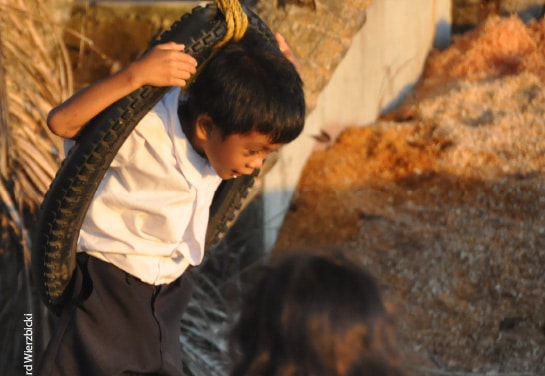
Playing in the Sun by Ryszard Wierzbicki
Captured during a golden sunset near the Marco Polo restaurant, this photograph documents a spontaneous moment of joy as local children play along the shoreline. The photographer utilized the dramatic, warm light of the setting sun to transform a simple beach scene into a vibrant narrative of childhood innocence. The image is award-worthy for its masterful use of natural light and its ability to evoke a profound sense of connection, turning a fleeting, everyday interaction into a timeless, evocative portrait of life in the Philippines.
Ryszard Wierzbicki
Born in 1963, Ryszard Wierzbicki is a dedicated photographer and traveler based in Swindon, United Kingdom. After a diverse professional career in education and marketing, he transitioned to a life of exploration, focusing his lens on the cultures and landscapes of South-East Asia. His work is deeply influenced by his passion for scuba diving and his commitment to humanitarian efforts, including volunteering with orphanages in Thailand and Burma. Through his platforms, Instant Travelling and World Around, he shares his unique perspective on the world's hidden corners.
Resonance Score Breakdown
Transparency Note: The resonance score (12.3/20) is calculated based on social engagement metrics collected before the award announcement.
Expert Photography Reviews · 4
The Salt on Skin
The taste of summer is always salt. It settles on the back of the throat, a dry, stinging reminder of the ocean’s reach.
Read the reflection →The Weight of Bare Feet
I spent this morning trying to organize my bookshelf, pulling out old paperbacks I haven't touched in years. I found a dried leaf pressed between the pages of a journal from a summer I barely remember. It felt brittle, like it might turn to dust if I held it too tightly.
Read the reflection →Reviews & Comments
Share your thoughts about this award-winning photograph. Your reviews contribute to the community engagement score.
Of the thousands of sunset beach shots I’ve reviewed, most are forgettable clichés. What separates this from the pack is the specific geometry of the children’s silhouettes against the tide’s reflection. It’s not just light; it’s the way their posture captures pure, unscripted momentum. I’ll admit, it made me miss my own childhood summers. It survives because it avoids sentimentality, choosing instead to anchor that fleeting joy in the cold, hard reality of the shoreline.
The tide recedes. A sliver of wet sand remains. The children are small, dark silhouettes against the glare. I’ve spent years looking for this exact stillness. It’s not about the joy; it’s about the distance between them and the horizon. The light doesn’t crowd the frame. It leaves room for the breath. Nothing here is accidental. The empty corner is not empty. It’s where the silence lives. I find myself wanting to step into that quiet.
The frame resolves into a precise 1:2 ratio of dark, silhouetted foreground to luminous, golden atmosphere. The children’s limbs create a series of intersecting vectors that break the horizon’s rigid horizontal axis. I’m genuinely struck by how the negative space in the upper quadrant balances the kinetic energy below. It’s a beautifully solved spatial equation; the geometry doesn’t just contain the joy, it dictates the rhythm of the movement. It’s rare to see such perfect, calculated equilibrium.
Golden hour in Siquijor is a siren song for the casual tourist, and it’s easy to snap a pretty silhouette when the sun does the heavy lifting. One wonders if the photographer lingered past the sunset, or simply caught the light on a whim. It’s pleasant, certainly, but I’ve spent enough damp evenings waiting for the tide to turn to know that joy is rarely this convenient. It’s a nice shot, but it didn’t cost enough.