Boudhanath by Shirren Lim
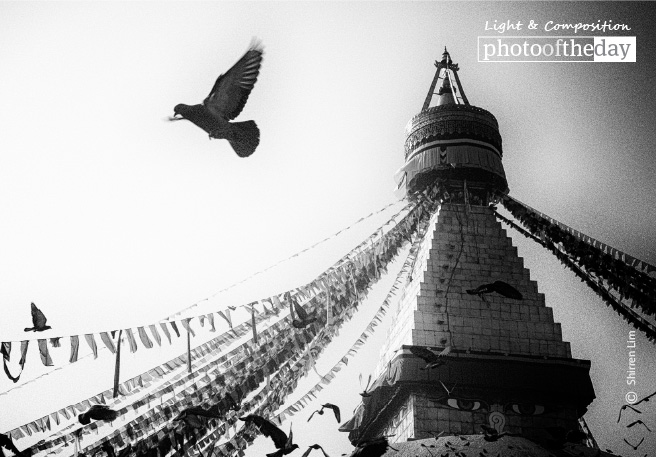
Captured in 2009, this evocative image immortalizes the Boudhanath stupa in Kathmandu, Nepal, before the devastating earthquake altered its landscape. The photographer was drawn to the monument’s sheer dominance over the skyline, finding a profound sense of peace while wandering its perimeter. By focusing on the spiritual gravity of the site, the image serves as a poignant historical record and a personal tribute to a cherished location. Its award-worthy status stems from the photographer's ability to translate the stupa’s architectural grandeur and cultural weight into a single, timeless frame that resonates with quiet, enduring beauty.
Shirren Lim
Born on Penang Island, Malaysia, in 1970, Shirren Lim is currently based in Jakarta, Indonesia. After discovering photography in 2009, she transitioned from a casual hobbyist to a dedicated artist with a deep passion for portraiture and the raw sincerity of human expression. Influenced by the iconic work of Steve McCurry, Lim strives to capture intense, earthy imagery that cuts to the heart of her subjects. Her evocative work has been featured in various international web and printed publications.
Resonance Score Breakdown
Transparency Note: The resonance score (11.5/20) is calculated based on social engagement metrics collected before the award announcement.
Expert Photography Reviews · 7
The Weight of Stillness
I keep a small, smooth stone in my pocket, worn down by years of nervous thumbing. It came from a riverbed I visited as a child, a place that no longer exists in the way I remember it, having been redirected by concrete and industry long ago.
Read the reflection →The Weight of Stillness
In the study of geology, there is a concept known as deep time—the staggering, almost incomprehensible span of the earth’s history.
Read the reflection →Reviews & Comments
Share your thoughts about this award-winning photograph. Your reviews contribute to the community engagement score.
The focal plane here is remarkably deep, capturing the stupa’s intricate geometry without succumbing to diffraction limits. I’m struck by how the lens resolves the prayer flags’ micro-textures against the soft, atmospheric haze. It’s a rare instance where the optics don’t just record architecture; they translate the very density of the Kathmandu air. I’ve spent hours staring at these fine details, and honestly, the way the light renders those weathered surfaces just breaks my heart.
f/8 at 1/250, ISO 200, 24mm. A standard architectural baseline. It’s sharp, but it’s safe. The depth of field keeps the stupa’s geometry rigid, which is exactly what this structure demands. I’ve stared at these prayer flags for ten minutes, and the lack of motion blur in the fabric is technically correct, though it feels sterile. It’s a precise record of a lost skyline. I’d have preferred a wider aperture to isolate the prayer wheels.
Boudhanath’s geometry echoes the structured serenity of Frith’s 19th-century architectural studies, yet Lim captures a kinetic spirituality those early glass plates couldn’t grasp. The way the prayer flags slice through the stupa’s mass reminds me of the tension in Cartier-Bresson’s compositions, though here it’s softer, more atmospheric. I’ve spent decades cataloging such monuments, but the quiet, rhythmic pulse of this frame genuinely caught my breath. It’s a rare, elegant dialogue between ancient stone and fleeting human devotion.
The stupa looms, a massive, silent protagonist in a frame that refuses to blink. It’s a wide shot that captures the weight of history before the earth shook. I’ve spent minutes just breathing in that stillness; it’s haunting. The composition holds the rhythm of a long, steady tracking shot, perfectly balanced. Lim didn’t cut away. She let the architecture dictate the pace, and honestly, it’s the kind of frame an editor keeps forever. Pure, cinematic gravity.
The stupa rises. It doesn’t crowd the sky. It breathes. I’ve walked this perimeter, and Lim captures the exact weight of the air. The white dome anchors the frame, yet the surrounding haze invites the eye to wander into the void. It’s quiet. My chest tightens, remembering the stillness before the tremors. Nothing here is accidental. The empty corner is not empty. It’s the sound of a bell, fading. A rare, disciplined silence.
Boudhanath’s massing is usually a chaotic sensory overload, but here, Lim finds a stillness that’s rare. The white dome’s curvature acts as a datum, grounding the shifting light against the sky. It’s a clever omission of the surrounding clutter; by tightening the frame, she captures the stupa’s heavy, spiritual gravity. I’ve walked those perimeter paths, and looking at this, I can almost feel the cool stone beneath my feet. It’s a haunting, honest spatial memory.
Most travel photography is just visual noise, but this frame earns its place in history. While others captured the stupa as a mere landmark, Lim caught the weight of the air before the earthquake changed everything. The way the prayer flags slice through the haze creates a tension that feels almost heavy. I’ve looked at thousands of these, and honestly, this one makes me ache for a world that doesn’t exist quite like this anymore.