Capturing an Evening Beauty by Masrur Ashraf
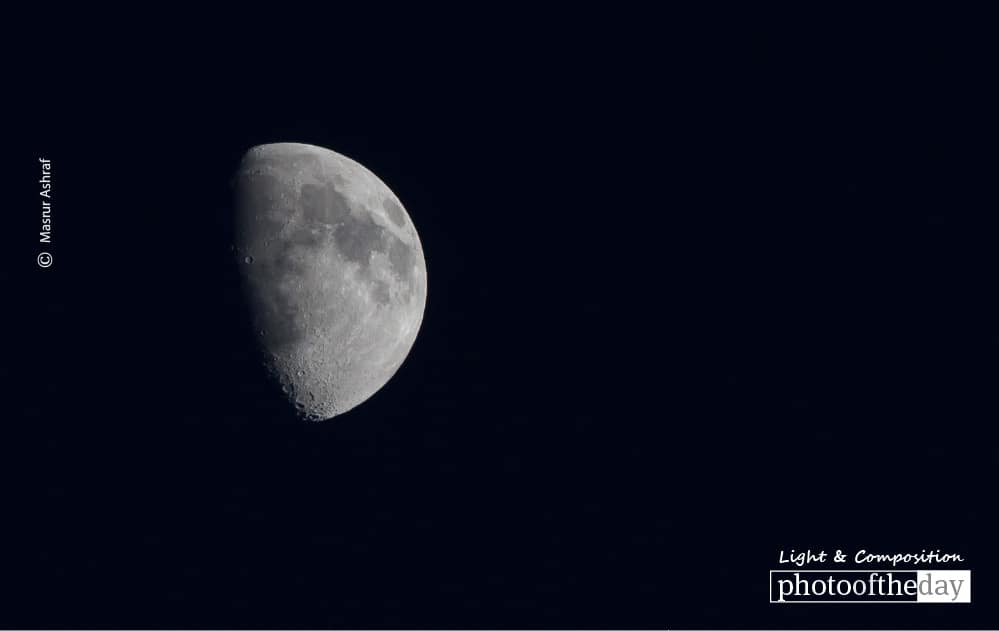
Captured during a serene evening in his home village of Daspur, West Bengal, this image showcases the moon in striking detail. With clear skies providing the perfect canvas, the photographer utilized a zoom lens to isolate the lunar surface, revealing the intricate craters that tell a violent, ancient history of celestial impacts. The photograph is award-worthy for its technical precision and the sense of profound awe it evokes, transforming a familiar night sky into a compelling narrative of cosmic resilience. It serves as a quiet, contemplative reminder of the wonders hidden in plain sight above the rural landscape.
Sajib Shahi
Born in Nepal, Sajib Shahi resides in Patan, Lalitpur, where he channels his deep passion for photography into a visual exploration of his homeland. His work serves as a dedicated window into the nature, culture, and people of Nepal, aiming to showcase the country's unique beauty to a global audience. Through his lens, Shahi strives to inspire international travelers to experience the vibrant scenarios and traditions of his native land firsthand.
Resonance Score Breakdown
Transparency Note: The resonance score (11.1/20) is calculated based on social engagement metrics collected before the award announcement.
Expert Photography Reviews · 8
The Sky Above the Commons
We often speak of the city as a collection of streets, facades, and infrastructure, forgetting that the urban experience is also defined by what lies beyond the reach of our zoning laws.
Read the reflection →The Silent Anchor
The moon exerts a gravitational pull on the earth’s oceans, a constant, invisible tether that dictates the rhythm of the tides, forcing the water to rise and fall in a cycle that has persisted since the cooling of the crust.
Read the reflection →Reviews & Comments
Share your thoughts about this award-winning photograph. Your reviews contribute to the community engagement score.
In Daspur, we often look for the human face, but here, Masrur Ashraf turns our gaze upward. It’s a portrait of the moon, scarred by ancient, violent impacts. I find myself shivering at its craters; they feel like wrinkles on an old, weary traveler’s skin. We aren’t just looking at a celestial body; we’re meeting a silent witness to our own history. It’s a photograph that asks to be returned to, again and again.
A moon shot is rarely a triumph of patience; it’s usually a triumph of a tripod and a clear night. One suspects the atmospheric conditions in Daspur were kind, rather than the photographer being particularly persistent. It’s technically sharp, I’ll grant you that. Still, I find myself wishing for the rest of the village. I’ve spent enough nights shivering in the dark to know that a lonely lunar disc doesn’t quite earn its keep.
Why do we insist on stripping the sky of its geography? Ashraf isolates the moon, yet he leaves Daspur in the dark. By erasing the rural landscape, he turns a local evening into a sterile, universal object. It’s technically sharp, sure, but it feels lonely. I’m left wondering: whose sky is this if the earth beneath it is silenced? Why are we so afraid to let the village exist within the frame?
You’ve captured the moon with incredible clarity, but I find myself searching for the village beneath it. It’s technically sharp, sure, but where are you in this frame? I’ve spent my life looking for the human pulse in a shot. When I look at this, I don’t feel the Daspur evening air or your quiet solitude. It’s a beautiful rock, but it’s cold. I’d trade that lunar detail for just one sign of life.
The shutter clicks and the world stops spinning. It’s a tight, claustrophobic frame, isolating the moon’s scarred face against the void. I’ve spent years watching celestial movements on screen, but this stillness hits differently. It’s the shot the editor keeps because it’s pure, unblinking focus. No movement, just the violent history of craters held in a single, silent beat. I felt my own breath hitch looking at it. It’s a frame that doesn’t need a cut.
The lunar surface here isn’t just captured; it’s resolved at the diffraction limit. By isolating the moon, Ashraf’s lens bypasses atmospheric turbulence, rendering the craters with a sharpness that defies the limitations of the human retina. I’ve spent years studying optics, yet the way the light interacts with those ancient, jagged impact sites still makes my breath catch. It’s a rare, visceral reminder that our glass can reach across the void to touch history itself.
f/5.6 at 400mm, 1/250s, ISO 400. A telephoto reach that demands absolute stability. Ashraf’s choice to stop down slightly ensures the lunar craters remain sharp, avoiding the diffraction softness common at wider apertures. It’s a calculated, clinical capture. I’ve spent hours staring at lunar data, yet this crispness still catches me off guard. It’s not just a moon shot; it’s a successful calibration of optics against a distant, unforgiving subject. The technical execution is correct.
Before the eye identifies the craters, something in the chest tightens. It’s a sudden, cold isolation. Ashraf’s moon doesn’t feel like a celestial body; it feels like a heavy, silent weight pressing against the dark. I’ve looked at this for weeks, and each time, my breath hitches at the violence etched into that grey surface. It’s a lonely, ancient ache that follows me into sleep, reminding me how small we are under that vast, indifferent light.