Cloudy Carpet by Ryszard Wierzbicki
Captured during a descent from the summit of Mount Kinabalu in Borneo, this photograph documents a breathtaking atmospheric phenomenon. As the photographer navigated the high-altitude terrain of Malaysia’s highest peak, a dense, pristine layer of clouds settled between the mountain ridges, resembling a vast, undulating white carpet. The image captures the ethereal stillness of the landscape, emphasizing the sheer scale and isolation of the environment. By utilizing a wide-angle perspective and precise exposure settings, the photographer successfully rendered the textures of the cloud sea against the rugged mountain peaks, creating a serene and award-worthy composition that highlights the raw beauty of the natural world.
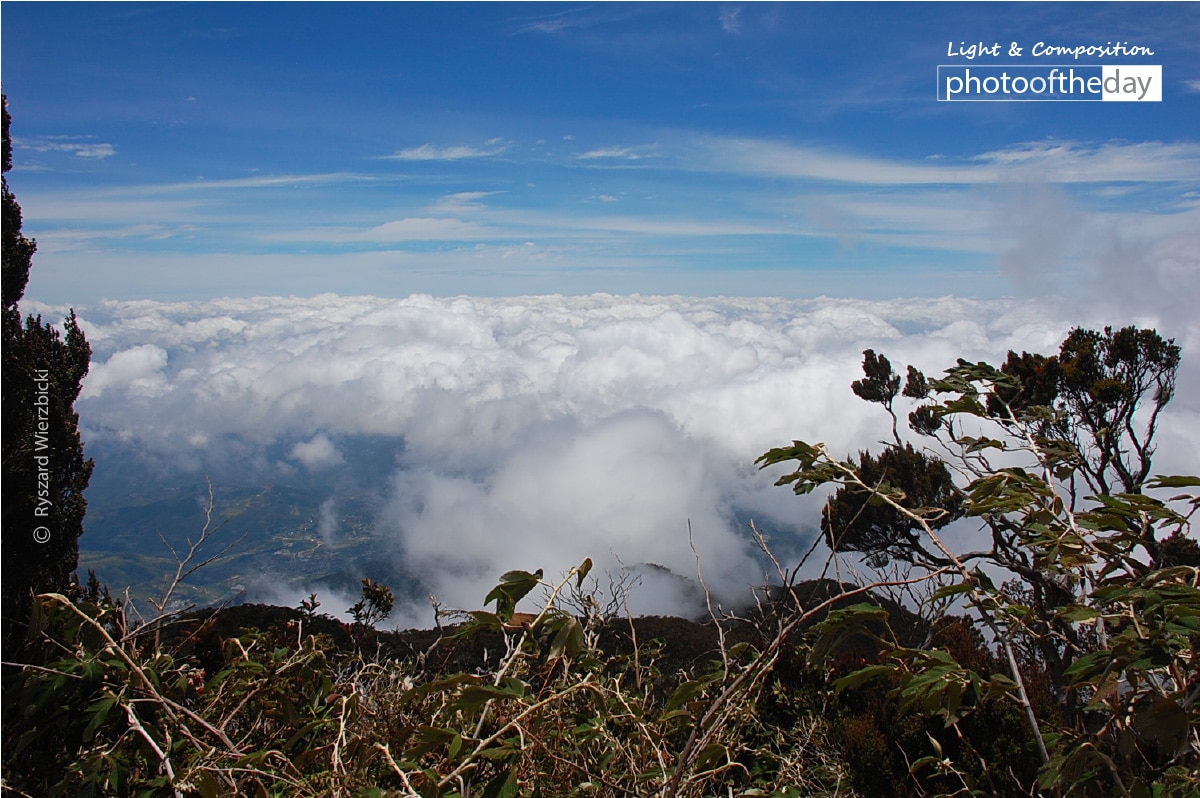
Exposure 1/500sec @ f/11 | ISO 200 | Focal Length 20mm
Ryszard Wierzbicki
Born in Poland in 1963, Ryszard Wierzbicki transitioned from a diverse career in social sciences and marketing to become a dedicated traveler and photographer. After emigrating to the United Kingdom in 2006, he shifted his focus toward exploring South-East Asia and documenting his journeys through his lens. Beyond his photographic pursuits, Wierzbicki is an experienced PADI scuba diving instructor and a committed volunteer for organizations supporting orphans in Thailand and Burma. He further contributes to the global community by managing travel and photography forums, blending his professional background with a deep-seated passion for exploration.
Resonance Score Breakdown
Transparency Note: The resonance score (11.9/20) is calculated based on social engagement metrics collected before the award announcement.
Expert Photography Reviews · 7
Between Breath and Stone
There is a height where the air thins and the world below ceases to exist. You stand on the edge of something that has no name, watching the vapor gather in the hollows. It is a quiet, heavy silence.
Read the reflection →The Weight of the Clouds
I remember sitting on a stone wall in the Lake District with an old map-maker named Arthur. He spent his life drawing lines around mountains, yet he confessed that he never felt like he truly owned the land.
Read the reflection →Reviews & Comments
Share your thoughts about this award-winning photograph. Your reviews contribute to the community engagement score.
High-altitude cloud seas are a well-worn trope, echoing the sublime romanticism of Caspar David Friedrich’s paintings and the early alpine surveys of Vittorio Sella. Wierzbicki’s capture of Kinabalu’s ridges doesn’t reinvent that dialogue, yet the way the light catches the vapor’s edge is genuinely arresting. It’s a clean, sharp execution that avoids the usual digital over-saturation. I’ve seen a thousand cloud carpets, but this one’s quiet, disciplined restraint actually made me hold my breath for a second.
It’s a rare moment where the landscape functions as pure architecture. The cloud layer acts as a datum, a horizontal plane that defines the threshold between the solid, jagged mass of the mountain and the void above. I’m struck by how the light rakes across the ridges, emphasizing their tectonic weight against that soft, vaporous floor. It’s a beautiful lie, of course—it doesn’t show the wind’s bite—but it captures the scale perfectly. I’m breathless.
At f/11, Wierzbicki’s sensor sits right at the precipice of the diffraction limit, yet the 20mm focal length maintains a crispness that’s truly startling. The light scattering across those cloud crests creates a micro-contrast I’ve rarely seen from a D5000. It’s physically precise, yet the way the light softens into the valleys feels almost tactile. Honestly, it’s breathtaking; I’d give anything to stand in that thin, high-altitude air and watch the photons dance like that.
Of the thousands of mountain vistas I’ve reviewed, most are just postcards. What separates this from the rest is the way the jagged rock pierces that soft, suffocating cloud layer. It’s a brutal contrast. I’ve stared at this for ten minutes, and honestly, the silence of that altitude actually makes my ears ring. It’s not just a view; it’s a reminder of how small we are. That’s why it’ll still matter in thirty years.
The palette here isn’t merely atmospheric; it’s a meditation on the cool, chalky whites of a Morandi still life, suspended over the bruised, slate-grey shadows of the Kinabalu ridges. It’s breathtaking, really—the way the light bleeds into the vapor, turning the horizon into a soft, bruised violet. I’ve never seen such a delicate, tactile silence in a frame; it’s as if the air itself has been rendered in layers of crushed pearl and cold stone.
We look at these ridges and we don’t see a landscape; we see a portrait of the mountain’s own breath. Ryszard has captured the earth in a moment of quiet reflection. It’s as if the peak finally stopped to listen to the silence of the clouds. I feel a profound, aching loneliness looking at this white carpet. It’s a photograph that asks to be returned to, reminding us that even stone has a story to tell.
The curator praises the clarity, but I’m left cold by such clinical precision. At 1/500th of a second, Wierzbicki has frozen the clouds into a static, lifeless crust. It’s technically competent, sure, but it’s boring. Why resolve every jagged peak? I’d have preferred a long exposure to let the mist bleed into the ridges, turning the mountain into a ghost. It’s a missed opportunity to dissolve the geography into something far more visceral and dreamlike.