Birth & Change by Stephen Chu
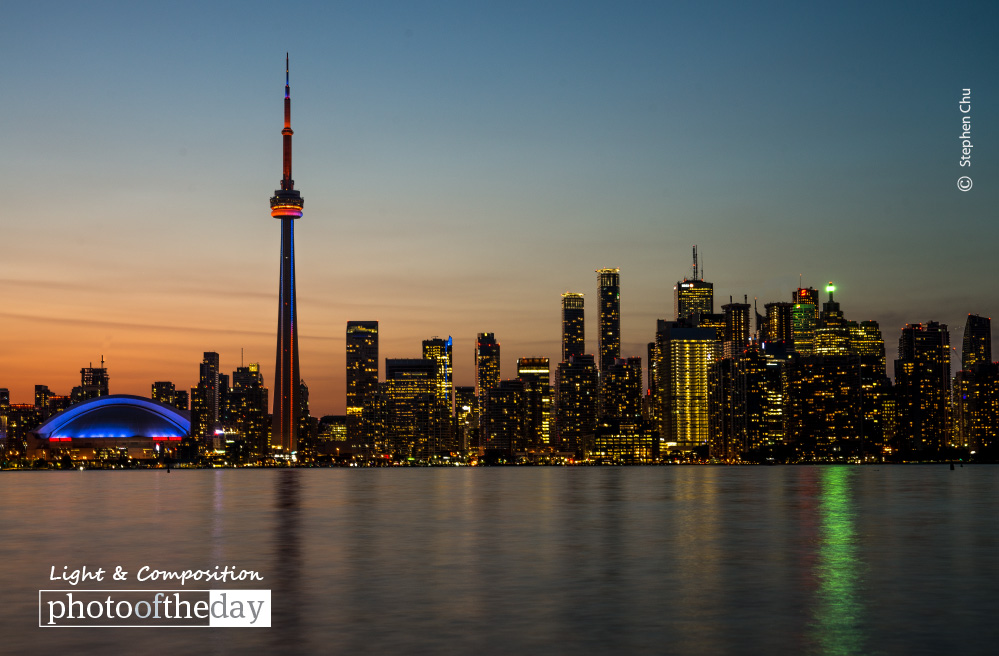
Captured during a night cityscape shoot at Centre Island, this image reflects the photographer's deep connection to his birthplace of Toronto. Eschewing a tripod for a creative, low-angle perspective, the photographer utilized the articulating screen of his Sony camera and a slow shutter speed to capture the vibrant illumination of the CN Tower and the Rogers Centre. The resulting photograph is a poignant meditation on the city's rapid evolution and the personal memories tied to its skyline. It is award-worthy for its technical ingenuity in challenging conditions and its ability to transform a familiar urban landscape into an evocative, emotional narrative of growth and change.
Stephen Chu
A Toronto native who returned to his hometown in 2016 after living in the USA for many years, Stephen Chu is a dedicated observer of the human experience. As a well-traveled former photography club organizer, he approaches his work as a lifelong student, focusing on the serendipitous and emotional moments that define urban life. His photography is characterized by a raw, compassionate perspective, striving to document the quirks and beauty of society while honing his technical craft through constant practice and exploration.
Resonance Score Breakdown
Transparency Note: The resonance score (12.8/20) is calculated based on social engagement metrics collected before the award announcement.
Expert Photography Reviews · 7
The City That Never Sleeps
I remember sitting on a ferry crossing the dark water toward the city lights, listening to an old man tell me that a skyline is just a collection of promises.
Read the reflection →The Pulse of Becoming
Everything that stands tall was once a seed, and everything that glows was once a flicker of intention. We often view the world as a finished thing, a collection of solid shapes and unmoving horizons.
Read the reflection →Reviews & Comments
Share your thoughts about this award-winning photograph. Your reviews contribute to the community engagement score.
Skyline with reflection just perfectly captured.
We look at these blurred, dancing lights and we aren’t just seeing Toronto; we’re seeing a city breathing. Stephen didn’t just point his lens at the skyline; he listened to the pulse of the water and the hum of the concrete. It’s a portrait of a place that’s constantly shedding its skin. I feel a strange, quiet ache looking at these streaks of color. It’s a photograph that asks to be returned to, again and again.
Toronto’s skyline is usually a static datum, but here, the low-angle blur turns the CN Tower into a kinetic pulse. It’s a rare, honest admission that architecture isn’t just stone and steel; it’s the movement we inhabit. I’m struck by how the light bleeds across the frame, dissolving the solid mass of the Rogers Centre into pure atmosphere. It’s messy, sure, but it captures the frantic, fleeting rhythm of the city better than any sharp, tripod-mounted postcard ever could.
The electric violet of the CN Tower bleeds into the ink-washed darkness like a bruised Vermeer, creating a chromatic dissonance that’s frankly intoxicating. One finds the Rogers Centre’s amber glow shivering against the cold, tidal-water blue of the Ontario night, a collision of temperatures that makes my own heart ache for a city I’ve never called home. It’s a gorgeous, trembling struggle between the artificial warmth of progress and the vast, indifferent silence of the dark.
The CN Tower acts as a rigid vertical axis, bisecting the frame into an asymmetric tension between the dense, light-saturated Rogers Centre and the dark, negative quadrant of the lake. Chu’s low-angle choice forces a 1:3 ratio of foreground to sky, creating a dizzying, unstable geometry. It’s a precarious, beautiful equation. I’m genuinely struck by how the motion blur turns the city’s rigid architecture into fluid, abstract vectors. It’s a perfectly solved spatial problem.
You didn’t use a tripod, and I’m glad. It’s messy, and that’s why it works. When I look at the blur of the CN Tower against the dark Toronto night, I don’t see a postcard. I see the way a city actually feels when you’re standing there, trying to hold onto a memory that’s shifting. You waited for the light to bleed. There’s something honest happening here. It feels like home, and it hurts a little.
The city breathes in long, blurred streaks of light. It’s a handheld gamble that pays off, capturing the CN Tower’s pulse against the dark Toronto sky. I love the way the motion blur softens the concrete, turning the Rogers Centre into a glowing, restless heartbeat. It’s a frame the editor keeps because it feels like a memory fading in real-time. The cut would’ve been a mistake; the stillness here is exactly where the story lives.
f/2.8 at 1/10s, ISO 3200, 24mm. Handheld night work is a gamble, and here, the motion blur on the CN Tower’s base isn’t a stylistic choice; it’s a failure of stability. I’ve spent years fighting sensor noise, and this ISO 3200 grain is a distraction, not a texture. It’s frustrating. When you skip the tripod, you surrender sharpness to chance. The composition works, but the technical execution is fundamentally compromised by avoidable camera shake.